


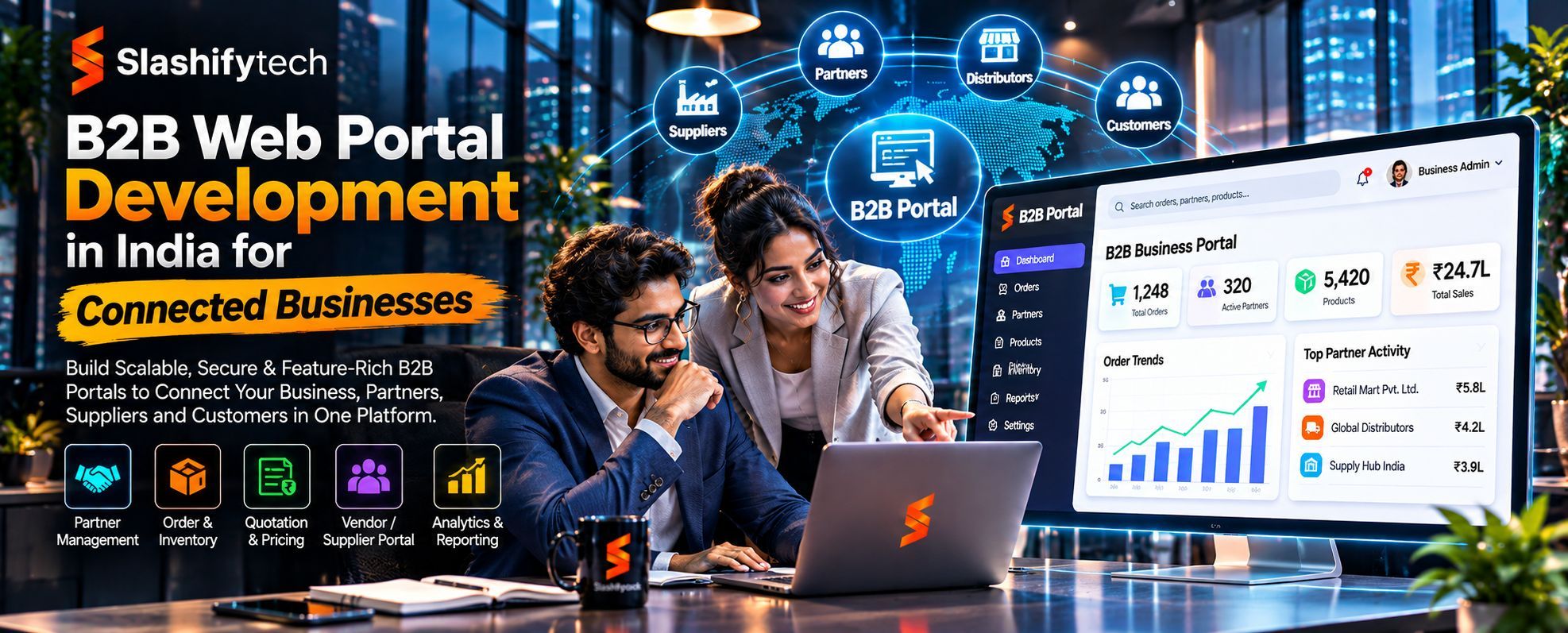
Managing business relationships becomes more complicated as your network of dealers, distributors, suppliers and business partners grows.
Orders arrive through emails. Dealers request stock updates over phone calls. Suppliers share documents through different channels. Sales teams maintain separate spreadsheets, while management struggles to get a unified view of business operations.
These disconnected processes create unnecessary coordination, slow down decisions and make it harder to maintain accurate business information.
SlashifyTech provides B2B Web Portal Development in India solutions to help businesses connect their external partners and internal teams through structured, secure and business-focused digital platforms.
Our approach focuses on building custom web applications around your actual business workflows, stakeholder requirements, data structures and integration needs.
Whether you need a dealer management portal, distributor ordering platform, supplier portal, vendor management system or a comprehensive B2B business platform, the solution should make collaboration easier for everyone involved.
Looking for B2B Web Portal Development in India? Let's discuss your project requirements.
Build Your B2B Web Portal with SlashifyTech.
What Is B2B Web Portal Development in India?
B2B Web Portal Development in India is the process of designing and building a secure online platform that allows businesses to interact with other businesses through a centralized digital environment.
Unlike a conventional business website, a B2B portal provides authenticated access to different stakeholders, such as dealers, distributors, suppliers, vendors, corporate customers and internal employees.
Each user can access specific information and functionality according to their role and permissions.
A custom B2B portal may include:
- Business partner registration and onboarding.
- Dealer and distributor management.
- Product catalogues and business pricing.
- Bulk ordering and order tracking.
- Supplier and vendor management.
- Purchase order processing.
- Document sharing and management.
- Approval and authorisation workflows.
- Inventory and stock visibility.
- Business reporting and analytics.
- ERP and CRM integrations.
- Role-based access management.
The objective is to bring important business interactions into one organised system.
For example, a manufacturer working with hundreds of distributors may need a platform where each distributor can view assigned products, access applicable pricing, place orders and monitor order progress.
At the same time, the manufacturer's internal team may need administrative controls to manage accounts, products, approvals and operational reports.
A properly designed B2B portal can support these activities within a single application.
Our B2B Web Portal Development in India
Different organisations require different portal functionalities depending on their business model and partner network.
SlashifyTech focuses on custom software and web application development, allowing portal requirements to be planned around specific business processes.
1. Custom B2B Portal Development
Build a business portal designed around your organisation's commercial workflows and stakeholder requirements.
A custom B2B platform can connect multiple organisations through controlled access to business information, transactions, documents and operational activities.
Potential capabilities include:
- Multiple business account management.
- Custom user roles and permissions.
- Organisation-specific dashboards.
- Business communication.
- Document exchange.
- Order and request management.
- Approval workflows.
- Reporting and analytics.
The architecture should be planned according to the number of organisations, users, workflows and integrations the platform needs to support.
2. Dealer Portal Development
A dealer portal provides authorised dealers with a dedicated environment to interact with manufacturers, wholesalers or distributors.
Instead of depending entirely on manual communication, dealers can access relevant business information through their accounts.
A dealer portal may include:
- Dealer registration and onboarding.
- Dealer-specific product catalogues.
- Account-specific pricing.
- Product availability.
- Order placement.
- Order history.
- Dispatch and delivery tracking.
- Invoice access.
- Payment information.
- Dealer performance reports.
For example, an automotive manufacturer may need a portal where authorised dealerships can manage orders, access warranty-related information and communicate with the central organisation.
The functionality should reflect the actual dealer network and commercial arrangements.
3. Distributor Portal Development
Distributor portals help manufacturers and suppliers manage relationships with their distribution networks.
A customized platform can provide distributors with relevant product information, account details and ordering functionality.
Possible features include:
- Distributor account management.
- Product and price catalogues.
- Bulk order management.
- Order status tracking.
- Inventory visibility.
- Sales information.
- Invoice management.
- Business notifications.
- Distributor-specific reporting.
Where required, the portal can be connected with existing inventory, accounting or ERP applications.
4. Supplier and Vendor Portal Development
Businesses frequently work with multiple suppliers and vendors to manage procurement, deliveries, documentation and payments.
A supplier portal provides a structured environment for these interactions.
Potential functionality includes:
- Supplier registration.
- Vendor onboarding.
- Purchase order visibility.
- Order acknowledgement.
- Delivery schedule management.
- Document submission.
- Invoice uploads.
- Payment status.
- Vendor communication.
- Supplier performance reporting.
The platform can also support internal approval workflows for procurement and vendor management.
5. B2B E-commerce Portal Development
Traditional e-commerce platforms primarily serve individual consumers, while B2B commerce often involves more complicated business purchasing requirements.
A B2B e-commerce portal can be designed around business accounts, negotiated pricing, bulk orders and commercial approval processes.
Depending on the requirements, functionality may include:
- Business customer registration.
- Account-specific product catalogues.
- Bulk ordering.
- Minimum order quantities.
- Tiered pricing.
- Request for quotation.
- Repeat ordering.
- Shopping cart and checkout.
- Payment gateway integration.
- Order management.
- Invoice generation.
- Order tracking.
The final commerce architecture should account for pricing rules, inventory management, customer accounts and integration with existing business systems.
6. B2B Marketplace Development
A B2B marketplace connects multiple buyers and sellers through a common digital platform.
Unlike a conventional online store, a multi-vendor B2B marketplace may require separate account structures and operational controls for different participating businesses.
Possible features include:
- Buyer and seller registration.
- Vendor dashboards.
- Product listings.
- Business catalogues.
- RFQ management.
- Buyer-seller communication.
- Order management.
- Payment processing.
- Transaction records.
- Administrative controls.
The marketplace model, transaction rules and responsibilities of participating businesses should be clearly defined before development.
7. B2B Partner Portal Development
Partner portals provide a structured environment for managing relationships with business partners, agents, franchisees and channel organisations.
A partner portal may include:
- Partner registration.
- Partner onboarding.
- Account dashboards.
- Resource and document libraries.
- Lead distribution.
- Business performance reports.
- Approval requests.
- Partner communication.
- Training resources.
- Activity tracking.
Access should be based on the partner's responsibilities and relationship with the organisation.
8. B2B Order Management Portal Development
Managing business orders manually can become difficult when multiple distributors, suppliers and sales representatives are involved.
A custom order management portal can organise the ordering process from initial submission to fulfilment.
Potential capabilities include:
- Order creation.
- Bulk order submission.
- Order modification requests.
- Order approvals.
- Order status updates.
- Dispatch information.
- Delivery tracking.
- Invoice management.
- Order history.
- Exception management.
The system can also be integrated with relevant ERP or inventory applications to maintain consistency between business operations.
9. B2B Portal Integration Services
A portal becomes more useful when it can exchange information with the business systems already being used by your organisation.
Integration requirements may include:
- ERP systems.
- CRM software.
- Inventory management systems.
- Accounting applications.
- Payment gateways.
- Logistics platforms.
- Email applications.
- Existing business databases.
- Internal enterprise applications.
The integration architecture should define which application owns each data record, how information is synchronised and how errors are handled.
This is particularly important when the portal handles orders, stock, pricing and invoices.
Essential Features of a Successful B2B Web Portal
A B2B portal must support different organisations and users without exposing information to the wrong people.
Its functionality should be planned around business requirements rather than simply adding as many features as possible.
1. Multi-Organisation User Management
A B2B platform may connect multiple companies, each with its own employees and administrators.
The system should support organisation-level accounts and appropriate relationships between users and their respective businesses.
2. Role-Based Access Control
Different stakeholders need different permissions.
For example:
- Dealers may access their assigned products and orders.
- Distributors may manage their permitted accounts.
- Suppliers may access relevant purchase orders.
- Managers may review business activities.
- Administrators may manage platform settings and user permissions.
Permissions must be enforced on the server side and across the application's data and APIs.
3. Centralised Business Dashboard
A dashboard provides users with a structured view of relevant information.
Depending on the user's role, it may display:
- Business account information.
- Recent orders.
- Pending approvals.
- Product availability.
- Outstanding requests.
- Important documents.
- Notifications.
- Business performance indicators.
The dashboard should prioritise information that helps users complete their daily tasks.
4. Product Catalogue and Pricing Management
Businesses may have different pricing arrangements for different dealers, distributors or customer accounts.
A custom portal can support account-specific product visibility, price lists, discounts and other agreed commercial rules.
The pricing logic should be defined carefully to prevent users from accessing unauthorised commercial information.
5. Order and Transaction Management
An order management module can help businesses organise purchasing activities, approvals and fulfilment.
The system may include order creation, validation, confirmation, tracking and transaction history.
6. Document Management
B2B relationships involve important documents such as purchase orders, invoices, contracts, delivery records and compliance documents.
A document management module can support secure uploads, downloads, categorisation, version control and access restrictions.
7. Workflow Automation
Repeated business activities can be organised using predefined workflow rules.
For example:
- A new dealer registration triggers an internal review.
- A purchase order is sent for approval when required.
- An approved order is forwarded to the relevant operational system.
- A supplier receives a notification about a new purchase order.
- A manager receives an alert when an important exception occurs.
Automation should include appropriate error handling and human review where business decisions require it.
8. Business Reporting and Analytics
Management may need visibility into partner activity, sales, orders and operational performance.
A reporting dashboard can be designed around metrics relevant to the organisation.
Examples include:
- Order volumes.
- Dealer activity.
- Distributor performance.
- Sales by business account.
- Pending approvals.
- Supplier performance.
- Order fulfilment status.
- Regional business activity.
Reports should use clearly defined metrics and reliable data sources.
9. Notifications and Communication
A portal can provide notifications for important events such as order updates, approval requests, new documents and account-related activities.
Communication may be connected to particular orders, organisations or business records to make conversations easier to retrieve.
10. Security and Audit Trails
A B2B portal may handle confidential commercial information, pricing data, financial records and business documents.
Security considerations should include:
- Secure authentication.
- Multi-factor authentication where appropriate.
- Role-based access.
- Organisation-level data isolation.
- Encrypted communication.
- Secure API access.
- Audit logs.
- Backup and recovery.
- Session management.
- Data retention controls.
The implementation should be assessed against the application's risk profile and applicable regulatory requirements.
B2B Web Portal Development in India for Different Industries
B2B portals can support many industries, but their functionality should reflect the actual business model.
Manufacturing Industry
Manufacturers often work with suppliers, distributors, dealers and wholesale customers.
A B2B portal can support product catalogues, purchase orders, inventory visibility, order management and partner communication.
Automotive Industry
Automotive businesses may need dealer networks, warranty workflows, spare-parts ordering and service-related information.
A specialised portal can connect authorised dealerships with relevant central business operations.
Wholesale and Distribution
Wholesalers and distributors may require account-specific pricing, bulk ordering, repeat purchases, stock information and invoice access.
A portal can help organise these activities across multiple business accounts.
Education and Overseas Consultancy
Education businesses may work with agents, institutions, students and administrative teams.
A multi-stakeholder portal can help manage applications, document exchange, status tracking and communication between authorised participants.
Financial Services
Financial organisations may require portals for corporate clients, business documentation, account-related requests and reporting.
Solutions handling financial or sensitive personal information require careful assessment of access, privacy and regulatory requirements.
Logistics and Supply Chain
Logistics businesses may need to coordinate customers, suppliers, transport partners and internal operations.
A portal may provide shipment information, delivery status, documents, service requests and operational updates.
Construction and Real Estate
Construction and real estate businesses often coordinate contractors, vendors, project owners and other business stakeholders.
A B2B portal can organise project documents, procurement activities, approvals and communication.
Our B2B Web Portal Development in India Process
Building a successful B2B platform requires an understanding of business relationships, data access, operational workflows and technical architecture.
Our recommended development approach follows these stages.
Step 1: Business Requirements Discovery
The first step is understanding how your organisation works with external businesses.
This involves identifying:
- Types of business stakeholders.
- Number of organisations and user groups.
- Existing business workflows.
- Product and pricing requirements.
- Order and approval processes.
- Document management requirements.
- Reporting expectations.
- Existing software integrations.
- Security and privacy requirements.
The outcome should be a documented scope with clearly defined project priorities.
Step 2: Portal Architecture and Planning
Once the requirements are established, the technical architecture can be planned.
Important considerations include:
- Multi-tenant or organisation-level data architecture.
- User roles and permissions.
- Database relationships.
- API architecture.
- Integration requirements.
- Hosting and infrastructure.
- Security controls.
- Expected data and user volumes.
Multi-tenant architecture is not automatically necessary for every portal. The right approach depends on the relationship between participating organisations and their data requirements.
Step 3: UI/UX Design
A B2B portal should make complex business activities straightforward.
Design work may include:
- Business registration.
- Organisation dashboards.
- Product catalogues.
- Order management screens.
- Supplier dashboards.
- Administrative panels.
- Reporting interfaces.
Different stakeholders should receive interfaces suited to their responsibilities.
Step 4: Frontend and Backend Development
The approved requirements and designs are translated into a functional application.
Frontend development covers the user interface and interactions.
Backend development handles business logic, authentication, database operations, permissions, integrations and transaction processing.
The application should be developed in manageable stages so that stakeholders can review progress.
Step 5: API and Third-Party Integrations
The portal may need to connect with existing ERP, CRM, accounting, inventory or payment systems.
This stage includes integration development, data mapping, authentication, synchronisation rules and error handling.
It is important to decide which system is the primary source of truth for business information.
Step 6: Testing and Quality Assurance
Before launch, the portal should undergo appropriate testing.
This includes:
- Functional testing.
- User permission testing.
- Organisation-level data isolation testing.
- API testing.
- Integration testing.
- Transaction validation.
- Performance testing.
- Security testing.
- Mobile responsiveness.
- User acceptance testing.
Particular attention should be given to ensuring that one business account cannot access another organisation's confidential information.
Step 7: Deployment and Data Migration
The application is prepared for the production environment.
Where required, existing business records, product information, partner accounts and operational data can be migrated after cleansing and validation.
A staged deployment may be appropriate for organisations with large partner networks.
Step 8: Maintenance and Continuous Improvement
After launch, the portal may require performance improvements, security updates, integration maintenance and new business functionality.
A documented support arrangement helps ensure that technical issues and future enhancements are managed properly.
B2B Web Portal Development in India vs B2B Website Development
A B2B website and a B2B web portal serve different purposes.
A conventional B2B website primarily presents company information, products, services and enquiries.
A B2B portal provides authenticated functionality for business users to perform specific activities.
| Consideration | B2B Website | B2B Web Portal |
|---|---|---|
| Main purpose | Present business information | Manage business interactions |
| Login access | Usually optional | Central to most portal functionality |
| User roles | Generally limited | Multiple stakeholder roles |
| Business transactions | Basic enquiries or commerce | Custom workflows and transactions |
| Order management | May be limited | Can support detailed order processes |
| Data access | Mostly public information | Controlled business information |
| Integrations | Often limited | Can connect multiple business systems |
| Dashboards | Usually not required | Often important |
If your objective is simply to present products and generate business enquiries, a B2B website may be sufficient.
If you need dealers, suppliers, distributors or business customers to log in and manage ongoing activities, a B2B portal may be more appropriate.
How Much Does B2B Web Portal Development Cost in India?
The cost of developing a B2B portal depends on the number of stakeholder groups, business workflows, integrations and technical requirements.
A basic dealer ordering portal has different development requirements from a comprehensive enterprise platform connecting distributors, suppliers, inventory systems and accounting applications.
Important cost factors include:
| Cost factor | Why it matters |
|---|---|
| 1. Number of user roles | Different stakeholder types require appropriate permissions, interfaces and workflows. |
| 2. Business complexity | Custom approval processes, commercial rules and transaction logic influence development effort. |
| 3. Integration requirements | ERP, CRM, accounting and inventory integrations can add substantial technical complexity. |
| 4. Portal functionality | Product catalogues, order processing, document management and reporting require different development components. |
| 5. Security requirements | Authentication, organisation-level data isolation, audit trails and security testing affect architecture. |
| 6. Data migration | Existing business records may require cleansing, mapping and validation. |
| 7. Scalability and infrastructure | Hosting, data volumes, performance requirements and operational monitoring influence long-term costs. |
| 8. Maintenance and support | Updates, troubleshooting, integration maintenance and future enhancements should be included in long-term planning. |
Before selecting a development company, request a project-specific proposal with defined functionality, milestones, deliverables, exclusions, ownership and support responsibilities.
SlashifyTech should confirm the exact project requirements before providing a development quotation or delivery commitment.
Why Choose SlashifyTech for B2B Web Portal Development in India?
Selecting a B2B Web Portal Development in India is about finding a team that understands both software engineering and the operational requirements of your business.
SlashifyTech's existing portfolio includes B2B and multi-stakeholder web applications across different business use cases.
Relevant published projects include:
MG Portal Raam Group
An automotive and warranty management B2B web application.
360 Car Protect
An automotive and warranty management B2B application.
Sov Portal
An education platform connecting students and agents.
Shivorix Overseas Portal
An education portal for students and agents.
Brand Monkey
An employee management system with B2B application positioning.
These projects demonstrate experience with different application and stakeholder models.
Custom Software Development Approach
Every organisation has different business requirements.
The development process should translate those requirements into suitable portal functionality rather than force the organisation into an unsuitable predefined system.
Multi-Stakeholder Application Experience
B2B platforms often involve several user groups with different permissions and responsibilities.
Relevant application experience can help inform the planning of these relationships, interfaces and workflows.
Integration-Focused Planning
A portal should work with the systems your business already depends on.
Integration feasibility, data ownership and synchronisation should be considered early.
Structured Development Process
Requirements, architecture, UI/UX design, development, testing and deployment should follow documented milestones.
Long-Term Maintainability
A B2B portal is an operational application that may evolve as the business grows.
Documentation, source-code ownership, infrastructure access and maintenance responsibilities should be agreed before the project begins.
Frequently Asked Questions About B2B Web Portal Development in India
1. What is B2B Web Portal Development in India?
B2B Web Portal Development in India is the process of building a secure online application that connects businesses with dealers, distributors, suppliers, vendors or other business partners. It can include account management, order processing, document exchange, approvals and business reporting.
2. What is the difference between a B2B portal and a B2B marketplace?
A B2B portal generally connects a business with its own partners, customers or suppliers. A B2B marketplace connects multiple independent buyers and sellers through a common platform where they can discover products, communicate and conduct transactions.
3. What features should a B2B web portal have?
Common features include secure login, organisation-level accounts, role-based permissions, business dashboards, product catalogues, order management, document sharing, notifications, reporting and relevant software integrations.
4. How much does B2B portal development cost in India?
The cost depends on functionality, user roles, business workflows, integrations, security and infrastructure requirements. A focused dealer portal will generally have a different scope from a comprehensive multi-organisation enterprise platform.
5. How long does it take to develop a B2B portal?
The timeline depends on the number of modules, stakeholder groups, integrations, data migration and testing requirements. A realistic development schedule should be established after the discovery and technical planning stages.
6. Can a B2B portal integrate with ERP software?
Yes, where the ERP system provides suitable integration options. The portal can potentially exchange information such as products, pricing, inventory, orders and invoices, subject to API availability and integration requirements.
7. Can a B2B portal support multiple dealers and distributors?
Yes. A portal can support multiple business accounts, with different users, permissions, product access and pricing rules. The data architecture must ensure that each organisation can access only its authorised information.
8. Is a B2B portal suitable for manufacturing businesses?
Yes. Manufacturing businesses may use B2B portals to connect distributors, dealers, suppliers and corporate buyers through product catalogues, purchase orders, inventory visibility and document management.
9. Can a B2B portal support bulk ordering?
Yes. Bulk ordering functionality can include quantity-based purchasing, minimum order quantities, customer-specific pricing, repeat orders and approval processes, depending on the business requirements.
10. Is a custom B2B portal better than ready-made software?
Not always. Ready-made platforms may be suitable for businesses with standard workflows. Custom development is worth considering when your organisation requires specialised business rules, integrations, data structures or functionality that existing products cannot adequately support.
11. Can a B2B portal be accessed through mobile devices?
Yes. A responsive web portal can be designed for desktops, tablets and mobile phones. If additional functionality such as offline operations or native device capabilities is required, a separate mobile application or progressive web application may be considered.
12. Who owns the B2B portal after development?
Ownership depends on the development agreement. Clarify source code ownership, intellectual property rights, database access, third-party licences, hosting accounts, documentation and maintenance responsibilities before starting the project.
Build a Connected B2B Business Platform with SlashifyTech
Your dealers, distributors, suppliers and business partners need a more organised way to work with your organisation.
A well-planned B2B web portal can bring important business activities into one digital environment, improve information visibility and create more structured collaboration between different stakeholders.
From dealer management and distributor ordering to supplier coordination, business transactions and enterprise integrations, the right solution starts with understanding how your organisation operates.
Looking for B2B Web Portal Development in India?
Connect with SlashifyTech to discuss your business requirements, existing applications and desired portal functionality.
Let's plan a B2B web platform that supports your business relationships and operational goals.
Contact SlashifyTech to discuss your B2B portal development project.


