



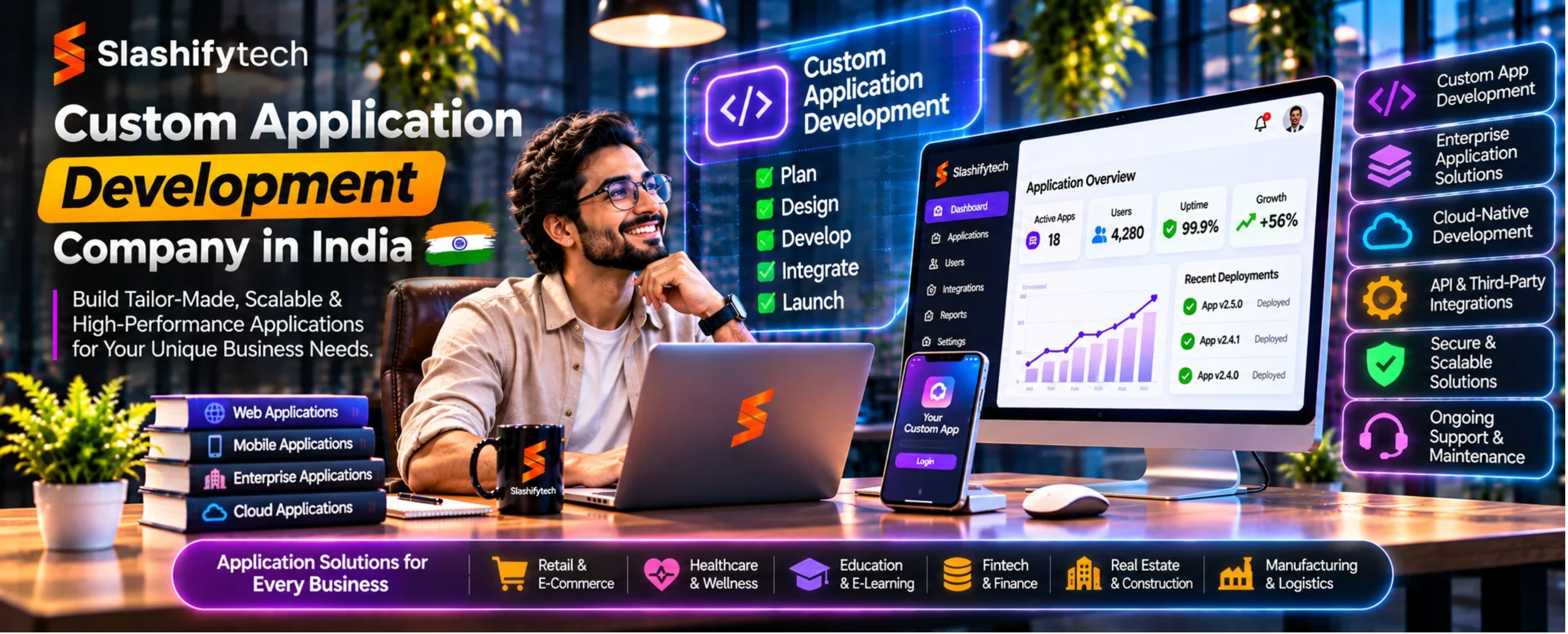
Build Business Applications That Work the Way Your Business Works
Looking for a reliable Custom application development company In India to turn your business idea into a powerful digital product? SlashifyTech designs and develops custom applications that help startups, growing businesses and enterprises streamline operations, improve customer experiences and build scalable digital solutions.
We develop tailored web applications, mobile applications, enterprise software, SaaS platforms, business portals, CRM systems, ERP solutions and workflow automation applications based on your specific requirements.
Unlike ready-made software that forces your business to adapt to predefined features, custom application development allows you to build technology around your workflows, customers, business model and long-term objectives.
From initial product planning and UI/UX design to application development, testing, deployment and ongoing support, we help transform complex requirements into practical digital products.
Have an application idea? Let's discuss what you want to build.
Book a Discovery Call | Discuss Your Project
What Is Custom Application Development?
Custom application development is the process of designing, developing and maintaining software applications specifically for the requirements of a particular business, organisation or user group.
Instead of relying entirely on generic software with predefined features, businesses can develop applications that match their internal processes, customer expectations, operational requirements and business objectives.
For example, a logistics company might need a platform to manage shipments, drivers, customers, tracking and delivery operations from one dashboard. An educational organisation might require a portal that connects students, agents, administrators and institutions.
These requirements can be addressed through a custom-built application designed around the organisation's actual workflows.
At SlashifyTech, we approach application development as a product-building process rather than simply writing code. We first understand the business problem, identify the essential functionality, plan the application architecture and then develop a solution that can evolve as the business grows.
Why Do Businesses Need Custom Application Development?
As businesses expand, managing operations through spreadsheets, disconnected tools and multiple software subscriptions can become increasingly complicated.
Different departments may use different systems, resulting in duplicated work, inconsistent information, manual processes and limited visibility.
Custom application development helps businesses address these challenges by bringing essential processes into a unified digital environment.
1. Software Designed Around Your Business
Every business has different operational requirements. Custom applications allow you to define features, user roles, workflows, permissions and dashboards according to how your organisation operates.
2. Better Operational Efficiency
Automate repetitive activities, reduce manual data entry and simplify complex processes through structured workflows and connected systems.
3. Improved Customer Experience
Develop applications that provide customers with convenient access to services, personalised experiences, self-service functionality and real-time information.
4. Integration With Existing Systems
Connect your application with relevant CRM platforms, payment gateways, communication tools, third-party APIs and other business systems.
5. Greater Control Over Features
You decide which functionality your application needs. New modules, workflows and integrations can be introduced as business requirements change.
6. Scalability for Future Growth
Build an application with an architecture that considers future users, increasing data requirements, additional features and evolving business operations.
7. Centralised Business Management
Bring different activities into a connected system through dashboards, reports, administrative controls and role-based access.
Custom Application Development Services We Offer
SlashifyTech provides end-to-end application and software development services for startups, established businesses and enterprises.
Our services cover different application types, from customer-facing digital products to internal business management platforms.
1. Custom Web Application Development
We build browser-based applications that help businesses deliver digital services, manage operations and connect with customers.
Our web application development capabilities include:
- Custom business web applications.
- Customer and vendor portals.
- Admin dashboards and management panels.
- B2B and B2C platforms.
- Booking and appointment management systems.
- Employee and operational management applications.
- Financial and reporting dashboards.
- Workflow and approval management systems.
- Web-based customer service platforms.
Each application is planned around its intended users, functionality, integrations and operational requirements.
2. Custom Mobile Application Development
Mobile applications allow businesses to connect with customers and employees through convenient digital experiences.
We develop mobile application solutions for Android and iOS, including cross-platform development using suitable frameworks.
Our mobile application development services include:
- Android application development.
- iOS application development.
- Flutter application development.
- React Native application development.
- Business and enterprise mobile applications.
- Customer-facing mobile applications.
- Booking and service applications.
- Social and community applications.
- Mobile applications connected with web-based admin panels.
From user registration and authentication to payment integration, notifications and application management, we plan functionality according to your product requirements.
3. Custom SaaS Application Development
If you want to build a software product that customers can access through subscriptions, a custom SaaS application may be the right solution.
We develop SaaS platforms with functionality such as:
- Multi-user account management.
- Subscription and billing integrations.
- Role-based permissions.
- Administrative dashboards.
- Customer management.
- Reporting and analytics.
- API integrations.
- Product management functionality.
- Scalable application architecture.
Our SaaS development approach considers how the product will be operated, maintained and expanded after launch.
4. Custom CRM Development
Customer Relationship Management software helps organisations manage interactions with prospects, customers and business partners.
When standard CRM platforms do not support specific workflows, a custom CRM application can provide greater flexibility.
Depending on your requirements, a custom CRM can include:
- Lead and contact management.
- Sales pipeline tracking.
- Follow-up scheduling.
- Customer communication history.
- Employee and team management.
- Activity tracking.
- Reporting dashboards.
- Customer segmentation.
- Third-party integrations.
The objective is to create a centralised system that supports your actual sales and customer management processes.
5. Custom ERP Application Development
Enterprise Resource Planning applications help businesses coordinate different operational functions through a connected software system.
We can develop custom ERP solutions around requirements such as:
- Inventory management.
- Purchase and sales management.
- Employee management.
- Financial reporting.
- Order processing.
- Vendor management.
- Departmental workflows.
- Administrative controls.
- Operational reporting.
The exact modules depend on your organisation's size, processes and system requirements.
6. Enterprise Application Development
Larger organisations often require applications that support multiple departments, user groups, operational workflows and interconnected systems.
Our enterprise application development capabilities include:
- Enterprise web applications.
- Internal business management systems.
- Employee management platforms.
- B2B and partner portals.
- Customer service platforms.
- Data and reporting dashboards.
- Business workflow applications.
- System integration solutions.
We consider application security, access control, performance, maintainability and future expansion during the planning process.
7. AI-Powered Application Development
AI can make business applications more useful when it addresses a genuine operational requirement.
SlashifyTech also provides AI automation and voice-agent solutions that can be incorporated into suitable digital products.
Potential applications include:
- AI-powered customer support.
- Automated information retrieval.
- AI-assisted business workflows.
- Voice-based customer interactions.
- CRM and reporting automation.
- Intelligent document workflows.
The choice of AI functionality depends on the use case, available data, integration requirements and expected business outcomes.
8. Custom Desktop Application Development
Some businesses need software that operates in a desktop environment to support specialised operational or productivity requirements.
We develop desktop application solutions based on the intended users, operating environment and functionality.
Examples include:
- Internal productivity applications.
- Business management tools.
- Administrative software.
- Operational dashboards.
- Data management applications.
Types of Custom Applications We Develop
Different businesses require different application architectures and functionality. We help identify the right application type based on the intended users and business requirements.
| Application type | Primary purpose |
|---|---|
| Business applications | Manage internal business operations |
| Enterprise applications | Coordinate complex organisational workflows |
| Web applications | Deliver browser-based digital services |
| Mobile applications | Provide Android and iOS experiences |
| SaaS applications | Deliver subscription-based software products |
| CRM applications | Manage customers, leads and sales activities |
| ERP applications | Coordinate business operations |
| B2B portals | Connect businesses, vendors and partners |
| B2C platforms | Deliver customer-facing digital services |
| Educational applications | Manage students, agents and educational workflows |
| eCommerce applications | Manage online shopping and transactions |
| Automation applications | Reduce repetitive operational work |
The final application structure is determined by the business problem rather than by a predefined template.
Industry-Specific Custom Application Development
An application designed for an educational organisation will have different requirements from one developed for a financial services company or an eCommerce business.
SlashifyTech has experience across multiple industries and application categories.
Education and EdTech
Educational organisations may need applications to manage students, agents, admissions, courses and institutional communication.
Potential solutions include:
- Student management portals.
- Education agent portals.
- Online learning platforms.
- Career guidance applications.
- Educational administration dashboards.
FinTech and Financial Services
Financial technology applications may require structured transaction workflows, reconciliation, reporting and access controls.
Possible solutions include:
- Financial management dashboards.
- Transaction reconciliation systems.
- Reporting applications.
- Financial workflow platforms.
- Business administration tools.
Security, data handling and applicable regulatory requirements must be considered for every financial application.
eCommerce and Retail
Retail and eCommerce businesses may need applications to manage customers, products, orders and business operations.
Possible solutions include:
- Custom eCommerce platforms.
- Product management systems.
- Customer portals.
- Order management applications.
- Inventory management integrations.
- Business reporting dashboards.
Real Estate
Real estate businesses can benefit from applications that simplify property management, customer interactions and internal operations.
Possible solutions include:
- Property management applications.
- Customer portals.
- Lead management systems.
- Property listing platforms.
- Agent management dashboards.
Automobile and Automotive Services
Automotive organisations may require software to manage customers, warranties, service operations and business information.
Potential solutions include:
- Warranty management platforms.
- Customer service portals.
- Vehicle management systems.
- Dealer and partner portals.
- Service management dashboards.
Travel and Hospitality
Travel businesses can use custom applications to manage bookings, customers, service providers and operational workflows.
Potential solutions include:
- Travel booking platforms.
- Customer management systems.
- Partner portals.
- Travel service applications.
- Booking administration dashboards.
Startups and SaaS Businesses
Startups need application architecture that supports product validation and future development.
We help build:
- Minimum Viable Products (MVPs).
- SaaS platforms.
- Subscription-based applications.
- Startup web applications.
- Mobile-first digital products.
- Product administration systems.
Our Custom Application Development Process
Successful application development requires more than selecting a programming language or designing an attractive interface.
At SlashifyTech, we follow a structured process to understand the business requirement, plan the product and develop the application.
Step 1: Discovery and Requirement Analysis
We begin by understanding your business, target users, application objectives and existing operational challenges.
During this stage, we identify:
- Business requirements.
- Target audience.
- Essential features.
- User roles and permissions.
- Required integrations.
- Technical and operational constraints.
- Expected application outcomes.
Deliverable: A documented understanding of the application requirements.
Step 2: Product Planning and Technical Roadmap
After understanding the requirements, we plan how the application should function and what needs to be developed.
This stage may include:
- Feature prioritisation.
- Application architecture planning.
- User journey mapping.
- Technology selection.
- Integration planning.
- Development milestones.
Deliverable: A structured application development roadmap.
Step 3: UI/UX Design and Prototyping
We plan the application's user experience and interface before moving into full development.
This includes:
- Application wireframes.
- User interface design.
- Navigation structure.
- Dashboard layouts.
- User interaction planning.
- Prototype reviews.
Deliverable: Approved interface designs and user flows.
Step 4: Application Development
Our development team builds the application according to the approved requirements and development roadmap.
Depending on the project, development can involve:
- Frontend development.
- Backend development.
- Database implementation.
- API development.
- User authentication.
- Administrative functionality.
- Third-party integrations.
Deliverable: A functional application developed according to the agreed scope.
Step 5: Quality Assurance and Testing
Before launch, the application needs to be tested to identify issues and verify that important functionality works as expected.
Our testing process can cover:
- Functional testing.
- User interface testing.
- Cross-device testing.
- Integration testing.
- Performance checks.
- Authentication and access testing.
- Error handling.
Security testing requirements are defined according to the application and its risk profile.
Deliverable: A tested application prepared for deployment.
Step 6: Deployment and Launch
Once the application is ready, we coordinate deployment to the agreed hosting or infrastructure environment.
This stage can include:
- Production environment preparation.
- Application deployment.
- Database configuration.
- Domain and hosting setup.
- Integration verification.
- Launch checks.
Deliverable: A deployed application ready for its intended users.
Step 7: Maintenance and Continuous Improvement
Application development does not necessarily end at launch.
As users interact with the application and business requirements evolve, additional updates may be needed.
Post-launch support can include:
- Bug fixes.
- Feature enhancements.
- Performance improvements.
- Application updates.
- Integration maintenance.
- Technical support.
- Scalability improvements.
Our approach focuses on building a long-term technology partnership.
Technologies and Integrations for Custom Application Development
The right technology depends on what the application needs to achieve.
Factors such as expected traffic, user experience, security, integrations, development complexity and long-term maintenance should influence technology selection.
SlashifyTech works across web, mobile, SaaS and AI-driven application development.
Our integration ecosystem includes platforms and services such as:
- Stripe.
- Razorpay.
- PayPal.
- WhatsApp API.
- Twilio.
- OpenAI.
- Google Gemini.
- Firebase.
- Google Analytics.
- HubSpot.
- Salesforce.
- Cloudflare.
- Google Maps Platform.
- Shiprocket.
- n8n.
These integrations are selected according to project requirements and supported platform capabilities.
We do not recommend adding technologies simply because they are popular. The objective is to select an appropriate technology and integration approach for the product.
Why Choose SlashifyTech as Your Custom application development company In India?
Choosing an application development partner is an important business decision. You need a team that understands the product, communicates clearly and considers what happens after the initial launch.
Here is what SlashifyTech brings to the development process.
1. Experience Across Different Application Categories
Our publicly presented portfolio includes web applications, mobile applications, B2B portals, B2C products, eCommerce platforms and business management systems.
This experience helps us understand different product requirements and application use cases.
2. Product-First Development Approach
We focus on understanding why an application needs to exist before deciding how it should be developed.
This helps keep the development roadmap connected to actual business requirements.
3. Transparent Communication
We believe clients should understand what is being developed, what stage the project has reached and what comes next.
Our process includes structured planning and regular project communication.
4. Scalable Application Architecture
We consider future product requirements during the planning stage, including additional functionality, users, integrations and evolving business workflows.
5. Multiple Development Capabilities
From web and mobile applications to SaaS platforms, enterprise systems and AI automation, we offer different development capabilities under one technology partnership.
6. Long-Term Support
We understand that software requires attention after deployment. Maintenance, updates and future improvements are important parts of a product's lifecycle.
7. Business-Focused Engineering
Our objective is not simply to deliver software. It is to develop a digital solution that addresses a defined business requirement.
Our Custom Application Development Portfolio
Our work demonstrates the different types of digital products and applications we develop.
Here are selected projects presented in the SlashifyTech portfolio.
Shivorix Overseas Portal
Category: EdTech | B2B and B2C Web Application
A web-based education portal designed for students and agents.
Wise Talk
Category: Career Guidance | B2C Mobile Application
A mobile application focused on career guidance.
Connecting Soulmate
Category: Matrimony | Web and Mobile Applications
A digital matrimony product available in web and mobile application formats.
Brand Monkey
Category: Employee Management | B2B Web Application
An employee management system developed for business operations.
IDSSPL
Category: Financial Technology | B2C Web Application
A financial technology and reconciliation-related application.
Online Filing India
Category: Legal, Compliance and Business Services | B2C Web Application
A web application serving legal, compliance and business service requirements.
MG Portal - Raam Group
Category: Automotive | B2B Web Application
An automotive and warranty management-related portal.
360 Car Protect
Category: Automotive | B2B Web Application
A digital application associated with automotive and warranty management.
Memoria
Category: Social Technology | B2C Mobile Application
A mobile application developed for social memory experiences.
The WanderCircle
Category: Travel and Lifestyle | eCommerce Application
A digital commerce project in the travel and lifestyle category.
Explore our application development projects and portfolio.
How Much Does Custom Application Development Cost in India?
The cost of custom application development in India depends on the functionality, complexity and technical requirements of the project.
There is no single price that applies to every application because a basic business application and a multi-user enterprise platform require different development resources.
The following factors influence the total development cost.
| Cost factor | Why it matters |
|---|---|
| 1. Application Complexity | A simple application with limited functionality generally requires less development effort than a complex platform with multiple modules and interconnected workflows. |
| 2. Number of Features | User authentication, dashboards, reporting, payment processing, notifications, administrative panels and automation features all influence development requirements. |
| 3. UI/UX Design Requirements | The number of screens, user journeys, interface complexity and design requirements affect the planning and development effort. |
| 4. Third-Party Integrations | Connecting payment gateways, CRM systems, communication tools and external APIs may increase project complexity. |
| 5. Security and Access Requirements | Applications handling confidential information, financial workflows or multiple user roles may require additional security planning and testing. |
| 6. Application Scalability | The infrastructure and architecture needed for a small application may differ significantly from those required for a large-scale platform. |
| 7. Maintenance and Support | Hosting, monitoring, updates, maintenance and future development should also be considered when calculating the overall cost of ownership. |
Want to know how much your application will cost?
Share your requirements with SlashifyTech. We will review the project scope and discuss a suitable development approach, estimated timeline and project quotation.
Request a Custom Application Development Estimate
Custom Application Development vs Ready-Made Software: Which Is Better?
Both custom-built and ready-made applications can solve business problems. The right choice depends on your requirements, budget, operational complexity and long-term plans.
| Comparison | Custom Application | Ready-Made Software |
|---|---|---|
| Functionality | Designed around specific requirements | Based on predefined features |
| Customisation | Greater flexibility | Depends on vendor options |
| Business workflows | Can support specialised processes | May require workflow adjustments |
| Integrations | Can be planned around business systems | Limited by platform capabilities |
| Initial investment | Usually requires project-specific development | Often available through subscriptions |
| Time to start | Requires planning and development | Can be faster to configure |
| Ownership | Depends on the development agreement | Generally governed by vendor terms |
| Future expansion | Can be developed around evolving requirements | Depends on the product roadmap |
When Should You Choose Custom Application Development?
Custom development may be suitable when:
- Your business has specialised workflows.
- Existing software cannot meet important requirements.
- You need multiple systems connected through one platform.
- You want to develop your own software product.
- Your application requires specific user roles and permissions.
- You need greater control over product functionality.
- You expect to introduce new features as the business grows.
When Is Ready-Made Software a Better Option?
Ready-made software may be more suitable when:
- Your requirements are relatively standard.
- An existing product already meets your needs.
- You want to start using a solution quickly.
- Your budget does not justify custom development.
- You do not need extensive customisation.
Our recommendation is to build custom software when it solves a genuine business problem that existing products cannot adequately address.
Security, Scalability and Maintenance: What Should You Consider?
A successful application should not only work during its initial launch. It should remain manageable as users, data and business requirements change.
Before starting development, businesses should consider the following areas.
Application Security
Depending on the application, security planning may include authentication, role-based access control, secure data transmission, input validation, backup procedures and appropriate protection of sensitive information.
Data Management
Applications should have a clear approach to storing, retrieving, managing and protecting business information.
Application Performance
Efficient database queries, appropriate infrastructure and performance testing help applications remain responsive as usage increases.
Scalability
The application architecture should consider expected user growth, additional functionality, increasing data volumes and future integrations.
Integration Reliability
Third-party integrations should account for authentication, API limitations, error handling and service availability.
Ongoing Maintenance
Software needs updates, monitoring and improvements throughout its lifecycle.
Businesses should understand the ongoing support arrangements before launch.
At SlashifyTech, these considerations form part of the application planning and development discussion.
Looking for a Custom Application Development Company in India?
Your business deserves software that supports the way you operate, serves your customers and adapts to your future requirements.
Whether you want to develop a custom web application, mobile application, enterprise management system, SaaS platform, CRM, ERP or a completely new digital product, SlashifyTech can help you plan and develop the right solution.
We focus on understanding your requirements, building practical digital products and maintaining transparent communication throughout the development journey.
Let's turn your application idea into a working digital product.
Contact SlashifyTech to discuss your project, explore development possibilities and receive a project-specific estimate.
SlashifyTech - Your Technology Partner for Custom Application Development.
Website: https://slashifytech.com/
Email: info@slashifytech.com
Phone: +91 9431697649
Frequently Asked Questions About Custom Application Development in India
1. What is a Custom application development company In India?
A Custom application development company In India designs, builds, tests and maintains software applications according to specific business requirements. These applications can include web platforms, mobile applications, SaaS products, enterprise systems, CRM, ERP and business portals.
2. Which is the best Custom application development company In India?
The best development partner depends on your project requirements, technical complexity, budget, industry experience, portfolio, communication and post-launch support.
When evaluating a company, review its previous projects, development process, technical capabilities and ability to understand your business requirements.
SlashifyTech offers web, mobile, SaaS, enterprise and custom software development capabilities for businesses and startups.
3. How much does custom application development cost in India?
The cost depends on the application type, number of features, design complexity, integrations, infrastructure and development timeline. A project-specific estimate should be prepared after reviewing the requirements and scope.
4. How long does it take to develop a custom application?
The development timeline depends on the application requirements and complexity. It includes planning, design, development, testing and deployment. SlashifyTech defines project milestones after understanding the scope.
5. Can you develop applications for startups?
Yes. We work on digital product development requirements for startups, including MVPs, mobile applications, web platforms and SaaS products.
6. Do you develop both web and mobile applications?
Yes. SlashifyTech provides web application development and mobile application development services, including Android, iOS, Flutter and React Native development.
7. Can you develop custom CRM and ERP applications?
Yes. We can develop CRM and ERP-related applications based on business requirements, including customer management, reporting, administrative functionality and operational workflows.
8. Can you integrate an application with existing business software?
Yes. We work with third-party APIs and integrations such as payment gateways, communication platforms, CRM systems, analytics tools and other supported services. The feasibility of each integration depends on the availability and capabilities of the relevant platform or API.
9. Do you provide support after application development?
Yes. Post-launch support can include maintenance, updates, bug fixes, performance improvements and additional feature development according to the agreed support arrangement.
10. Can you develop an application from scratch?
Yes. We can work with businesses that have an application idea but need help with requirement analysis, product planning, interface design, development, testing and deployment.
11. Will my application be scalable?
Scalability depends on application architecture, infrastructure, database design, development quality and expected usage. We consider these factors during the planning stage and recommend an approach according to the project requirements.
12. How do I get started with SlashifyTech?
Contact our team and share your application idea, business objectives, expected features and target users. We will review your requirements and discuss the next steps.


