


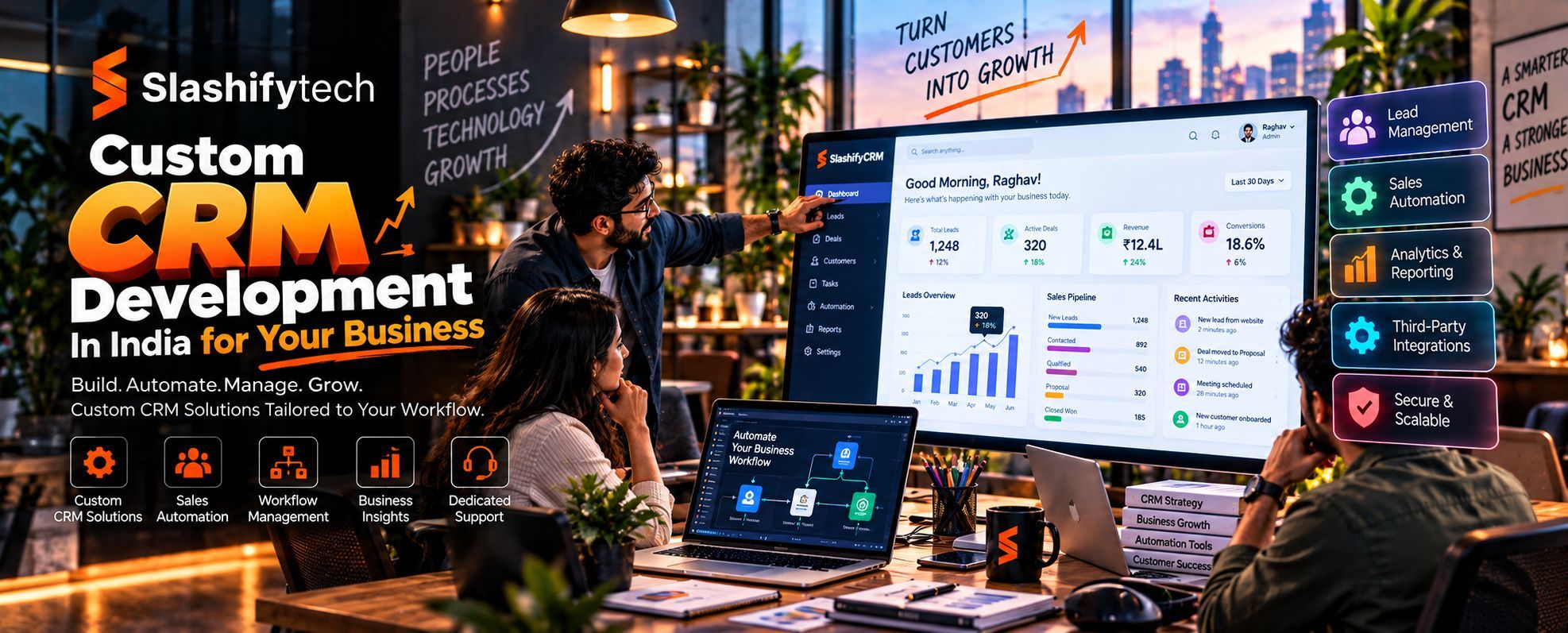
Your customer relationships are too important to manage through disconnected spreadsheets, scattered conversations and manual follow-ups. As your business grows, you need a reliable way to organise leads, manage customer information, track sales opportunities and keep every team member aligned.
SlashifyTech helps businesses plan and develop tailored software solutions around their operational requirements. With a custom CRM system, your organisation can bring customer information, sales activities and business workflows into a more organised environment, subject to the features defined for your project.
If your existing tools no longer support the way your business works, Custom CRM Development In India can provide a path towards a system designed around your processes, users and long-term objectives.
Whether you need a lead management platform, a sales pipeline, a customer support system or a more comprehensive customer relationship management solution, the first step is to identify what your team needs the software to accomplish.
Discuss your CRM requirements with SlashifyTech and explore a solution aligned with your business goals.
What Is Custom CRM Development In India?
Custom CRM Development In India is the process of designing and building customer relationship management software around a business's specific requirements rather than relying entirely on a standard, ready-made product.
A customer relationship management system can centralise information about prospects, existing customers, communications, sales opportunities and service interactions. Depending on its scope, it can also automate routine tasks, generate reports and connect different business applications.
Unlike a one-size-fits-all system, a custom CRM can be designed around your internal processes, approval requirements, data fields, reporting needs and user permissions.
For example, a business that manages enquiries through a website, sales representatives and customer service staff may need a shared system that records each enquiry, assigns responsibility and tracks what happens next.
A carefully scoped CRM can help bring these activities together while reducing dependence on manual record-keeping.
Why Businesses Choose Custom CRM Software Development
Every business follows a different process for attracting customers, managing enquiries and delivering services. A standard CRM may cover common requirements, but its default workflows may not suit every organisation.
Custom CRM software development is worth considering when your business needs more control over how customer information is handled and how work moves between teams.
1. Workflows Designed Around Your Business
Your sales process may include qualification, demonstrations, quotations, internal approvals, negotiations and onboarding. Another organisation may use entirely different stages.
A tailored CRM can represent these stages using fields, rules, task assignments and permissions that reflect your actual operations.
The objective is to make the software support your team rather than force your team to work around unnecessary system limitations.
2. Centralised Customer Information
Customer details can become fragmented across spreadsheets, inboxes, forms and individual team members' records.
A properly designed CRM provides a shared view of relevant customer information, subject to appropriate access permissions.
Team members can understand the history of a relationship, review previous interactions and identify the next action without repeatedly searching through separate systems.
3. More Consistent Lead Management
When enquiries arrive from multiple channels, teams need a dependable process for recording and assigning them.
A custom CRM may include lead capture, duplicate checks, ownership assignment, qualification fields and pipeline tracking.
These capabilities help establish clearer accountability for incoming enquiries and make it easier to identify leads that need attention.
4. Automated Routine Tasks
Manual administration can consume time that employees could otherwise spend serving customers or progressing opportunities.
Depending on your requirements, a CRM can automate tasks such as follow-up reminders, notifications, task creation, status updates and approval requests.
Automation rules should be based on clearly defined business conditions, with suitable safeguards for exceptions and failed integrations.
5. Business-Specific Reporting
Standard reports do not always answer the questions management needs to ask.
A custom reporting interface can be designed around relevant indicators, such as enquiry sources, sales pipeline stages, conversion rates, response times, open service requests or team workloads.
The value comes from choosing accurate, actionable metrics rather than adding dashboards that nobody uses.
Our Custom CRM Development In India Services
The right CRM scope depends on your business model, existing systems, users and operational priorities. Potential modules for a tailored CRM project include the following, where confirmed within the agreed scope.
Custom CRM Software Development
Develop a CRM around your business rules, data structure, user roles and operational requirements.
The system can be planned as a focused internal application or as part of a broader software platform, depending on the complexity of your requirements.
Lead and Contact Management
Organise prospect and customer records in a structured environment.
Potential functionality includes:
- Lead and contact profiles.
- Company and account records.
- Custom data fields.
- Lead status and ownership.
- Notes and interaction history.
- Duplicate identification.
- Search, filtering and record management.
The final data model should reflect how your team qualifies, manages and maintains customer relationships.
Sales Pipeline Management
Give your team a structured way to follow opportunities from initial enquiry to a final outcome.
A sales pipeline may include configurable stages, opportunity values, expected closing dates, assigned representatives, next actions and lost-opportunity reasons.
Managers can use this information to review progress and identify opportunities that require additional attention.
CRM Workflow Automation
Define repeatable rules for common business activities.
For example, a new enquiry may trigger a task for a designated team member. A change in opportunity status may notify a manager, while an approaching deadline may create a reminder.
Each workflow should have clear triggers, responsible users, exception handling and a way to identify whether the intended action succeeded.
CRM Dashboard and Reporting Development
Bring important operational information into a dashboard designed for the people who need it.
Sales representatives may need their assigned leads and upcoming follow-ups. Team managers may need pipeline visibility and workload information. Business owners may need a broader view of customer activity and performance.
Reports should use clearly defined metrics, reliable source data and suitable access controls.
CRM Integration Services
Your CRM may need to exchange information with existing business applications.
Integration requirements should be assessed individually, including API availability, authentication, data mapping and vendor restrictions.
Potential integration categories include:
- Website enquiry forms.
- Email and calendar applications.
- Communication platforms.
- Marketing and advertising systems.
- Accounting and billing software.
- Customer support applications.
- Existing databases and business applications.
The goal is to reduce unnecessary duplicate entry and keep relevant information consistent across connected systems.
Custom CRM Web Application Development
A browser-based CRM can give authorised users access to business information without requiring a separate desktop installation.
The interface should be designed around the tasks users perform most frequently, with suitable navigation, responsive layouts, validation and loading performance.
The underlying architecture should reflect the expected number of users, data volumes, integrations and security requirements.
CRM Maintenance and Enhancement
A CRM may need changes as your business evolves.
Depending on the agreed support arrangement, ongoing work can include defect fixes, compatibility updates, performance improvements, new reports, integration maintenance and additional modules.
A documented enhancement process helps distinguish urgent issues from future improvements and keeps changes aligned with business priorities.
Our CRM Development Process
A successful CRM project starts with a clear understanding of the problem being solved.
The following is a recommended delivery framework for a project undertaken by SlashifyTech.
Step 1: Requirements Discovery
Begin by understanding how your organisation manages leads, customers, sales activities and service requests today.
The discovery phase should identify:
- Existing systems and data sources.
- Current workflows and approval rules.
- User roles and permission requirements.
- Reporting and dashboard expectations.
- Required integrations.
- Security, privacy and operational constraints.
- Essential features for the first release.
The outcome should be an agreed requirements document with clear priorities and acceptance criteria.
Step 2: Solution Planning and Architecture
Translate business requirements into a practical technical plan.
This stage should define the major modules, data relationships, user roles, integration approach, hosting requirements and deployment environment.
It should also distinguish essential launch requirements from features that can be introduced later.
A phased scope helps teams validate the core solution before committing to more complex functionality.
Step 3: UI/UX Design and Prototyping
Plan the screens and workflows that users will interact with.
A prototype can help stakeholders review navigation, data entry, record layouts, dashboards and common tasks before development proceeds.
Feedback from actual users is particularly valuable because a CRM must support everyday work, not merely look complete during a demonstration.
Step 4: CRM Development
Build the agreed functionality in manageable increments.
Development may cover data models, business rules, user interfaces, APIs, automation, reporting and integration components, according to the approved scope.
Regular reviews can help stakeholders verify progress, clarify requirements and identify issues early.
Step 5: Testing and Validation
Test the system against the agreed acceptance criteria before launch.
Relevant checks may include:
- Functional and workflow testing.
- User permissions and access controls.
- Input validation and error handling.
- Integration and data synchronisation.
- Performance under expected workloads.
- Backup and recovery procedures.
- Data migration accuracy.
- User acceptance testing.
Testing requirements should reflect the sensitivity of the data and the operational risks associated with the CRM.
Step 6: Deployment and Team Onboarding
Prepare the production environment, validate migrated data and plan the transition from existing tools.
Users should understand their responsibilities, the new workflows and the process for reporting problems.
Where operational continuity is important, a staged rollout or parallel-running period may be appropriate.
Step 7: Monitoring and Continuous Improvement
After deployment, review system reliability, user feedback, data quality and workflow effectiveness.
Prioritise improvements using evidence from actual usage rather than adding features simply because they are available.
A clear maintenance and enhancement plan helps the CRM remain useful as business requirements change.
Custom CRM Development In India for Different Industries
A CRM should reflect the way a particular organisation works. Its modules and workflows will depend on the business model and the decisions the system needs to support.
Real Estate
Real estate teams may need to manage property enquiries, buyer and seller records, viewing appointments, broker assignments and deal progress.
A tailored CRM can organise these activities around the organisation's actual sales process.
Education and Training
Educational organisations may manage student enquiries, counselling, applications, admissions stages and follow-up schedules.
A CRM can provide a structured view of enquiries and their progress, subject to appropriate handling of student information.
Healthcare Administration
Healthcare organisations may require systems for non-clinical enquiries, appointment coordination, service requests and administrative communication.
Any solution handling patient information requires careful assessment of privacy, access control, applicable regulations and the boundary between administrative CRM functions and clinical systems.
Professional Services
Consultancies, agencies and other service providers may need to manage prospects, proposals, client communications, project handovers and renewals.
A tailored workflow can connect the customer relationship process with the organisation's internal responsibilities.
Manufacturing and Distribution
Manufacturers and distributors may need account records, dealer relationships, quotation tracking, sales territories and order-related integrations.
The CRM should be designed around the relationship-management requirements and clearly defined connections to inventory, accounting or enterprise resource planning systems.
Startups and Growing Businesses
Growing organisations may begin with spreadsheets and disconnected applications before their processes become difficult to manage.
A focused CRM can establish a structured foundation for customer records, sales activity and reporting, with additional modules introduced when justified by business needs.
These are potential use cases, not claims that SlashifyTech has delivered CRM projects in every listed industry.
Custom CRM vs Ready-Made CRM Software
Choosing between a custom CRM and an existing product requires an honest assessment of business requirements, implementation effort and long-term cost.
| Consideration | Custom CRM | Ready-made CRM |
|---|---|---|
| Workflow flexibility | Can be designed around agreed business rules | Uses existing features and configuration options |
| Initial investment | Requires discovery, design and development | Often has a lower initial setup cost |
| Time to launch | Depends on scope and complexity | Often quicker for standard requirements |
| Integrations | Can be built for supported integration requirements | Depends on available connectors, APIs and plan limits |
| Maintenance | Requires an agreed maintenance and ownership model | Core product maintenance is generally managed by the vendor |
| Upgrades | Must be planned and implemented | Product upgrades are generally vendor-managed |
| Unique requirements | Suitable when requirements justify bespoke development | Suitable when existing functionality is sufficient |
| Future changes | Depend on architecture, documentation and available resources | Depend on vendor capabilities and configuration limits |
A custom CRM is not automatically better than an established product. Ready-made tools can be the more practical option when they already support your processes.
Custom development becomes more compelling when distinctive workflows, specific integrations, data ownership requirements or long-term product plans justify the additional investment.
The right decision should come from a requirements assessment, not from the assumption that every business needs software built from scratch.
How Much Does Custom CRM Development Cost in India?
The cost of Custom CRM Development In India depends on the size and complexity of the solution. There is no single price that accurately represents every CRM project.
Important cost factors include:
- Number and complexity of CRM modules.
- Number of user roles and permission levels.
- Custom workflow and approval requirements.
- Third-party integrations and API limitations.
- Data migration and cleansing requirements.
- Dashboard and reporting complexity.
- Security, audit and compliance needs.
- Hosting, deployment and infrastructure.
- Testing, training, maintenance and future support.
A focused CRM for a single team will generally involve a different scope from a multi-department platform with mobile applications, advanced automation and several external integrations.
Before development begins, request a written proposal that explains the deliverables, exclusions, milestones, assumptions, acceptance criteria, maintenance arrangements and payment schedule.
Security and Data Management in Custom CRM Development In India
A CRM may contain contact details, business communications, sales records and other confidential information. Security must therefore be considered during design, development and operation.
Depending on the project's requirements, relevant safeguards may include:
- Role-based access controls.
- Secure authentication and session management.
- Encrypted connections.
- Appropriate protection for stored sensitive data.
- Input validation and secure API design.
- Audit logs for important activities.
- Backup and recovery procedures.
- Monitoring and incident-response planning.
- Data retention and deletion policies.
- Controlled access to production environments.
The correct safeguards depend on the data being processed, the deployment environment and the applicable legal and contractual requirements.
Businesses should also define who owns the data, who can access it, how long it is retained and what happens when a contract ends.
Security should be validated through appropriate testing and operational controls rather than treated as a checklist completed only at launch.
Why Choose SlashifyTech for Custom CRM Development In India?
SlashifyTech presents itself as a custom software development company working across web applications, mobile applications, SaaS and AI automation. Its website also describes a development process covering discovery, planning, design, development, quality assurance, launch and ongoing support.
For a custom CRM engagement, the relevant question is how these capabilities can be applied to your specific requirements.
A suitable engagement should establish:
| What to establish | What it covers |
|---|---|
| Requirements clarity | A documented understanding of your current workflow and business objectives. |
| Practical solution design | A defined scope that prioritises essential capabilities. |
| Integration planning | A realistic assessment of the systems your CRM must connect with. |
| Testing and validation | Acceptance criteria that can be checked before release. |
| Maintainability | Appropriate documentation and a clear approach to future changes. |
| Transparent delivery | Agreed milestones, responsibilities, exclusions and communication arrangements. |
Frequently Asked Questions
What is Custom CRM Development In India?
Custom CRM Development In India involves designing and building customer relationship management software around a business's specific workflows, data, user roles and integration requirements. Businesses can work with an Indian development team to scope a solution for their operational needs.
Why should a business invest in custom CRM software?
Custom CRM software may be useful when a business has specialised workflows, needs integrations that existing products cannot adequately support, or requires greater control over its data structure and functionality. The investment should be justified by the expected business value and total cost of ownership.
What features can a custom CRM include?
Depending on the project scope, features may include lead and contact management, sales pipeline tracking, follow-up reminders, workflow automation, customer interaction history, reporting dashboards, user permissions and integrations with existing applications.
How much does custom CRM development cost in India?
The price depends on modules, integrations, data migration, security requirements, user roles and maintenance needs. The most reliable way to estimate the cost is to document the requirements and obtain a project-specific proposal.
How long does it take to develop a custom CRM?
The timeline depends on the scope, complexity, integrations, testing requirements and availability of stakeholders. A defined first release can sometimes be delivered before the full system is complete, but the actual schedule should be established during technical planning.
Can a custom CRM integrate with existing business software?
Potentially, yes. Integration feasibility depends on the external system's APIs, permissions, data formats, vendor policies and technical constraints. Each required integration should be assessed before its scope and cost are confirmed.
Can a custom CRM be designed for a specific industry?
Yes. A CRM can be structured around industry-specific workflows, such as real estate enquiries, education admissions, professional service clients or distributor relationships. The features should reflect actual business requirements and any applicable privacy obligations.
Is a custom CRM better than an off-the-shelf solution?
Not in every case. Ready-made products may be more economical and faster to deploy for standard workflows. Custom development is worth evaluating when existing products cannot meet important requirements without excessive workarounds or limitations.
Can a CRM be expanded after launch?
A CRM can be designed for future expansion, provided its architecture, documentation, infrastructure and maintenance arrangements support the planned changes. New modules should be prioritised according to business needs and technical feasibility.
How do I get started with a CRM development project?
Start by documenting your existing workflow, the problems you need to solve, the users involved, your current tools and the outcomes you want to measure. Share those requirements with SlashifyTech to discuss project feasibility and the next steps.
Let's Discuss Your Custom CRM Requirements
Your CRM should help your business manage customer relationships more systematically, support consistent workflows and provide useful operational visibility.
The right starting point is not a long feature list. It is a clear understanding of how your team works, where existing processes create friction and what a better system needs to accomplish.
Contact SlashifyTech to discuss your requirements, evaluate possible approaches and determine whether Custom CRM Development In India is the right fit for your business.
Ready to plan your CRM project? Get in touch with SlashifyTech to discuss your requirements.


