


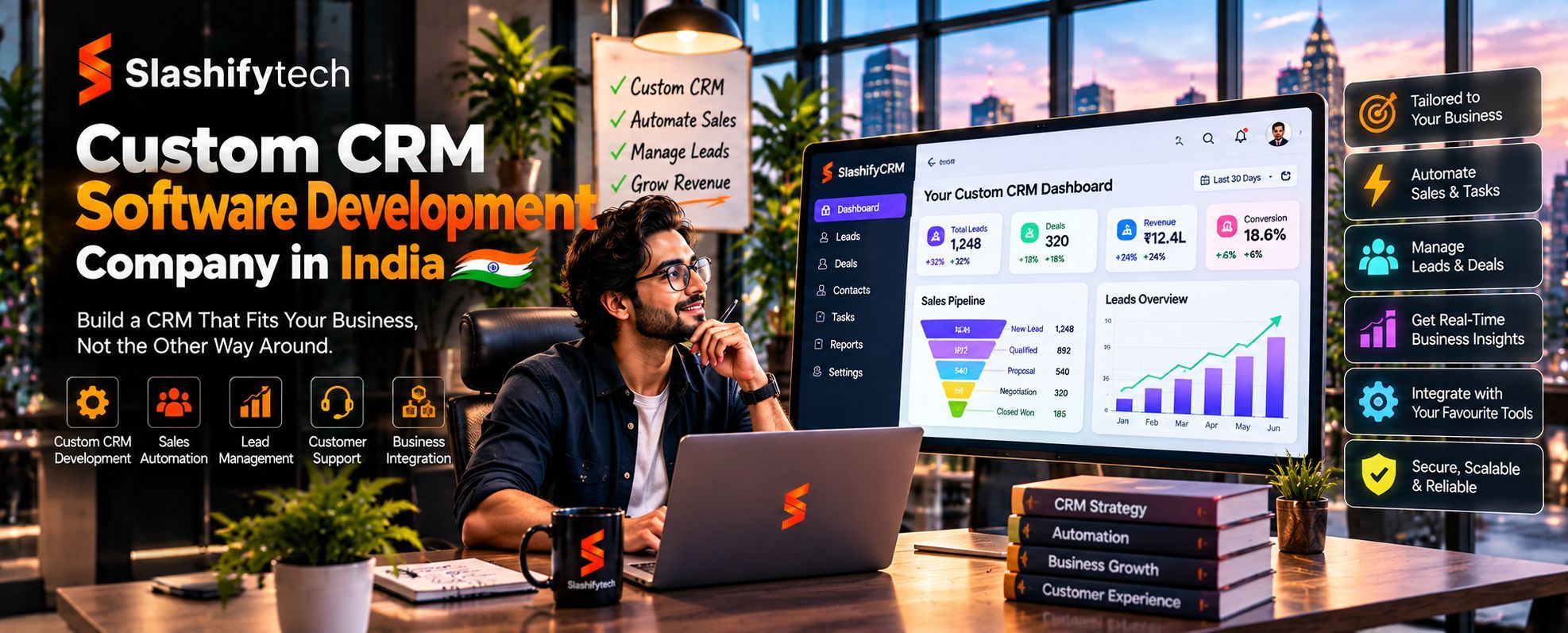
Your business doesn't need another complicated software tool. It needs a system that understands how your business operates.
From managing incoming enquiries and tracking sales opportunities to maintaining customer relationships and automating repetitive tasks, every business has its own way of working.
But when customer information is scattered across spreadsheets, emails, WhatsApp conversations and disconnected applications, managing these activities becomes increasingly difficult.
SlashifyTech helps businesses plan and build custom software solutions designed around their operational requirements, including customer relationship management systems.
As a technology development partner, our approach focuses on understanding your business processes, identifying operational gaps and translating those requirements into a structured software solution.
If ready-made CRM platforms cannot accommodate your workflows, custom CRM software development company in India can provide greater flexibility over functionality, integrations, data management and future enhancements.
Looking for a custom CRM software development company in India? Let's discuss what your business actually needs.
What Does a custom CRM software development Company in India Do?
A custom CRM software development company in India designs and develops customer relationship management systems according to an organisation's specific business processes.
Instead of relying entirely on predefined features, the development process starts with understanding how a business manages prospects, customers, sales activities, communications and internal responsibilities.
A custom CRM can bring these operations into one organised platform.
Depending on the project requirements, it may include:
- Lead and customer management.
- Sales pipeline management.
- Automated follow-up reminders.
- Customer communication history.
- Employee and team management.
- Workflow and approval automation.
- Reporting and analytics dashboards.
- Third-party software integrations.
- Role-based access management.
The objective is straightforward: create software that supports the way your organisation operates rather than forcing employees to change their entire working process to accommodate a generic tool.
custom CRM software development company in India Services by SlashifyTech
Every CRM project has different functional and technical requirements. Some businesses need a focused lead management application, while others require a comprehensive platform connecting sales, customer support and internal operations.
The following capabilities can be considered when defining the scope of a custom CRM project.
1. custom CRM software development company in India
Build a customer relationship management platform around your business requirements.
The development scope can include custom modules, business-specific data fields, user permissions, dashboards and operational workflows.
Whether you need a CRM for a small team or a more extensive business application, the architecture and functionality should reflect your actual requirements.
2. Lead Management Software Development
Managing enquiries efficiently is essential for businesses that depend on a consistent sales pipeline.
A custom lead management module can help organise incoming enquiries, assign responsibilities and track lead progress.
Potential capabilities include:
- Lead capture and registration.
- Lead source identification.
- Lead assignment and distribution.
- Lead qualification.
- Follow-up scheduling.
- Lead status management.
- Duplicate record identification.
- Lead activity tracking.
This creates a structured process for managing enquiries and understanding what happens after a potential customer contacts your business.
3. Sales CRM Development
A sales CRM helps organisations manage opportunities throughout the sales cycle.
The system can be configured around your actual sales stages, approval processes and reporting requirements.
Depending on the scope, functionality may include:
- Customisable sales pipelines.
- Opportunity management.
- Sales representative assignments.
- Deal value tracking.
- Quotation management.
- Sales activity monitoring.
- Expected closing dates.
- Lost opportunity analysis.
Managers can use structured pipeline information to understand sales activity and identify opportunities that require attention.
4. CRM Workflow Automation
Repetitive administrative activities can create unnecessary work for employees.
CRM workflow automation allows businesses to define rules for common processes and trigger appropriate actions when specific conditions are met.
For example:
- Assign a new enquiry to a designated sales representative.
- Create a follow-up task when a lead enters a particular stage.
- Notify a manager when an opportunity requires approval.
- Send an internal reminder when an important deadline approaches.
- Update records when a connected application sends new information.
Automation should be designed around real business rules, with appropriate exception handling and activity monitoring.
5. CRM Dashboard and Reporting Development
Business owners and managers need more than a collection of customer records. They need useful information to understand operational performance.
A custom CRM dashboard can present relevant business indicators in one interface.
Depending on your requirements, reports may cover:
- Total enquiries received.
- Lead source performance.
- Sales pipeline distribution.
- Opportunity status.
- Follow-up activities.
- Individual and team performance.
- Customer acquisition trends.
- Outstanding tasks.
The most effective dashboards prioritise meaningful metrics rather than displaying unnecessary information.
6. CRM Integration and API Development
Businesses often use several applications to manage their daily operations.
A CRM can be designed to exchange information with other systems through available APIs and integration mechanisms.
Potential integration requirements include:
- Website enquiry forms.
- Email platforms.
- WhatsApp Business integrations.
- Payment gateways.
- Accounting applications.
- Marketing automation platforms.
- Customer support systems.
- ERP and inventory applications.
- Internal business databases.
Integration feasibility depends on API availability, authentication requirements, vendor restrictions and the structure of the connected systems.
The objective is to reduce duplicate data entry and improve information consistency across business applications.
7. CRM Web Application Development
A web-based CRM provides authorised employees with access through a browser.
The application can be designed around the tasks employees perform regularly, including customer record management, lead tracking, sales activities and reporting.
Important considerations include responsive interfaces, secure authentication, appropriate permissions, data validation and application performance.
8. CRM Maintenance and Enhancement
A CRM should continue supporting the business as its requirements evolve.
Maintenance and enhancement work may include:
- Technical issue resolution.
- Performance improvements.
- Integration maintenance.
- Security updates.
- New modules and functionality.
- Dashboard enhancements.
- Compatibility updates.
- Data management improvements.
The maintenance arrangement and ownership responsibilities should be defined before deployment.
Why Choose Custom CRM Software Instead of Ready-Made Platforms?
Ready-made CRM software can be an excellent option for businesses with standard requirements.
However, some organisations have processes that do not fit neatly into predefined software features.
For example, a business may require a particular approval sequence, a specialised sales pipeline, multiple business divisions or integrations with internally developed applications.
In these situations, custom CRM development may provide greater control.
| Business requirement | Ready-made CRM | Custom CRM |
|---|---|---|
| Standard lead management | Usually available | Can be developed |
| Custom business workflows | Limited by product capabilities | Designed around agreed requirements |
| Specialised reporting | Depends on available plans and features | Can be tailored to defined metrics |
| Unique integrations | Depends on connectors and APIs | Can be developed where technically feasible |
| User permissions | Available predefined options | Can be designed around business roles |
| Interface customisation | Depends on the platform | Greater design flexibility |
| Future enhancements | Depends on vendor roadmap and plans | Depends on architecture and maintenance |
When Should You Consider Custom CRM Development?
A custom solution may be worth evaluating when:
- Your business has specialised workflows that existing CRM products cannot adequately support.
- Your teams maintain customer information across multiple disconnected systems.
- You need specific integrations with internal applications.
- Existing reporting options do not provide the information management requires.
- You need greater control over your software's functionality and data structure.
- Your business plans to develop its own CRM-based commercial product.
Custom development also involves additional responsibilities, including initial engineering costs, maintenance, hosting and future upgrades.
The decision should be based on total cost of ownership and actual business value, not simply the number of available features.
Industry-Specific CRM Software Development
Different industries have different customer journeys, operational requirements and data management needs.
A useful CRM should reflect these differences.
CRM Software for Real Estate Businesses
Real estate organisations may need to manage property enquiries, buyer and seller records, site visits, broker assignments and sales opportunities.
A tailored CRM can organise these activities around the company's actual property sales process.
CRM Software for Educational Institutions
Educational organisations may manage student enquiries, admission applications, counselling activities and follow-up schedules.
A CRM can help structure these processes and provide better visibility into enquiry and admission progress.
CRM Software for Healthcare Organisations
Healthcare organisations may require administrative CRM functionality for enquiries, appointment coordination, service requests and communication.
Solutions involving patient information require careful consideration of privacy, applicable regulations and access restrictions.
CRM Software for E-commerce Businesses
E-commerce businesses may benefit from structured customer records, order-related communication, support requests, customer segmentation and retention workflows.
Integration requirements should be assessed against the capabilities of the existing commerce platform.
CRM Software for Manufacturing and Distribution
Manufacturers and distributors may need to manage dealer relationships, customer accounts, quotations, sales territories and order-related communication.
CRM integrations with inventory and ERP systems can be considered where they support the operational requirements.
CRM Software for Startups and Growing Businesses
Startups often begin with spreadsheets and basic applications.
As their customer base and team grow, these tools can become difficult to manage.
A focused CRM can establish a more structured foundation for customer information, lead management and sales reporting, with additional modules introduced as needed.
These are potential application areas, not claims of completed industry-specific CRM deployments by SlashifyTech.
Our custom CRM software development company in India Process
Building useful CRM software requires more than writing code. The development process should connect business requirements, technical architecture, user experience and operational needs.
Here is the recommended project framework.
Step 1: Business Requirements and Discovery
The first stage is understanding how your business currently operates.
We need to identify:
- How enquiries enter your organisation.
- How leads are assigned.
- How sales representatives manage follow-ups.
- How customer information is stored.
- Which applications your team currently uses.
- What reports management needs.
- Which activities should be automated.
The outcome should be a documented project scope with clearly prioritised requirements.
Step 2: CRM Architecture and Technical Planning
Once the requirements are understood, they can be translated into a technical solution.
This includes planning the database structure, application modules, user roles, permissions, integration requirements and deployment architecture.
The system should be designed with appropriate flexibility for expected future requirements without introducing unnecessary complexity.
Step 3: UI/UX Design
The interface should make everyday tasks straightforward.
Design work may include:
- Login and user management screens.
- Customer and lead profiles.
- Sales pipeline interfaces.
- Task and follow-up views.
- Reporting dashboards.
- Administrative panels.
Prototypes allow stakeholders to review the experience before full development begins.
Step 4: CRM Software Development
The approved requirements and designs are translated into working software.
Development may include frontend interfaces, backend functionality, databases, APIs, business logic and automation components.
Work should be organised into manageable milestones so stakeholders can review functionality as it progresses.
Step 5: Quality Assurance and Testing
The CRM should be tested against its agreed requirements.
Testing may cover functionality, user permissions, integration behaviour, data validation, application performance, security controls and error handling.
User acceptance testing helps confirm that the system supports actual business workflows before launch.
Step 6: Deployment and Implementation
Deployment involves preparing the production environment, configuring the application and validating the transition from existing systems.
Where required, existing customer records can be migrated following data mapping, cleansing and validation.
The team should also receive suitable onboarding and instructions for using the new system.
Step 7: Ongoing Support and Improvements
After launch, the software can be monitored and improved according to actual usage and business feedback.
Future improvements may include additional modules, integrations, reports and workflow enhancements.
The scope of post-launch support should be agreed as part of the project.
How Much Does Custom CRM Software Development Cost in India?
The cost of hiring a custom CRM software development company in India depends on the functionality, technical complexity and delivery requirements of the project.
A basic CRM with customer records and lead tracking has different development requirements from an enterprise platform with multiple departments, advanced reporting and several external integrations.
The main factors affecting project cost include:
| Cost factor | Why it matters |
|---|---|
| 1. Number of modules | More business functions require additional design, development and testing. |
| 2. Workflow complexity | Specialised approval rules, automation and business logic can increase development effort. |
| 3. Integrations | External applications may require API development, authentication and data synchronisation. |
| 4. User roles | Complex permissions and organisational hierarchies require additional planning. |
| 5. Data migration | Existing records may need cleansing, restructuring and validation. |
| 6. Reporting requirements | Advanced dashboards and customised analytics require appropriate data architecture. |
| 7. Security and infrastructure | Hosting, access controls, backups and operational requirements influence the overall investment. |
| 8. Maintenance | Ongoing updates, technical support and enhancements should be included in long-term cost planning. |
Instead of choosing a development partner based only on the lowest quotation, evaluate the project scope, technical approach, documentation, ownership arrangements and maintenance responsibilities.
SlashifyTech can assess your requirements and discuss a suitable project scope before pricing or delivery commitments are confirmed.
Security and Data Protection in CRM Development
A CRM may store sensitive business information, customer details and internal communications.
Security should therefore be considered from the beginning of the development process.
Depending on the project, appropriate safeguards may include:
- Role-based access control.
- Secure authentication.
- Encrypted network communication.
- Input validation.
- Secure API authentication.
- Database access restrictions.
- Audit logs.
- Regular backups.
- Data retention policies.
- Recovery and incident-response procedures.
The appropriate security architecture depends on the data being handled, the application environment and relevant legal requirements.
Businesses should also establish clear arrangements for data ownership, access, retention and deletion.
Why Choose SlashifyTech as Your CRM Software Development Partner?
Choosing a software development company is an important decision because your CRM will influence how employees manage customers, information and business activities.
SlashifyTech presents itself as a custom software development company working across web applications, mobile applications, SaaS platforms and AI-driven solutions. Its wider software portfolio includes B2B applications, business portals and enterprise-oriented solutions.
For a CRM project, the focus should be on translating your specific business requirements into a practical technical solution.
Business-Focused Development
A CRM should solve operational problems rather than introduce unnecessary complexity.
The project should begin with an understanding of your current processes, priorities and desired outcomes.
Custom Software Approach
Different organisations require different workflows, modules and integrations.
The solution should be scoped around those requirements rather than relying on an unsuitable collection of predefined features.
Structured Project Execution
Requirements discovery, technical planning, UI/UX design, development, quality assurance and deployment should follow a clearly defined process.
Integration Planning
Your CRM may need to communicate with other business applications.
Integration requirements should be evaluated early to reduce technical surprises during implementation.
Long-Term Maintainability
Software should be designed and documented with future maintenance in mind.
The agreed project should clearly define deliverables, documentation, access, ownership and support responsibilities.
Scalable Solution Architecture
The architecture should reflect the expected users, data volumes, business processes and future development requirements.
Scalability should be planned according to realistic business needs rather than used as an unsupported marketing promise.
Frequently Asked Questions
1. What does a custom CRM software development company in India do?
A custom CRM software development company in India designs, builds and implements customer relationship management software according to business-specific requirements. This can include lead management, customer records, sales pipelines, automation, dashboards and third-party integrations.
2. How do I choose the right CRM software development company in India?
Evaluate the company's relevant software development experience, technical capabilities, project methodology, portfolio, communication process and maintenance arrangements. Ask how it will understand your workflows, handle data migration, manage integrations and document the final application.
3. What is the difference between CRM software and custom CRM software?
Standard CRM software provides predefined functionality that businesses can configure within the platform's limitations. Custom CRM software is developed around specific business workflows, data structures, integrations and functional requirements.
4. How much does custom CRM software development cost in India?
The cost depends on project scope, number of modules, integration requirements, security, reporting and development complexity. A detailed requirements assessment is necessary before providing a reliable quotation.
5. How long does it take to develop custom CRM software?
The development timeline depends on functionality, design complexity, integrations, data migration and testing. A smaller initial release may take less time than a comprehensive CRM platform. A realistic schedule should be established after requirements discovery.
6. Can a custom CRM integrate with WhatsApp and email?
Potentially, yes. Integration depends on the availability of supported APIs, account permissions, platform policies and the intended functionality. For example, businesses may require communication notifications, enquiry capture or interaction records.
7. Can CRM software be customised for my industry?
Yes. CRM modules can be designed around industry-specific workflows, such as property enquiries, student admissions, customer support, dealer management and professional service relationships.
8. Is custom CRM software suitable for small businesses?
It can be suitable when a small business has specific requirements that existing CRM platforms do not meet. However, businesses with straightforward needs may find ready-made CRM software more economical.
9. Who owns the custom CRM software after development?
Ownership depends on the contractual agreement. Before development begins, clarify intellectual property rights, source code delivery, database access, third-party licences, documentation and hosting responsibilities.
10. Can new features be added after the CRM is launched?
Yes, provided the architecture and maintenance arrangements support the required changes. Additional modules, reports, integrations and automation can be planned according to future business needs.
Build a CRM That Works Around Your Business
Your customer management system should make business operations more organised, not more complicated.
From lead tracking and sales management to customer communication and reporting, the right CRM architecture starts with understanding your actual requirements.
SlashifyTech works across custom software development and digital product engineering. If your organisation is evaluating a tailored CRM solution, start with a discussion about your workflows, existing systems and long-term objectives.
Looking for a custom CRM software development company in India?
Let's understand your requirements and explore the right development approach for your business.
Contact SlashifyTech to discuss your custom CRM software project.


