



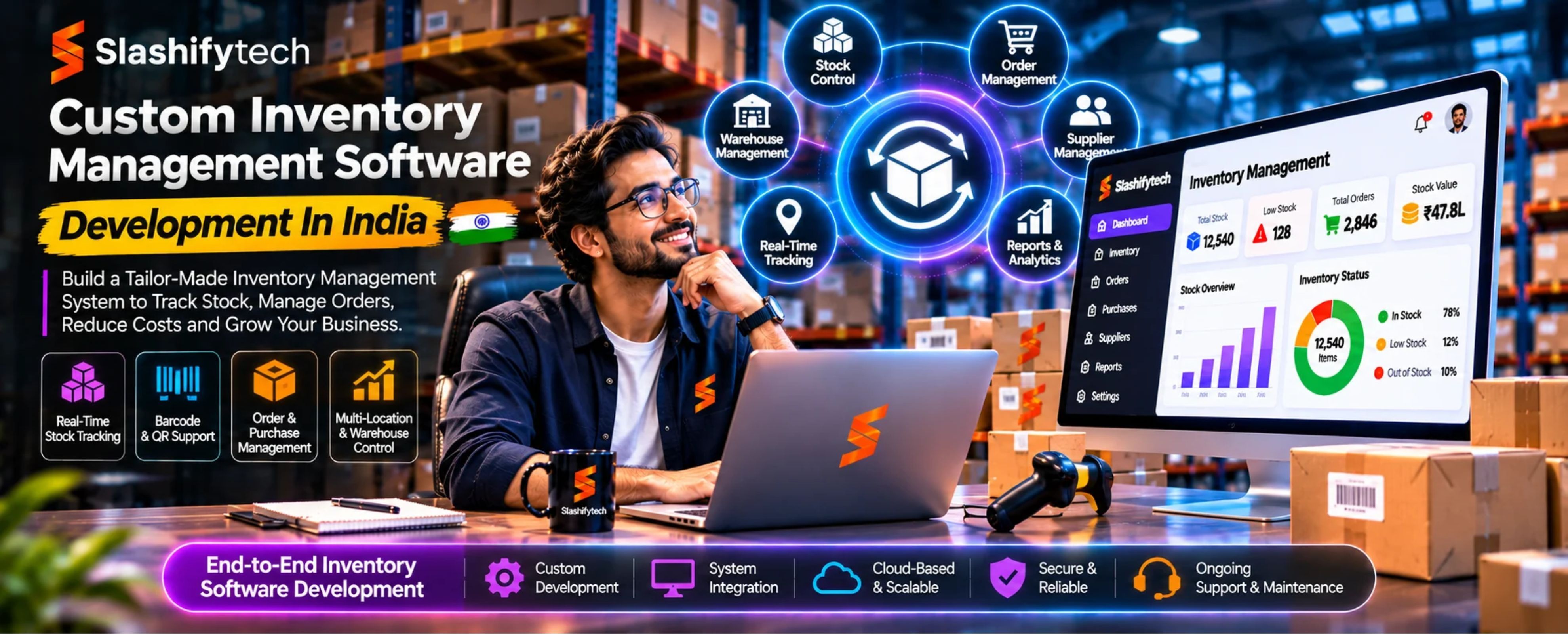
Build Smarter Inventory Systems. Gain Complete Control Over Your Stock, Warehouses and Business Operations.
Are you looking for custom inventory management software development in India to streamline stock operations, manage multiple warehouses, automate inventory workflows and improve business efficiency?
SlashifyTech develops custom software solutions designed around business-specific requirements. We help businesses plan and develop digital applications that simplify complex operations, connect business systems and provide better visibility into operational data.
Our custom software development capabilities can support inventory management platforms with features such as real-time stock tracking, purchase order management, warehouse management, product management, barcode scanning, inventory reporting, supplier management and third-party integrations.
Whether you operate a manufacturing business, retail store, wholesale distribution company, eCommerce business or multi-location enterprise, we can help you plan an inventory management application around your workflows.
From requirement analysis and UI/UX design to application development, integration, testing and deployment, our approach focuses on building practical software that supports your business operations.
Want to build an inventory management system for your business?
Discuss Your Inventory Software Project | Contact SlashifyTech
What Is Custom Inventory Management Software Development In India?
Custom Inventory Management Software Development In India is the process of designing and building a software application specifically for managing a business's inventory, stock movements, warehouse operations, purchasing activities and product information.
Unlike generic inventory applications with predefined functionality, custom inventory software is developed around the actual operational requirements of an organisation.
For example, a wholesale distribution business may need to manage thousands of products across multiple warehouses, track incoming shipments, process purchase orders, manage suppliers and monitor stock availability.
A manufacturing company may require a different system that tracks raw materials, production consumption, finished goods, batches and dispatch operations.
A custom inventory management system can bring these activities together through a centralised platform.
Depending on business requirements, the software can include:
- Real-time inventory and stock tracking.
- Multi-warehouse inventory management.
- Product and SKU management.
- Purchase order management.
- Supplier and vendor management.
- Barcode and QR code integration.
- Stock transfer and adjustment management.
- Batch, lot and serial number tracking.
- Inventory forecasting and reporting.
- Low-stock and reorder notifications.
- Sales and order management integrations.
- Role-based access and administrative dashboards.
At SlashifyTech, we approach inventory software as a business application that should reflect how products are purchased, received, stored, moved, sold and managed.
The objective is to create a system that improves inventory visibility, supports operational workflows and can evolve with changing business requirements.
Why Do Businesses Need Custom Inventory Management Software?
Managing inventory through spreadsheets, manual registers and disconnected applications can become increasingly difficult as a business expands.
Stock discrepancies, delayed updates, duplicate records and limited warehouse visibility can affect purchasing decisions, order fulfilment and customer satisfaction.
A custom inventory management application helps businesses address these challenges through connected workflows and centralised information.
1. Real-Time Stock Visibility
Businesses need accurate information about how much inventory is available and where it is stored.
A properly designed inventory system can provide stock visibility across warehouses, stores and other inventory locations.
It can help teams monitor:
- Available stock.
- Reserved inventory.
- Incoming stock.
- Dispatched products.
- Damaged or returned items.
- Stock movement history.
2. Reduce Manual Inventory Management
Manual stock updates require employees to maintain multiple records and repeatedly enter information.
Custom inventory software can automate appropriate activities such as stock adjustments, order updates, purchase workflows and notifications.
This reduces repetitive work and helps create more consistent inventory records.
3. Better Warehouse Management
Businesses operating multiple warehouses need a structured way to track products across different locations.
A custom inventory system can support warehouse-level stock visibility, location management, product transfers, receiving and dispatch workflows.
4. Improved Purchasing Decisions
Inventory information helps purchasing teams understand which products need replenishment and which products already have sufficient stock.
Custom software can support reorder thresholds, purchase order workflows and stock reporting to improve purchasing decisions.
5. Better Order Fulfilment
When sales and inventory systems are connected, businesses can improve visibility into product availability and order processing.
This helps teams identify stock shortages, manage reservations and coordinate dispatch operations.
6. Centralised Business Information
A connected inventory management platform can bring product records, suppliers, purchasing, warehouse activities and stock reports into one application.
This provides a more organised operational environment for employees and management.
7. Flexible Business Workflows
Different organisations have different inventory requirements.
Custom software allows businesses to define product attributes, stock movement rules, approval workflows, user permissions and reporting requirements according to their operational needs.
Custom Inventory Management Software Development Services by SlashifyTech
SlashifyTech offers custom software, web application, mobile application and SaaS development capabilities that can be applied to inventory management projects.
We can help plan and develop inventory-related software modules according to the project scope and business requirements.
1. Custom Inventory Management System Development
We can develop a centralised inventory management application that helps businesses manage product records, stock quantities, inventory movements and operational activities.
Potential functionality includes:
- Product and category management.
- SKU and item identification.
- Stock-in and stock-out records.
- Inventory adjustments.
- Stock transfer management.
- Inventory valuation workflows.
- Stock movement history.
- Inventory dashboards.
- Administrative management.
The application structure can be customised according to the business model and inventory management requirements.
2. Warehouse Management Software Development
Warehouse operations involve multiple activities, including receiving products, storing inventory, transferring stock, picking orders and dispatching shipments.
We can develop warehouse management functionality as part of a custom inventory application.
Potential modules include:
- Multiple warehouse management.
- Warehouse and storage location records.
- Goods receiving workflows.
- Put-away management.
- Picking and packing workflows.
- Warehouse transfers.
- Dispatch management.
- Stock reconciliation.
- Warehouse performance reports.
This is particularly relevant to businesses managing inventory across different branches, distribution centres and storage facilities.
3. Stock Management Software Development
Stock management software helps businesses monitor product quantities and maintain accurate inventory records.
Depending on your requirements, the system can include:
- Stock availability tracking.
- Stock movement records.
- Minimum stock thresholds.
- Maximum stock levels.
- Reorder point configuration.
- Stock adjustment workflows.
- Product-wise reporting.
- Stock reconciliation.
- Inventory alerts.
The goal is to make inventory information easier to access and manage.
4. Multi-Warehouse Inventory Management Software
Businesses operating across multiple locations require accurate stock information for each warehouse.
We can plan a multi-warehouse inventory management system that supports:
- Multiple warehouse records.
- Location-based stock quantities.
- Inter-warehouse stock transfers.
- Centralised inventory dashboards.
- Warehouse-specific permissions.
- Location-based reporting.
- Transfer approval workflows.
- Stock availability across locations.
For example, a distributor operating warehouses in Delhi, Mumbai and Bengaluru may require a centralised system to understand inventory availability at each location.
This is a hypothetical use case illustrating how multi-location inventory functionality can work.
5. Inventory Management Mobile Application Development
Mobile inventory applications can help warehouse employees and field teams access important inventory functions without depending entirely on desktop systems.
We can develop Android and iOS application functionality according to project requirements.
Potential features include:
- Mobile stock updates.
- Product information access.
- Barcode and QR code scanning integration.
- Stock verification.
- Warehouse transfer requests.
- Receiving and dispatch updates.
- Mobile notifications.
- User authentication.
- Inventory dashboards.
Mobile applications can be connected with a central web-based inventory management platform.
6. Inventory Management SaaS Development
If you want to develop an inventory software product for multiple customers, a SaaS application may be suitable.
We can help plan a subscription-based inventory platform with functionality such as:
- Multiple customer accounts.
- Multi-tenant architecture.
- Subscription management.
- User and permission management.
- Centralised administration.
- Customer-specific inventory records.
- Reporting dashboards.
- API integrations.
- SaaS billing functionality.
The architecture should account for customer data separation, access permissions and future product expansion.
7. Custom Inventory Dashboard Development
A centralised dashboard helps business owners and managers understand inventory performance without navigating multiple reports.
Depending on the available data, dashboards can display:
- Total recorded inventory value.
- Available stock quantities.
- Low-stock products.
- Pending purchase orders.
- Incoming shipments.
- Out-of-stock items.
- Warehouse-wise stock.
- Fast-moving and slow-moving products.
- Recent stock adjustments.
- Inventory movement summaries.
The dashboard should prioritise information that supports actual business decisions rather than displaying unnecessary metrics.
8. Inventory Software Integration Services
Inventory software often needs to exchange information with other business applications.
We can plan API-based integrations according to the capabilities and documentation of the external platforms.
Potential integration categories include:
- eCommerce platforms.
- Payment gateways.
- Accounting software.
- Enterprise resource planning systems.
- Customer relationship management platforms.
- Point-of-sale applications.
- Shipping and logistics services.
- Barcode and scanning hardware.
- Business reporting platforms.
Integration requirements should be evaluated individually, including data mapping, API permissions, synchronisation frequency and error handling.
Essential Features of Custom Inventory Management Software
The functionality of an inventory management system depends on the industry, product types, warehouse structure and business processes.
Below are important features businesses may consider when planning an inventory application.
1. Product and SKU Management
Product management is the foundation of an inventory system.
The application can maintain product information such as:
- Product name and description.
- SKU and product codes.
- Product category.
- Product images.
- Unit of measurement.
- Product variants.
- Purchase price.
- Selling price.
- Supplier details.
- Product status.
Businesses with different product sizes, colours, packaging or specifications may require variant-level inventory tracking.
2. Real-Time Inventory Tracking
Inventory tracking records stock quantities and movements as transactions are processed.
The application should distinguish between available stock, reserved stock, incoming stock and other relevant inventory states.
Accurate tracking depends on correctly recording purchases, sales, returns, transfers and adjustments.
3. Purchase Order Management
Purchase order management helps businesses organise procurement activities.
Potential functionality includes:
- Purchase requisitions.
- Purchase order creation.
- Supplier selection.
- Order approval.
- Expected delivery dates.
- Receiving records.
- Purchase order status.
- Supplier purchase history.
4. Barcode and QR Code Integration
Barcode and QR code scanning can help employees identify products and record inventory transactions more efficiently.
Potential use cases include:
- Product identification.
- Stock receiving.
- Warehouse picking.
- Product dispatch.
- Stock counting.
- Product verification.
The implementation depends on the selected scanning hardware, application environment and barcode standards.
5. Batch, Lot and Serial Number Tracking
Businesses handling products that require traceability may need batch, lot or serial number management.
This can help record:
- Batch identification.
- Manufacturing dates.
- Expiry dates.
- Serial numbers.
- Product movement history.
- Batch-wise stock availability.
This functionality is especially relevant to industries where product traceability and expiry management are important.
6. Low-Stock Alerts and Reorder Management
Low-stock alerts help purchasing teams identify products that may require replenishment.
Businesses can define reorder thresholds based on product demand, supplier lead times and internal purchasing policies.
The application can generate notifications or purchase recommendations when inventory reaches a specified level.
7. Inventory Reporting and Analytics
Inventory reporting helps businesses understand how stock is being purchased, stored, sold and transferred.
Useful reports may include:
- Current stock report.
- Stock movement report.
- Purchase history.
- Product-wise inventory report.
- Warehouse-wise stock report.
- Low-stock report.
- Inventory adjustment report.
- Slow-moving inventory report.
- Stock valuation report.
Reporting accuracy depends on the completeness and consistency of recorded transactions.
8. User Roles and Permissions
Different employees need different levels of access.
For example:
- Administrators can manage system settings.
- Warehouse managers can oversee warehouse activities.
- Purchasing employees can manage purchase orders.
- Sales employees can access relevant stock information.
- Management can view business reports.
Role-based access helps ensure that users can access the functionality relevant to their responsibilities.
Industry-Specific Inventory Management Software Development
Inventory management requirements vary significantly across industries.
A manufacturing company may focus on raw materials and production consumption, whereas an eCommerce business may prioritise order fulfilment and stock synchronisation.
SlashifyTech can plan custom application functionality around the specific requirements of different business sectors.
1. Manufacturing Inventory Management Software
Manufacturing businesses need visibility into raw materials, components, work-in-progress inventory and finished products.
A custom manufacturing inventory application may include:
- Raw material tracking.
- Component management.
- Production consumption records.
- Finished goods inventory.
- Batch and lot tracking.
- Supplier management.
- Purchase order workflows.
- Warehouse management.
- Material movement reports.
This can help manufacturers connect inventory records with production-related activities.
2. Retail Inventory Management Software
Retail businesses need accurate stock information across stores, product categories and sales channels.
Potential features include:
- Product and SKU management.
- Store-level inventory.
- POS integration.
- Barcode scanning.
- Stock transfers.
- Sales and returns tracking.
- Reorder alerts.
- Product performance reporting.
3. eCommerce Inventory Management Software
Online businesses often sell products through multiple digital channels.
An inventory application can help centralise stock information and connect with eCommerce platforms.
Potential capabilities include:
- Product inventory management.
- Order-based stock updates.
- Multi-channel inventory visibility.
- Stock reservation.
- Returns management.
- Product availability synchronisation.
- Warehouse fulfilment workflows.
- Shipping integrations.
4. Wholesale and Distribution Inventory Software
Wholesalers and distributors often manage large product catalogues, supplier relationships and bulk orders.
Their inventory software may require:
- Bulk stock management.
- Supplier and vendor records.
- Purchase order tracking.
- Multiple warehouse management.
- Bulk order processing.
- Product-wise pricing.
- Customer order management.
- Stock transfer workflows.
5. Pharmaceutical Inventory Management Software
Pharmaceutical inventory requires particular attention to batch identification, expiry dates and traceability.
Potential functionality may include:
- Batch-wise stock management.
- Expiry date tracking.
- Product traceability.
- Supplier records.
- Stock movement history.
- Expiry alerts.
- Controlled access.
- Inventory reports.
Applicable regulatory, validation and data-handling requirements must be assessed before development.
6. FMCG Inventory Management Software
FMCG businesses frequently handle high product movement, multiple SKUs and distribution networks.
An inventory system may support:
- Batch management.
- Expiry monitoring.
- Warehouse stock.
- Distributor inventory.
- Product movement.
- Purchase management.
- Stock replenishment.
- Sales reporting.
7. Automotive Inventory Management Software
Automotive businesses may need to manage spare parts, accessories, components and product compatibility.
Potential functionality includes:
- Spare parts management.
- Product identification.
- SKU and serial number tracking.
- Warehouse inventory.
- Supplier management.
- Purchase records.
- Stock availability.
- Parts movement history.
8. Logistics and Warehouse Businesses
Logistics and warehousing organisations may require software to coordinate inventory handling and storage activities.
Potential features include:
- Goods receiving.
- Warehouse location management.
- Stock transfers.
- Picking and packing.
- Dispatch management.
- Inventory reconciliation.
- Shipment-related records.
- Operational dashboards.
How Our Inventory Management Software Development Process Works
Building an inventory management application requires an understanding of how products move through the business.
At SlashifyTech, our general software development process provides a structured foundation for planning and developing custom inventory applications.
Step 1: Business Discovery and Inventory Workflow Analysis
We begin by understanding your current inventory operations.
This may involve reviewing:
- Product categories and SKUs.
- Purchasing workflows.
- Warehouse locations.
- Stock receiving procedures.
- Sales and dispatch processes.
- Inventory adjustments.
- Existing business applications.
- Reporting requirements.
The objective is to understand how inventory is currently managed and where software can improve the process.
Outcome: Documented business requirements and application scope.
Step 2: Application Planning and Architecture
After understanding the workflows, we plan the application structure.
This stage may cover:
- Inventory modules.
- Database structure.
- User roles and permissions.
- Warehouse hierarchy.
- Integration requirements.
- Application architecture.
- Development milestones.
Outcome: A technical roadmap based on the agreed requirements.
Step 3: UI/UX Design and Prototyping
We design the user interface and application workflows.
This can include:
- Inventory dashboards.
- Product management screens.
- Warehouse interfaces.
- Purchase order screens.
- Reporting layouts.
- Administrative panels.
- Mobile application interfaces.
Outcome: Reviewed interface designs and user flows.
Step 4: Custom Software Development
The development stage involves building the agreed inventory functionality.
Depending on the project, this can include:
- Frontend development.
- Backend development.
- Database implementation.
- API development.
- Authentication and permissions.
- Inventory transaction workflows.
- Dashboard functionality.
- Third-party integrations.
Outcome: A working inventory application based on the agreed development scope.
Step 5: Testing and Quality Assurance
Inventory applications require careful testing because incorrect stock calculations or transaction records can affect business operations.
Testing may include:
- Product management testing.
- Stock calculation validation.
- Purchase and sales workflow testing.
- Warehouse transfer testing.
- User permission testing.
- Integration testing.
- Mobile and browser testing.
- Performance checks.
Outcome: A tested application prepared for deployment.
Step 6: Deployment and Implementation
Once the application has passed the agreed testing process, it can be deployed to the selected production environment.
Deployment activities may include:
- Hosting configuration.
- Database deployment.
- Application configuration.
- Domain setup.
- Integration verification.
- Initial data migration.
- Production launch checks.
Outcome: A deployed inventory management application.
Step 7: Maintenance and Future Enhancements
As business requirements change, the application may need new modules, updates and improvements.
Post-launch support can include:
- Bug fixes.
- Feature updates.
- Performance improvements.
- Integration maintenance.
- Application monitoring.
- Additional reporting.
- New warehouse functionality.
Outcome: Continued technical support according to the agreed maintenance arrangement.
Technologies and Integrations for Inventory Management Software
The technology stack should be selected according to the application's requirements, expected usage, infrastructure and integration needs.
SlashifyTech offers custom web, mobile, SaaS and software development capabilities. The final technology selection for an inventory project should be confirmed during technical discovery.
Common Technology and Integration Categories
| Technology or platform | Potential application |
|---|---|
| React | Web application interfaces |
| Node.js | Backend application development |
| Next.js | Web application development |
| PostgreSQL | Relational inventory data |
| MongoDB | Suitable document-oriented data requirements |
| Firebase | Selected application and mobile capabilities |
| AWS | Cloud infrastructure |
| Google Cloud | Cloud infrastructure and services |
| REST APIs | Third-party system integration |
| Barcode scanners | Product identification and scanning |
| QR code technology | Product and location identification |
Business System Integrations
Depending on API availability and project requirements, an inventory management application may connect with:
- Shopify.
- WooCommerce.
- Tally.
- QuickBooks.
- Zoho.
- Razorpay.
- Stripe.
- Payment and billing systems.
- POS applications.
- Shipping and logistics platforms.
- CRM and ERP applications.
Integration feasibility must be confirmed individually. Not every platform supports every integration or synchronisation workflow.
Custom Inventory Management Software vs Ready-Made Inventory Software
Before investing in custom development, businesses should understand whether they actually need a new application or whether an existing inventory product can meet their requirements.
Both options can be suitable in different situations.
| Factor | Custom Inventory Software | Ready-Made Inventory Software |
|---|---|---|
| Functionality | Developed around specific requirements | Predefined features |
| Business workflows | Can support specialised processes | May require workflow adjustments |
| Integrations | Can be planned around business systems | Depends on available integrations |
| User permissions | Can be customised | Depends on product capabilities |
| Warehouse management | Can support specific warehouse structures | Depends on the selected product |
| Initial investment | Requires development budget | Often subscription-based |
| Time to implementation | Requires planning and development | Generally faster to configure |
| Future enhancements | Can be developed as requirements evolve | Depends on vendor roadmap |
| Maintenance | Requires an agreed support arrangement | Often managed by the vendor |
When Should You Choose Custom Inventory Management Software?
Custom development may be appropriate when:
- Existing inventory applications cannot support your workflows.
- You manage complex warehouse operations.
- You need specialised product or batch tracking.
- Your business uses multiple disconnected applications.
- You require specific integrations.
- You want to develop your own inventory SaaS product.
- You need custom reporting and operational dashboards.
- You want greater control over application functionality.
When Is Ready-Made Software a Better Option?
A ready-made solution may be better when:
- Your inventory processes are standard.
- An existing application already supports your requirements.
- You want to start quickly.
- Your business does not need extensive customisation.
- A subscription product is more economical for your current operations.
Our recommendation is to evaluate existing products before investing in custom software. Custom development should solve a genuine operational or product requirement.
How Much Does Custom Inventory Management Software Development Cost in India?
The cost of Custom Inventory Management Software Development In India depends on the application scope, business requirements, number of modules, integrations and technical complexity.
A basic stock management application will require a different development effort compared with an enterprise inventory platform supporting multiple warehouses, mobile applications, barcode scanning, complex permissions and external integrations.
Factors That Influence Inventory Software Development Cost
| Cost factor | Why it matters |
|---|---|
| 1. Number of Inventory Modules | The number of modules, such as product management, stock tracking, purchasing, supplier management and warehouse operations, affects development effort. |
| 2. Number of Warehouses | A single-location inventory application may be simpler than a system supporting multiple warehouses, storage locations and stock transfers. |
| 3. Barcode and QR Code Functionality | Scanning workflows, hardware compatibility, product identification and label generation can influence project scope. |
| 4. Third-Party Integrations | Connecting eCommerce platforms, accounting applications, ERP systems, POS software and logistics services can add technical complexity. |
| 5. Mobile Application Requirements | Developing Android and iOS applications alongside a web-based inventory system can increase the overall project scope. |
| 6. Reporting and Analytics | Advanced reporting, inventory valuation, stock movement analysis and custom dashboards require additional planning and development. |
| 7. Security and User Permissions | Applications with multiple departments, user roles and sensitive business information may require additional access controls and security testing. |
| 8. Data Migration | Moving existing product information, stock records, suppliers and transaction history into a new application can require a separate migration process. |
Get a Project-Specific Inventory Software Estimate
Instead of providing an arbitrary price for every type of inventory system, we recommend understanding your business requirements first.
Share your expected modules, number of warehouses, user requirements and integration needs with SlashifyTech.
Our team can review the project scope and discuss an appropriate development approach and quotation.
Request an Inventory Software Development Estimate
Why Choose SlashifyTech for Custom Inventory Management Software Development in India?
Choosing a software development company requires evaluating more than its technical service list.
You need a development partner who understands your requirements, communicates clearly and considers the long-term operation of the software.
1. Custom Software Development Capabilities
SlashifyTech develops custom web applications, mobile applications, SaaS platforms and business software solutions.
These capabilities provide a foundation for developing inventory management applications around specific business workflows.
2. Business-Focused Application Planning
We believe software should solve operational problems.
Before deciding on the development approach, we focus on understanding the business requirements, intended users and application objectives.
3. Flexible Application Architecture
Different inventory systems require different functionality.
We can plan an application structure based on your required modules, users, integrations, warehouse requirements and expected future enhancements.
4. Web and Mobile Application Capabilities
Businesses may require desktop-based inventory administration alongside mobile access for warehouse and operational employees.
Our web and mobile application development capabilities can support these requirements.
5. Integration-Oriented Development
Inventory information often needs to be shared with accounting systems, eCommerce platforms, payment services and other applications.
We consider relevant integration requirements during application planning.
6. Transparent Development Process
We follow a structured software development process covering discovery, planning, design, development, testing and deployment.
This helps establish clear expectations around project scope and delivery milestones.
7. Long-Term Technology Partnership
Inventory software may need new features as business operations expand.
Our broader software development capabilities support ongoing application improvements and future development requirements.
Inventory Management Software Use Cases
Understanding real operational workflows is important when planning a custom inventory application.
The following are illustrative examples of how different businesses might use inventory software.
Example 1: Wholesale Distribution Business
A wholesale distributor manages thousands of SKUs across multiple warehouses.
The business needs to track incoming purchases, available stock, customer orders, warehouse transfers and product dispatch.
A custom application could connect these activities through:
- Centralised product management.
- Warehouse-wise inventory records.
- Purchase order tracking.
- Stock transfer workflows.
- Order fulfilment management.
- Inventory reporting.
Example 2: Manufacturing Company
A manufacturing organisation needs to track raw materials, production consumption and finished goods.
An inventory platform could support:
- Raw material records.
- Supplier information.
- Material Receiving.
- Production-related stock consumption.
- Finished goods management.
- Batch tracking.
- Warehouse transfers.
Example 3: Multi-Channel eCommerce Business
An online retailer sells products through its website and multiple sales channels.
The company needs better visibility into stock availability and order fulfilment.
An inventory application could provide:
- Centralised product records.
- Channel-based inventory synchronisation.
- Order-related stock updates.
- Stock reservation.
- Returns management.
- Warehouse-level inventory reporting.
These are hypothetical use cases, not claims of completed SlashifyTech client projects.
Build Custom Inventory Management Software Development In India With SlashifyTech
Managing inventory efficiently requires more than knowing how many products are available.
Businesses need a connected system that helps manage purchasing, stock movements, warehouse operations, product information and business reporting.
Whether you need a custom stock management application, multi-warehouse inventory platform, manufacturing inventory system, retail stock management solution or inventory SaaS product, SlashifyTech can help you plan and develop a solution around your business requirements.
Our custom software, web application, mobile application and SaaS development capabilities provide a foundation for building business-specific inventory applications.
Let's discuss your inventory management software requirements.
Tell us about your business, current inventory challenges, expected application features and integration requirements.
Our team will review your requirements and discuss the next steps for your project.
SlashifyTech - Building Custom Software Solutions for Growing Businesses.
Website: https://slashifytech.com/
Email: info@slashifytech.com
Phone: +91 9431697649
Frequently Asked Questions About Custom Inventory Management Software Development In India
1. What is Custom Inventory Management Software Development In India?
Custom Inventory Management Software Development In India involves building an application around a business's specific inventory requirements. It can include product management, stock tracking, purchasing, warehouse operations, supplier management, reporting and integrations.
2. Which company provides Custom Inventory Management Software Development In India?
Businesses should evaluate software development companies based on their technical capabilities, application portfolio, development process, industry understanding, integrations and post-launch support.
SlashifyTech offers custom software, web application, mobile application and SaaS development capabilities that can be applied to inventory management projects.
3. How much does custom inventory management software cost in India?
The cost depends on the number of features, application complexity, warehouses, integrations, user roles, reporting requirements and development scope. A project-specific quotation should be prepared after reviewing the requirements.
4. How long does it take to develop inventory management software?
The timeline depends on the number of modules, application architecture, integrations, data migration requirements and testing scope. A development roadmap can be established after requirement analysis.
5. Can inventory management software support multiple warehouses?
Yes. A custom application can be designed to manage inventory across multiple warehouses, including location-specific stock quantities, transfers, receiving, dispatch and warehouse-level reporting.
6. Can inventory management software integrate with Shopify and WooCommerce?
Yes, where supported by the respective platform APIs and integration requirements. These integrations can help synchronise product, order and inventory information between connected systems.
7. Can you develop barcode inventory management software?
Barcode scanning functionality can be incorporated into a custom inventory application. The implementation depends on the barcode standard, scanning device, application environment and required workflows.
8. Can custom inventory software manage batch and expiry dates?
Yes. The application can be designed to record batch numbers, manufacturing dates, expiry dates and related stock movements where these features are required.
9. Can inventory management software be accessed through mobile devices?
Yes. Mobile access can be provided through responsive web applications or dedicated Android and iOS applications, depending on the project requirements.
10. Can inventory software integrate with accounting and ERP systems?
Yes. Relevant integrations can be developed using supported APIs and data exchange mechanisms. Integration feasibility depends on the external software and the required data workflows.
11. Is custom inventory software better than ready-made inventory software?
Not necessarily. Ready-made software is often suitable for standard inventory requirements. Custom development is more appropriate when existing applications cannot adequately support specialised workflows, integrations or business requirements.
12. Can you build inventory management SaaS software?
Yes. SlashifyTech offers SaaS development capabilities that can be applied to building a multi-customer inventory management platform, including account management, user permissions, subscription functionality and administrative dashboards.
13. What information is required before starting an inventory software project?
Useful information includes product categories, SKU count, number of warehouses, user roles, purchasing and sales workflows, integrations, reporting requirements and expected application functionality.
14. Do you provide maintenance after inventory software development?
Post-launch support can be arranged according to the project agreement. It may include bug fixes, application updates, integration maintenance, performance improvements and additional functionality.


