



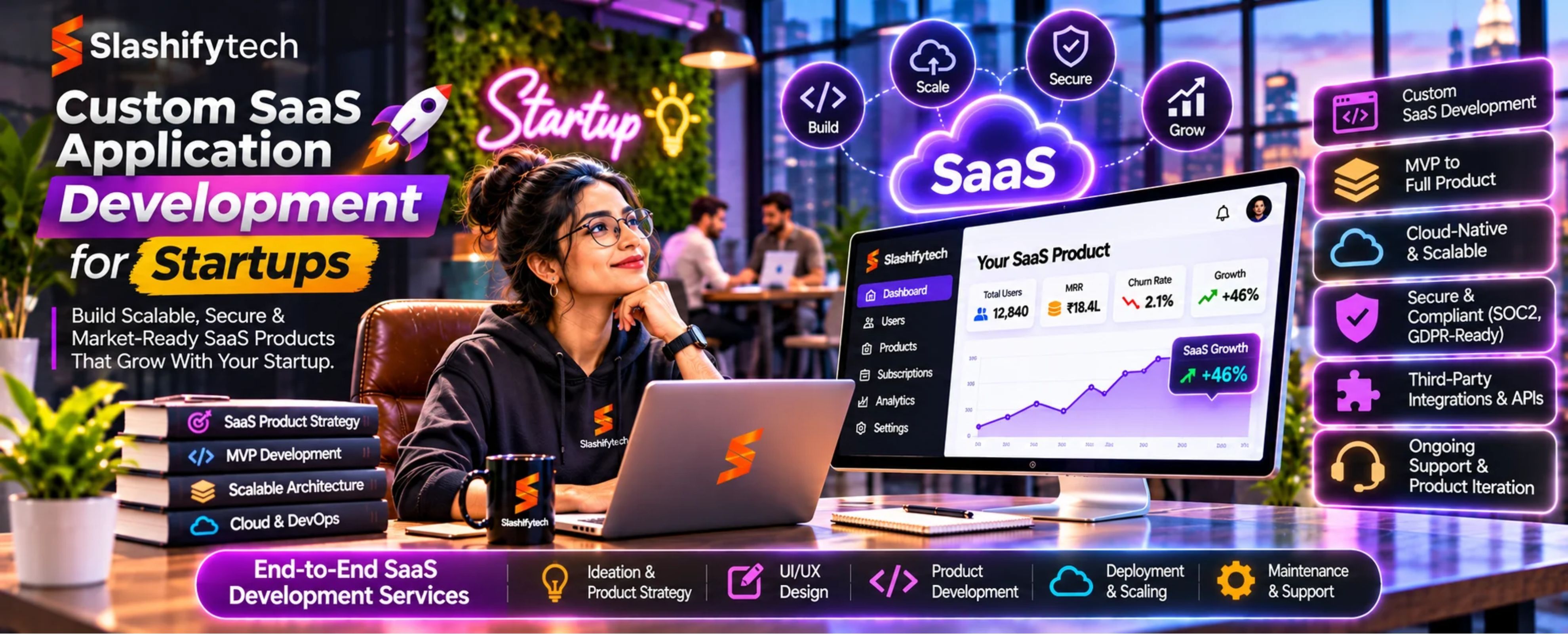
Building a SaaS product is more than developing an application and putting it online. You need a product architecture that supports multiple customers, protects business data, manages subscriptions, handles integrations, and evolves as your startup grows.
At SlashifyTech, we provide Custom SaaS Application Development for Startups looking to turn business ideas into functional, scalable software products. Whether you are validating your first SaaS concept, preparing to launch an MVP, developing a B2B subscription platform, or modernising an existing application, we help you plan, design, develop, test, and launch your product.
We approach SaaS development from both a product and engineering perspective. Instead of building features without understanding the business model, we first consider your target customers, core workflows, revenue model, technical requirements, and long-term product direction.
Our goal is to help you build software that solves a genuine customer problem while creating a technical foundation that can support future product development.
Have a SaaS product idea? Let's discuss what it takes to turn it into a working application.
Why Startups Need Custom SaaS Application Development for Startups
Startups often begin with an idea that addresses a specific problem in an industry. However, turning that idea into a software product requires more than a basic website, dashboard, or collection of features.
You need an application that customers can access, use, and potentially pay for through a recurring subscription.
Off-the-shelf software can be useful for managing internal operations, but it may not provide the functionality, flexibility, or ownership required when the software itself is your business.
Custom SaaS Application Development for Startups allows you to create a product around your actual business model.
For example, a startup building a SaaS platform for accounting firms may need separate business accounts, accountant permissions, document management, financial reporting, automated workflows, and subscription-based access.
A generic application may not accommodate all these requirements without significant compromises.
With a custom-built SaaS platform, we can design the product around your specific workflows, customer requirements, and planned revenue model.
What We Help Startups Build
Our custom SaaS development capabilities cover:
- B2B SaaS applications for business customers.
- B2C subscription-based software platforms.
- Industry-specific and vertical SaaS products.
- AI-powered SaaS applications.
- Multi-tenant SaaS platforms.
- SaaS dashboards and business management systems.
- Subscription and billing management applications.
- API-driven SaaS products.
- Compliance-oriented software platforms.
- Existing SaaS application modernisation.
Every product has different requirements. We determine the appropriate architecture and development scope based on what you are building.
Our Custom SaaS Application Development for Startups
We provide development capabilities across the major components of a SaaS product.
1. SaaS MVP Development
You do not need to build every planned feature before introducing your product to potential customers.
A Minimum Viable Product (MVP) focuses on the essential functionality needed to test your product concept and understand how users interact with it.
We help startups identify their core product requirements and translate them into a functional SaaS application.
Our SaaS MVP development can include:
- Product requirement analysis.
- User journey mapping.
- UI/UX design and prototyping.
- User registration and authentication.
- Core application workflows.
- Initial database architecture.
- Essential dashboards.
- Basic subscription functionality where required.
- Testing and deployment.
We focus on defining a manageable initial scope while making important architectural decisions with future product requirements in mind.
2. Custom B2B SaaS Application Development
B2B SaaS products often need to serve several businesses through one centrally managed application.
Each organisation may have its own employees, administrators, permissions, subscription plans, business records, and workflows.
We develop custom B2B SaaS platforms with capabilities such as:
- Organisation-based accounts.
- Multi-tenant architecture.
- Tenant-level data isolation.
- Role-based access control.
- Employee and team management.
- Business dashboards.
- Subscription management.
- Customer onboarding.
- Reporting and analytics.
- Third-party integrations.
For example, a startup building software for multiple accounting firms may need each firm to access its own customers, documents, employees, and financial workflows without accessing another organisation's information.
The application architecture must support these requirements from the beginning.
3. Multi-Tenant SaaS Application Development
Multi-tenancy allows multiple customer organisations to use the same SaaS platform while maintaining appropriate separation of their information and permissions.
It is an important architectural consideration for subscription-based products serving multiple customers.
We design multi-tenant applications around:
- Tenant identification.
- Tenant-specific configurations.
- Data isolation.
- Organisation-level permissions.
- User roles and access policies.
- Subscription-based feature access.
- Tenant-level reporting.
- Application performance.
- Secure database queries.
Depending on the product, we evaluate shared database schemas, separate schemas, or dedicated databases for different tenants.
The appropriate approach depends on data sensitivity, compliance requirements, infrastructure costs, and expected application usage.
4. AI-Powered SaaS Application Development
AI can become an important part of a SaaS product when it directly improves the functionality customers are paying for.
We help startups incorporate AI capabilities into application workflows rather than treating AI as an unrelated add-on.
Potential applications include:
- AI-powered customer support.
- Intelligent document processing.
- Automated business reporting.
- Natural-language search.
- AI assistants.
- Workflow automation.
- Data classification.
- Recommendation systems.
- AI-powered analytics.
- LLM-based application features.
We can integrate suitable AI models and APIs depending on your product requirements.
For AI-enabled SaaS applications, we also consider access permissions, data handling, model costs, response reliability, and the security of information shared with external AI services.
5. SaaS Backend and API Development
A SaaS application's backend controls much of its core functionality.
It manages application data, user authentication, business logic, integrations, subscription events, and communication between different application components.
Our backend development capabilities include:
- REST API development.
- GraphQL API development.
- Authentication and authorisation.
- Database architecture.
- Webhook integrations.
- API security.
- Business logic implementation.
- Background processing.
- Third-party integrations.
- Application monitoring.
We design backend systems according to the product's functional and operational requirements.
6. SaaS Subscription and Payment Integration
A subscription-based application needs more than a payment checkout page.
It must understand the complete subscription lifecycle, including trials, payments, renewals, upgrades, downgrades, failed transactions, cancellations, and account access.
We can integrate suitable payment and subscription platforms, including:
- Razorpay.
- Stripe.
- Chargebee.
- Other relevant payment APIs.
Depending on the business model, the application can support monthly or annual plans, usage-based billing, per-user subscriptions, feature-based access, and subscription administration.
The objective is to connect payment activity with the actual application permissions and customer account status.
7. SaaS Application Modernisation and Scaling
Some startups begin with a basic application and later discover that their original architecture cannot support increasing product requirements.
You may experience difficulties introducing new features, managing customer data, integrating external services, or supporting additional users.
We help evaluate existing SaaS applications and plan improvements such as:
- Backend modernisation.
- Database optimisation.
- Single-tenant to multi-tenant migration.
- API restructuring.
- Security improvements.
- Cloud infrastructure improvements.
- Performance optimisation.
- Legacy code modernisation.
- Integration upgrades.
We assess the existing application before recommending architectural changes, so that necessary functionality and customer data remain part of the migration plan.
What Features Should a Startup SaaS Application Include?
The right feature set depends on the problem your product solves and the customers who will use it.
However, many SaaS applications require a combination of the following capabilities.
| Feature | Business purpose |
|---|---|
| User registration | Allows customers to create accounts |
| Authentication | Controls secure application access |
| Organisation management | Separates business customers |
| Role-based permissions | Controls access to features and information |
| Admin dashboard | Manages application operations |
| Customer dashboard | Gives users access to relevant functionality |
| Subscription management | Controls plans and billing |
| Payment integration | Processes customer payments |
| Notifications | Communicates important account events |
| Analytics | Helps understand product usage |
| API integrations | Connects external business systems |
| Audit logs | Records important application activities |
| Data management | Organises and protects application records |
We do not recommend implementing every feature in the first release.
Instead, we identify which capabilities are necessary for launch, which can be introduced after customer feedback, and which architectural foundations should be planned early.
Our SaaS Technology Stack
Technology selection depends on the application's complexity, performance requirements, integration needs, security considerations, and future development plans.
Our published SaaS development technology approach includes the following options.
| Development layer | Technologies |
|---|---|
| Frontend | React, Next.js |
| Backend | Node.js, Django, Laravel |
| Database | PostgreSQL, MongoDB |
| Cloud infrastructure | AWS, Google Cloud |
| API architecture | REST, GraphQL |
| Authentication | JWT, OAuth, SAML |
| Payment integrations | Razorpay, Stripe, Chargebee |
| AI integrations | OpenAI, Anthropic, Hugging Face |
We select technologies based on the requirements of your product rather than using the same architecture for every startup.
Our Custom SaaS Development Process
A successful SaaS application requires a structured development process. We organise the work around product understanding, technical planning, implementation, testing, and launch.
Step 1: Product Discovery and Consultation
We begin by understanding your product idea, target audience, industry, business model, and the problem you want to solve.
We discuss:
- Who will use the application?
- What problem does it solve?
- What makes the product different?
- Will customers pay through subscriptions?
- Does the application need multiple organisations?
- What integrations are required?
- What functionality is essential for the first release?
This discussion helps establish the project's initial scope.
Step 2: Requirements and Technical Planning
Once we understand the product, we translate the requirements into a development roadmap.
This may include feature prioritisation, user roles, database planning, application architecture, integration requirements, and infrastructure decisions.
We also identify potential technical dependencies before development begins.
Step 3: UI/UX Design and Prototyping
We design the application's interface around the intended user experience.
This includes navigation, dashboards, onboarding flows, account management, and the primary product workflows.
Prototypes help clarify how users will interact with the application before full development begins.
Step 4: SaaS Application Development
Our development team implements the frontend, backend, database, APIs, authentication, and other agreed functionality.
Depending on the requirements, this stage can also include multi-tenant architecture, subscription management, AI integrations, and third-party business systems.
Step 5: Quality Assurance and Security Testing
Before deployment, we test the application to identify functional and technical issues.
Testing can include:
- Functional testing.
- API testing.
- Authentication testing.
- Permission testing.
- Tenant isolation testing.
- Integration testing.
- Performance testing.
- Responsive testing.
- Security checks.
Step 6: Deployment and Launch
After testing and final review, we prepare the application for production deployment.
This includes the required infrastructure configuration, environment setup, deployment, and launch checks.
Step 7: Post-Launch Support and Improvements
Launching the application is the beginning of its product lifecycle.
We can support ongoing maintenance, security updates, performance improvements, integration maintenance, and additional feature development.
Our focus is to help your product remain maintainable as customer requirements evolve.
How Much Does Custom SaaS Application Development for Startups Cost in India?
The cost of developing a custom SaaS application depends on what you are building.
A product with a small number of core workflows will have different requirements from a complex multi-tenant platform with enterprise permissions, AI functionality, external integrations, and compliance requirements.
At SlashifyTech, our published SaaS development pricing is structured around the following project ranges:
| SaaS project type | Indicative development cost |
|---|---|
| Focused SaaS MVP | ₹15 lakh-₹40 lakh |
| Full B2B SaaS platform | ₹40 lakh-₹80 lakh |
| Complex compliance-driven or AI-native SaaS | ₹80 lakh-₹1.5 crore+ |
These are indicative ranges, not fixed quotations. The final estimate depends on functionality, design complexity, architecture, integrations, infrastructure, testing, and support requirements.
What Influences SaaS Development Costs?
| Cost factor | Why it matters |
|---|---|
| Product complexity | More workflows, modules, and user roles generally require additional development effort. |
| Multi-tenant architecture | Tenant isolation, organisation management, and tenant-specific configurations affect architectural complexity. |
| Third-party integrations | Payment gateways, CRMs, ERPs, external APIs, and AI services can add implementation and testing requirements. |
| Security and compliance | Products handling sensitive or regulated information may require additional access controls, auditability, and security measures. |
| UI/UX requirements | Custom dashboards, specialised workflows, and complex user experiences influence design and development effort. |
| Infrastructure | Cloud services, storage, monitoring, backups, and expected application usage affect ongoing operating costs. |
We recommend discussing the product requirements before deciding on a final development budget.
SaaS Applications We Have Worked On
Our portfolio includes business applications across financial technology, compliance, education, employee management, and other digital product categories.
Some relevant examples include:
IDSSPL - Financial Technology and Reconciliation Systems
A financial technology application associated with reconciliation workflows.
This project is relevant to businesses evaluating software for structured financial operations and business data management.
Online Filing India - Legal, Compliance and Business Services
An application in the legal, compliance, and business services category.
It is relevant to discussions around digital business processes, compliance-related workflows, and application functionality.
Shivorix Overseas Portal - Education Application
A B2B and B2C web application for students and agents in the overseas education sector.
Brand Monkey - Employee Management System
A B2B web application in the employee management category.
These projects demonstrate application development experience across different business requirements. They should not be interpreted as proof that every project was delivered as a subscription-based SaaS product.
You can explore our project portfolio to understand the applications and solutions we have worked on.
Why Choose SlashifyTech for Custom SaaS Development?
Choosing a SaaS development partner is an important decision because the technical team will influence how your product is structured, developed, and maintained.
At SlashifyTech, we approach software development with an emphasis on business requirements, technical planning, and long-term product usability.
Product-Focused Development
We begin by understanding the business problem and the people who will use your product. This helps us prioritise functionality according to actual product requirements.
Architecture Planned Around Your Business Model
We consider multi-tenancy, user permissions, billing, integrations, and application data requirements during the planning stage.
Development Across Multiple Technology Layers
Our capabilities cover frontend development, backend systems, databases, APIs, cloud infrastructure, application integrations, and AI functionality.
Security-Conscious Engineering
We consider authentication, access permissions, data handling, and auditability as part of the development process. SlashifyTech also publishes ISO/IEC 27001:2022 and ISO 9001:2015 certification information.
Communication Throughout Development
We involve clients in requirements discussions, development reviews, and project updates to maintain clarity about the work being delivered.
Support Beyond Initial Deployment
We can assist with maintenance, technical improvements, and additional product development after launch.
Frequently Asked Questions
1. What is Custom SaaS Application Development for Startups?
Custom SaaS Application Development for Startups is the process of designing and building subscription-based software products around a startup's specific business idea, target customers, and functional requirements.
It can include MVP development, multi-tenant architecture, authentication, dashboards, subscription billing, APIs, integrations, cloud infrastructure, and ongoing maintenance.
2. How much does it cost to build a SaaS application in India?
The cost depends on the product's complexity and technical requirements. At SlashifyTech, published indicative pricing ranges from ₹15 lakh to ₹40 lakh for a focused SaaS MVP, ₹40 lakh to ₹80 lakh for a full B2B SaaS platform, and ₹80 lakh to ₹1.5 crore or more for complex AI-native or compliance-driven platforms.
A detailed estimate requires an assessment of the product scope.
3. How long does it take to develop a custom SaaS application?
A focused SaaS MVP typically takes around four to six months. A full-featured B2B SaaS application may require six to nine months, while complex compliance-driven or AI-native platforms can take nine to twelve months or longer.
Actual timelines depend on scope, integrations, architecture, testing, and project dependencies.
4. Can you develop a SaaS MVP for an early-stage startup?
Yes. We can help define the initial product scope, design the application, implement essential features, and prepare the MVP for launch.
The first release should focus on validating the core product proposition rather than implementing every planned feature.
5. What is the difference between custom SaaS and ready-made SaaS software?
Ready-made SaaS is an existing product that businesses subscribe to and use. Custom SaaS development creates a new software product that your business owns and operates for its customers.
If you want to build and sell your own software platform, custom SaaS development may be appropriate.
6. What is multi-tenant SaaS architecture?
Multi-tenant architecture allows multiple customer organisations to use one software platform while keeping their information and permissions appropriately separated.
It is commonly used in B2B SaaS products where several businesses access the same application.
7. Can you integrate payment gateways into a SaaS application?
Yes. We can integrate payment services such as Razorpay, Stripe, and Chargebee, depending on the application and business requirements.
The integration can support subscription creation, renewals, payment events, plan changes, and related account permissions.
8. Can AI features be included in a custom SaaS application?
Yes. AI functionality can include intelligent search, document processing, AI assistants, automated reporting, recommendations, and workflow automation.
The right implementation depends on your product's use cases, data architecture, security requirements, and operating costs.
9. Which technologies are suitable for developing a SaaS product?
React or Next.js can be used for frontend development, while Node.js, Django, or Laravel can support backend development. PostgreSQL and MongoDB are database options, and AWS or Google Cloud can provide infrastructure.
The appropriate combination depends on your application's requirements.
10. Do you provide SaaS application maintenance after launch?
Yes. We offer ongoing maintenance options that can include monitoring, security patching, dependency updates, performance optimisation, API maintenance, and additional feature development.
11. Can an existing application be converted into a multi-tenant SaaS platform?
Yes, depending on its existing architecture. The process may involve redesigning the data model, implementing tenant identification, introducing data isolation, modifying permissions, and migrating existing customer information.
A technical assessment is necessary before determining the migration approach.
12. How do I start a custom SaaS development project with SlashifyTech?
You can contact SlashifyTech with your product idea, target audience, essential features, and expected business model.
We can discuss the requirements, identify the development scope, and evaluate the appropriate technical approach before preparing a project estimate.
Build Your SaaS Product with SlashifyTech
A strong SaaS product starts with a clear understanding of the problem it needs to solve and the customers who will use it.
Whether you are planning your first MVP, developing a B2B subscription platform, or expanding an existing application, we can help you evaluate the product requirements and plan the development process.
At SlashifyTech, we focus on building custom software around real business requirements, with attention to application architecture, functionality, security, and long-term maintainability.
Have an idea for your next SaaS product? Let's discuss the requirements and turn your concept into a development roadmap.


