


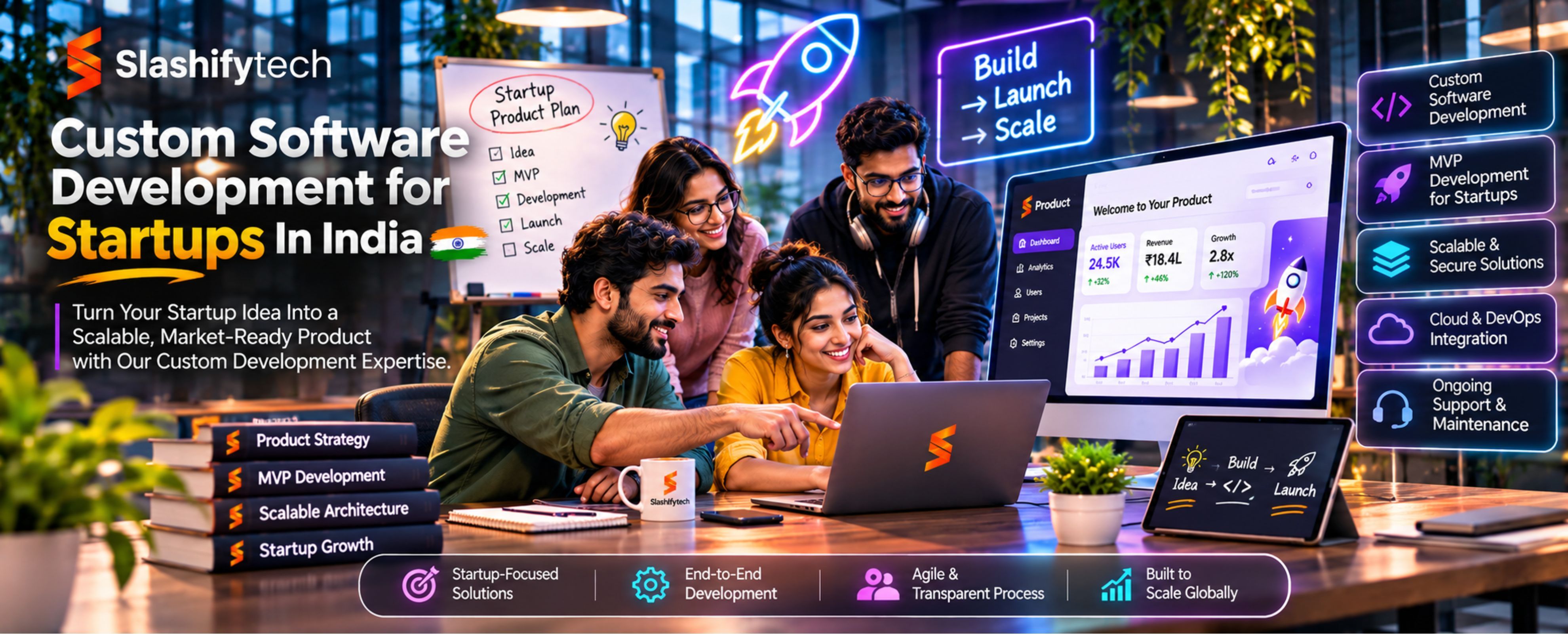
Building a startup requires more than a promising idea. You need technology that helps you turn that idea into a functional product, reach your target customers, manage operations and grow without constantly running into technical limitations.
At SlashifyTech, we provide Custom Software Development For Startups In India, helping founders transform business concepts into practical digital products. Whether you are validating an early-stage idea, preparing to launch a Minimum Viable Product (MVP), developing a SaaS platform or improving an existing application, we build software around your actual business requirements.
Our approach focuses on understanding your product vision, identifying essential functionality, selecting suitable technologies and developing software that supports your immediate objectives while allowing room for future expansion.
From startup MVP development and custom web applications to mobile apps, SaaS platforms and AI-powered automation, we help businesses build technology that serves real users and solves real problems.
Have a startup idea you want to turn into software?
Discuss your requirements with our development team and explore a practical approach to building your product.
A Technology Development Partner for Startups at Every Stage
Every startup has different technical requirements depending on its business model, funding position, target audience and product maturity.
An early-stage founder may need a working MVP to validate an idea. A growing startup might require a customer-facing application with multiple user roles, payment functionality and administrative controls. An established startup may need to replace disconnected tools with a unified software platform.
Choosing the right development approach at each stage can help avoid unnecessary development costs and technical complications.
SlashifyTech works across different startup development requirements, including:
- Idea-stage startups: Turn a business concept into a defined software product with clear functionality and technical direction.
- Pre-seed and seed-stage startups: Develop MVPs that allow founders to introduce their products and collect feedback from actual users.
- Growing startups: Improve existing applications, introduce new features and strengthen application architecture.
- Funded startups: Build more comprehensive digital products with advanced functionality, integrations and scalable infrastructure.
- Product-based startups: Develop SaaS applications, subscription platforms, marketplaces and other software products.
- Service-based startups: Build booking systems, customer portals, workflow applications and business management platforms.
The objective is not to build the largest possible application. It is to develop the right product for your current stage and business priorities.
Our Custom Software Development For Startups In India
Startups rarely need a single isolated technology solution. Their requirements often involve several connected components, from customer-facing applications to backend systems, integrations and automation.
We provide different software development services based on the type of product you want to build.
1. Startup MVP Development
An MVP helps you introduce the core version of your product without investing in every feature planned for its future development.
Instead of developing an extensive application immediately, we help define the essential functionality required to test your business concept.
Our startup MVP development approach can include:
- Product requirement analysis.
- Core feature identification.
- User journey planning.
- UI/UX design and prototyping.
- Front-end and backend development.
- User registration and authentication.
- Admin dashboard development.
- Payment gateway integration.
- Database architecture.
- Application testing and deployment.
For example, a startup planning to launch an online service marketplace may initially need customer registration, service listings, booking functionality, payment processing and an administrative dashboard.
Advanced recommendation engines, complex loyalty programmes and extensive automation can be considered in later development phases.
This phased approach helps founders focus on validating the product before expanding its functionality.
2. Custom SaaS Development for Startups
If your startup plans to sell software through subscriptions, a custom SaaS application may be the right solution.
We develop SaaS products around your business model, user requirements and operational workflows.
Our SaaS development capabilities include:
- Subscription-based applications.
- Multi-user software platforms.
- Role-based access management.
- Customer dashboards.
- Subscription and billing integrations.
- Admin panels.
- API integrations.
- Data management systems.
- Reporting and analytics.
- Scalable application architecture.
For example, a startup developing a project management SaaS platform may require separate workspaces, team invitations, task management, subscription plans, permissions and reporting functionality.
The architecture should account for how customers, data and subscriptions will be managed as the product grows.
Explore our custom SaaS development services.
3. Custom Web Application Development
A startup may need more than a conventional website. It may require an interactive application where users can log in, manage information, complete transactions or interact with other users.
We develop custom web applications designed around specific product requirements.
These applications can include:
- Customer portals.
- Business management applications.
- Online booking platforms.
- Marketplace applications.
- Educational portals.
- CRM applications.
- Employee management systems.
- Financial and reporting dashboards.
- Workflow management platforms.
The frontend, backend, database and third-party integrations are planned according to the application's functionality and expected usage.
Explore our web application development services.
4. Custom Mobile App Development
For startups targeting mobile-first customers, a dedicated mobile application can become an important part of the product experience.
We help develop mobile applications with functionality suited to the intended audience and business model.
Depending on project requirements, development may include:
- Android application development.
- iOS application development.
- Cross-platform mobile applications.
- User authentication.
- Push notifications.
- In-app payments.
- User profiles.
- Real-time updates.
- API integrations.
- Admin dashboards.
The right development approach depends on your target devices, performance requirements, budget and long-term product roadmap.
5. AI Integration and Business Automation
Startups often operate with limited teams and resources. Repetitive manual tasks can consume time that founders and employees could otherwise spend on product development and customer acquisition.
AI integration and workflow automation can help address specific operational challenges.
Potential solutions include:
- AI-powered customer support assistants.
- AI voice agents.
- Automated lead management.
- CRM workflow automation.
- Intelligent document processing.
- Automated reporting.
- Customer enquiry classification.
- API-based workflow connections.
We evaluate automation opportunities according to their practical value rather than adding AI features simply because they are trending.
Explore our AI agents and automation services.
6. Custom CRM and Business Management Software
When startups begin acquiring more customers, managing operations through spreadsheets and disconnected applications can become difficult.
Custom business software can bring essential workflows into one system.
Depending on your requirements, we can develop:
- Customer relationship management systems.
- Lead management platforms.
- Employee management applications.
- Internal administration portals.
- Inventory management systems.
- Sales tracking dashboards.
- Business reporting applications.
- Custom approval workflows.
The system can be designed around your actual business processes rather than forcing your team to adjust to the limitations of a generic application.
What Types of Startup Products Can We Build?
Different business models require different software architectures and functionality.
Here are some examples of digital products that startups may need.
| Startup business model | Possible software solution |
|---|---|
| SaaS startup | Subscription-based software platform |
| EdTech startup | Learning management system and student portal |
| FinTech startup | Financial dashboards and transaction management applications |
| Healthcare startup | Appointment and patient management platforms |
| Marketplace startup | Buyer, seller and administrator applications |
| E-commerce startup | Custom online shopping platform |
| HRTech startup | Recruitment and employee management software |
| Real estate startup | Property listing and management platform |
| Logistics startup | Shipment tracking and operations software |
| Service startup | Booking, scheduling and customer management systems |
The final functionality and technology stack depend on the startup's requirements, compliance considerations and operational model.
Why Startups Choose Custom Software Instead of Ready-Made Solutions
Ready-made software can be a sensible starting point when your requirements are standard. However, it may become restrictive when your product depends on unique workflows, specialised functionality or a differentiated customer experience.
Custom Software Development For Startups In India allows you to build around your own business requirements.
Software designed around your business model
You can define how customers interact with your platform, how information is processed and how internal workflows operate.
Control over product functionality
You can prioritise the features that matter to your users instead of relying entirely on the functionality available in an existing product.
Flexibility to introduce new features
As customer requirements change, your application can be extended with additional modules, integrations and capabilities.
Integration with existing tools
Custom applications can connect with suitable third-party services, including payment gateways, communication platforms, analytics tools and business systems.
Greater control over product development
You can plan your product roadmap, technical improvements and future development according to your business priorities.
Architecture based on future requirements
A properly planned architecture can accommodate additional users, new functionality and increasing operational complexity.
Custom development is not automatically the best option for every startup. If a standard product already solves your problem effectively, using it may be more economical. Custom development makes more sense when your business requirements justify the additional investment.
Our Startup Software Development Process
A structured development process helps founders understand what is being built, why particular features are necessary and how the project moves from planning to deployment.
At SlashifyTech, our development approach follows these stages.
Step 1: Discovery and Product Consultation
We begin by understanding your startup idea, business model, target audience and product objectives.
We discuss:
- What problem does your product solve?
- Who will use the application?
- What are the primary user journeys?
- Which features are essential for launch?
- What integrations are required?
- What are your budget and timeline expectations?
This stage helps establish a clearer direction before development begins.
Step 2: Requirements Analysis and Planning
Once the product requirements are understood, we organise them into functional components.
This includes identifying user roles, application modules, backend requirements, database needs and external integrations.
We also distinguish between launch-critical features and functionality that can be introduced later.
Step 3: UI/UX Design and Prototyping
The design process focuses on creating an understandable and practical user experience.
Depending on the project, this can include:
- Application wireframes.
- User flow diagrams.
- Interface design.
- Interactive prototypes.
- Dashboard layouts.
- Mobile-responsive screens.
The purpose is to establish how users will interact with the application before full development.
Step 4: Software Architecture and Development
After planning and design, the development team implements the application.
This stage may involve frontend development, backend programming, database configuration, authentication, business logic and API integration.
The technology stack is selected according to the product's functionality and technical requirements.
Step 5: Integration and Quality Testing
Before deployment, the application needs to be tested across its important workflows.
Testing can cover:
- Functional correctness.
- User authentication.
- Form validation.
- Payment workflows.
- API responses.
- Database operations.
- User permissions.
- Mobile responsiveness.
- Error handling.
- Application performance.
The scope of testing depends on the complexity and risk profile of the product.
Step 6: Deployment and Launch
Once the application is ready, it can be deployed to the selected hosting or cloud environment.
This stage includes the necessary configuration, deployment checks and launch preparation.
Step 7: Maintenance and Product Improvements
Software development does not end when the product goes live.
After launch, startups may need bug fixes, technical updates, new features, integration changes and performance improvements.
We can discuss ongoing development and support requirements according to the project.
Technology Stack for Startup Software Development
The technology stack affects application performance, development flexibility, maintenance requirements and future expansion.
There is no single technology stack that works best for every startup. The selection should depend on the product's complexity, expected users, integrations and development objectives.
Our website showcases technologies including React, Next.js, Node.js, AWS, MongoDB, PostgreSQL and .NET.
Launch & Scale Faster
Frontend development
React, Next.js and other suitable frontend technologies for responsive interfaces, dashboards and interactive applications.
Backend development
Node.js and .NET for application logic, APIs, authentication and server-side functionality.
Database management
PostgreSQL and MongoDB, selected according to data structures, application requirements and query patterns.
Cloud infrastructure
AWS and suitable hosting infrastructure for application deployment, storage and operational requirements.
Third-party integrations
Payment services, communication APIs, analytics platforms and other external systems based on project requirements.
The final architecture should be documented before implementation so that future developers can understand, maintain and extend the product.
How Much Does Custom Software Development For Startups In India?
The cost of Custom Software Development For Startups In India depends on what you want to build, how complex the application is and which features are necessary for the initial release.
A simple business application with a limited number of user roles will have different development requirements from a multi-tenant SaaS platform with subscription billing, advanced reporting and multiple external integrations.
At SlashifyTech, the existing service page lists the following starting prices:
| Software development project | Published starting price |
|---|---|
| Startup MVP development | ₹3,00,000 |
| Full SaaS application development | ₹12,00,000 |
These are the starting prices displayed on our website, not universal market rates or guaranteed quotations.
The final project estimate depends on several factors.
| Cost factor | Why it matters |
|---|---|
| 1. Number of features | More application modules, workflows and user interactions generally require additional development. |
| 2. Application complexity | Advanced business logic, real-time functionality and specialised requirements can increase development effort. |
| 3. User roles and permissions | Applications with customers, administrators, vendors, employees and managers may require more extensive access-control systems. |
| 4. Third-party integrations | Payment gateways, CRM systems, ERP platforms and external APIs introduce additional implementation and testing requirements. |
| 5. Platform requirements | Developing a web application, Android app, iOS app or multiple connected platforms affects the overall scope. |
| 6. Security and compliance | Products handling sensitive information or operating in regulated industries may require additional security and compliance work. |
| 7. Maintenance requirements | Hosting, monitoring, updates and ongoing development should also be considered when planning the total software investment. |
How to plan your startup software budget
Rather than spending your entire budget on an extensive first release, identify the functionality necessary to test your product with real users.
For example, a marketplace startup could initially focus on:
- Customer registration.
- Seller registration.
- Product or service listings.
- Search functionality.
- Booking or ordering.
- Payment integration.
- Basic administration.
Additional capabilities, such as advanced analytics, automated recommendations and complex reporting, can be introduced after validating the initial product.
Request a project-specific estimate from SlashifyTech based on your requirements, preferred features and development priorities.
Real Software Products and Projects Developed by SlashifyTech
When selecting a software development partner, startup founders should examine the types of applications the company has actually built.
A portfolio provides insight into the company's exposure to different application models, user requirements and business workflows.
SlashifyTech showcases several projects across different industries and product categories.
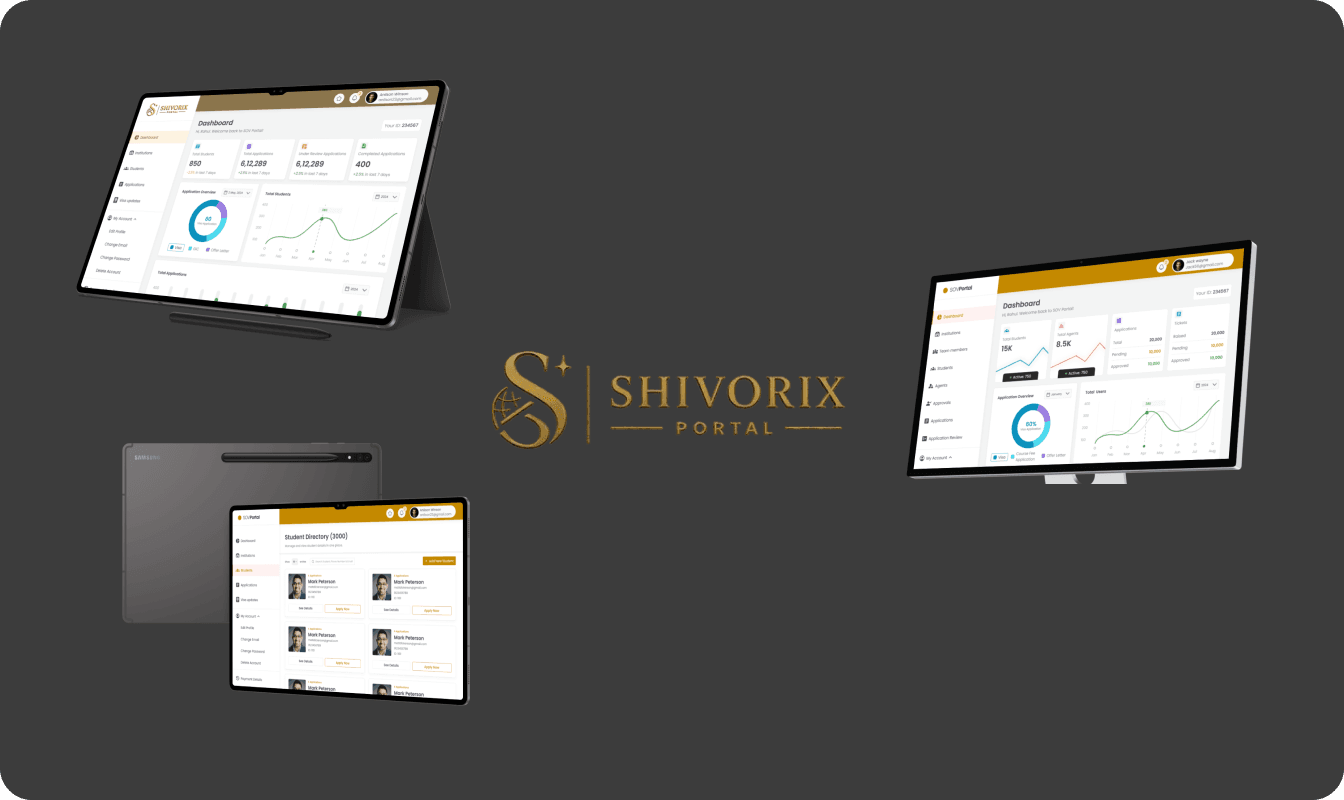
Shivorix Overseas Portal
An EdTech portal for students and agents, presented as a B2B and B2C web application.

Wise Talk
A career guidance application presented in the company's portfolio as a B2C mobile application.

Brand Monkey
An employee management system presented as a B2B web application.

IDSSPL
A financial technology and reconciliation system presented as a B2C web application.

MG Portal - Raam Group
An automotive and warranty management application presented as a B2B web application.

Connecting Soulmate
A matrimony application represented in both web and mobile product categories.
These examples demonstrate the range of application categories represented in the SlashifyTech portfolio.
Launch & Scale Faster
Explore the SlashifyTech project portfolio to review the available work.
Custom Software Development For Startups In India vs Ready-Made Software for Startups
Before investing in development, founders should understand the difference between purchasing existing software and building a customized solution.
| Decision factor | Ready-made software | Custom software |
|---|---|---|
| Initial setup | Usually faster | Requires planning and development |
| Functionality | Based on available features | Designed around requirements |
| Custom workflows | May have limitations | Can be developed specifically |
| Integrations | Depends on available options | Can be developed for required systems |
| Initial investment | Often lower | Generally higher |
| Product ownership | Governed by vendor terms | Depends on agreed IP and ownership terms |
| Future development | Depends on vendor roadmap | Controlled through your development roadmap |
| Best suited for | Standard business requirements | Differentiated product requirements |
When should a startup choose custom software?
Consider custom development when:
- Your product requires functionality unavailable in existing platforms.
- Your business model depends on specialised workflows.
- You want to develop a SaaS product for paying customers.
- You need multiple applications connected through a central system.
- Existing software creates operational limitations.
- You need greater control over your product roadmap.
If your requirements are straightforward, start by evaluating existing tools. The decision should be based on actual business needs rather than choosing custom development by default.
What Should Startups Check Before Hiring a Software Development Company in India?
Choosing a software development partner is an important decision because the quality of the initial technical implementation can affect future product development.
Before selecting a company, evaluate the following factors.
Relevant development experience
Look for projects that demonstrate experience with similar application types, workflows or technical requirements.
Understanding of startup requirements
Your development partner should understand MVP planning, feature prioritisation and the importance of validating a product before expanding its functionality.
Technical architecture
Ask how the application will be structured, how data will be managed and how future functionality can be introduced.
Development communication
Establish how requirements, milestones, progress updates and technical decisions will be communicated.
Testing and quality assurance
Understand the testing process, how bugs are handled and what happens before deployment.
Intellectual property and source code ownership
Clarify who owns the source code, designs, documentation and other project deliverables. These terms should be explicitly documented in the agreement.
Post-launch support
Discuss maintenance, hosting responsibilities, security updates, bug fixes and future development arrangements.
Transparent project estimation
A professional development partner should explain what is included in the quotation, which requirements may increase costs and what assumptions the estimate is based on.
The objective is to find a development partner who understands both the technical and commercial aspects of your product.
Why Choose SlashifyTech for Custom Software Development For Startups In India?
Selecting a development company is not simply about finding someone who can write code. You need a team that can understand your requirements and translate them into a working digital product.
SlashifyTech presents itself as a software development partner offering solutions across web applications, mobile applications, SaaS development, AI automation and eCommerce.
Reasons to consider SlashifyTech include:
- Multiple development capabilities: Access to different software development services through one technology partner.
- Startup-focused product development: Development paths covering MVPs and more comprehensive SaaS applications.
- Custom functionality: Software designed around specific business requirements.
- Integration capabilities: Connections with suitable third-party platforms and APIs.
- Different application categories: Portfolio examples spanning education, career guidance, employee management, matrimony and financial technology.
- Defined development process: Discovery, planning, design, development, testing, launch and ongoing support.
- Project-specific pricing: Published starting prices for MVP and full SaaS development, with final estimates based on scope.
Our objective is to help founders move from an initial product concept towards a functional software solution with a development approach aligned with their business goals.
Have a product idea or an existing application that needs improvement? Let's discuss what you want to build.
Let's Build Your Startup Software Product with SlashifyTech
A successful software product starts with a clear understanding of the problem it needs to solve.
Whether you are a first-time founder validating a new business idea, a funded startup preparing to launch a SaaS platform or an established company developing a specialised application, having the right technical foundation matters.
At SlashifyTech, we provide Custom Software Development For Startups In India, covering MVP development, SaaS applications, web applications, mobile software, business management systems and AI-powered automation.
We focus on understanding your requirements, prioritising essential functionality and developing solutions that support your product objectives.
Tell us what you want to build. Let's discuss the technical approach, development scope and next steps for your startup.
Build Your Idea. Launch Your Product. Grow Your Business.
- Website: https://slashifytech.com/
- Custom Software Development: https://slashifytech.com/custom-software-development
- Contact: https://slashifytech.com/
Frequently Asked Questions
1. What is Custom Software Development For Startups In India?
Custom Software Development For Startups In India is the process of designing and building applications specifically around a startup's business model, customer requirements and operational needs. It can include MVPs, SaaS platforms, mobile applications, marketplaces, CRM systems and business automation tools.
2. How much does custom software development cost for startups in India?
The cost depends on application complexity, features, integrations, platforms and development requirements. SlashifyTech currently lists MVP development starting at ₹3 lakh and full SaaS application development starting at ₹12 lakh. A final quotation requires project-specific assessment.
3. Can I build an MVP for my startup before developing the complete product?
Yes. An MVP focuses on the essential features needed to introduce your product and validate its core business idea. Additional functionality can be developed after collecting feedback from actual users.
4. How long does it take to develop custom software for a startup?
The timeline depends on the application's scope and complexity. A focused MVP generally requires less development effort than a multi-module SaaS platform or enterprise application. Discovery, design, development, integration and testing should all be considered when estimating delivery.
5. Can SlashifyTech develop software from an idea?
Yes. SlashifyTech offers discovery and consultation, planning, design and development services. Founders can discuss their product idea, target audience, required functionality and technical objectives before finalising the development scope.
6. What types of applications can a startup develop with custom software?
Startups can develop SaaS platforms, mobile applications, web applications, marketplaces, CRM systems, booking platforms, educational portals, financial applications and workflow management systems.
7. Can custom startup software integrate with payment gateways and third-party APIs?
Yes. Applications can be developed with suitable payment gateway integrations, communication APIs, CRM platforms, analytics tools and other third-party services, depending on their technical compatibility and project requirements.
8. Is custom software better than ready-made software for startups?
Not always. Ready-made software is often suitable for standard requirements, while custom software is useful when a startup needs specialised functionality, unique workflows, greater product control or a differentiated customer experience.
9. Can my startup's software be expanded as the business grows?
Yes. Software architecture can be planned to accommodate additional features, user roles, integrations and increased application requirements. Scalability depends on the architecture, infrastructure and quality of implementation.
10. Does SlashifyTech provide SaaS development services for startups?
Yes. SlashifyTech offers SaaS application development, including subscription-based platforms, multi-user applications, dashboards, integrations and other product functionality.
11. Who owns the source code after Custom Software Development For Startups In India?
Source code ownership depends on the contractual agreement between the startup and development company. Startups should clarify intellectual property rights, source code delivery, documentation and third-party licence obligations before starting a project.
12. How can I get started with SlashifyTech?
You can contact SlashifyTech through its website and share your startup idea, required application features, expected budget and development goals. The team can discuss the project requirements and an appropriate development approach.


