


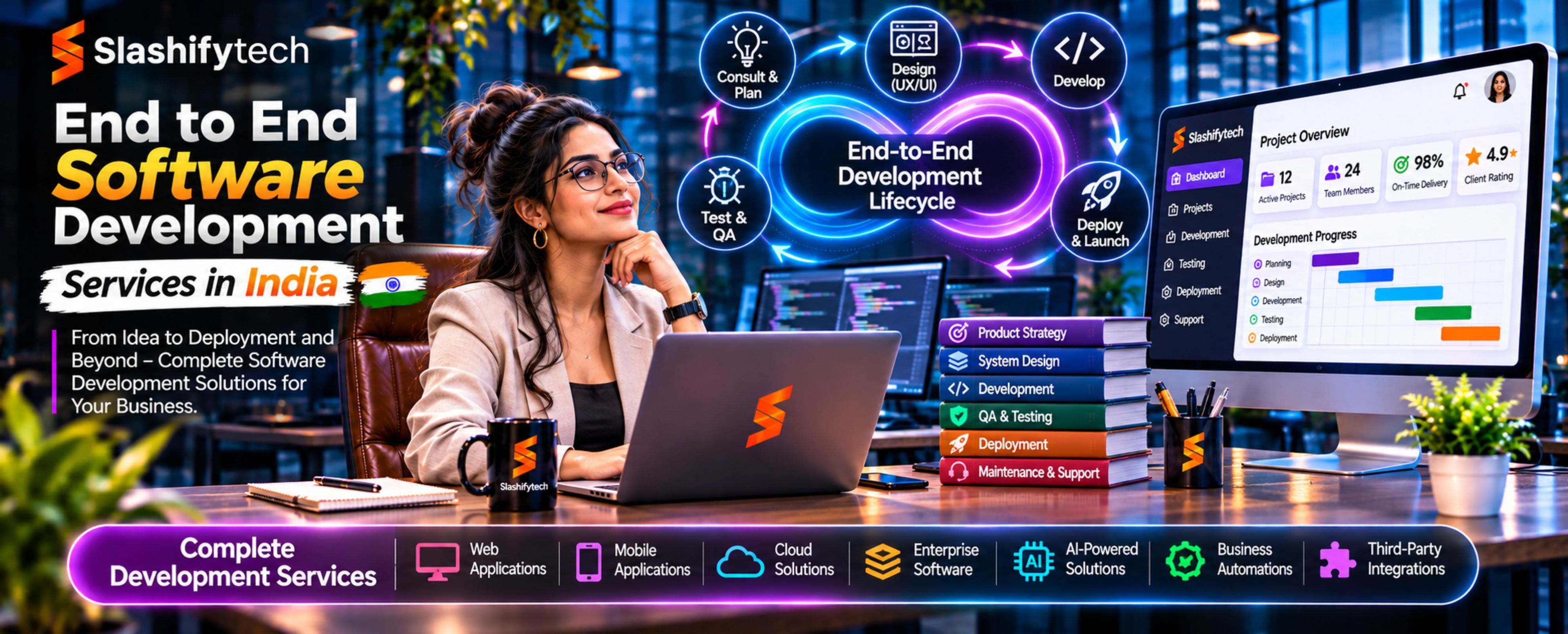
Building successful software requires more than hiring developers and writing code. It requires a clear understanding of business objectives, the right technical architecture, thoughtful product design, reliable development, proper testing and a deployment strategy that supports long-term growth.
At SlashifyTech, we provide End to End Software Development Services in India, helping startups, entrepreneurs, growing businesses and established enterprises transform their ideas and operational requirements into functional digital solutions.
From initial consultation and requirement analysis to UI/UX design, custom software development, web and mobile application development, API integrations, quality assurance, deployment and ongoing support, we help businesses manage the complete software development lifecycle through one technology partner.
Whether you want to develop a custom business application, launch a SaaS platform, build an eCommerce solution, automate business operations, create an AI-powered application or modernise an existing software system, our team can help you identify the right development approach.
We focus on building software around actual business requirements, user expectations and technical objectives rather than offering one-size-fits-all solutions.
Looking for a technology partner who can manage your complete software development journey?
Let's discuss your requirements and plan a solution that supports your business objectives.
Discuss Your Software Development Project
What Are End-to-End Software Development Services?
End-to-end software development services cover the complete process of planning, designing, developing, testing, launching and maintaining a software application.
Instead of coordinating separate companies for design, development, integrations, testing and deployment, businesses can work with one development partner responsible for managing the agreed stages of the project.
A complete software development engagement can include:
- Business requirement analysis.
- Software consultation and technical planning.
- Product architecture and technology selection.
- UI/UX design and prototyping.
- Frontend development.
- Backend development.
- Database development.
- Web and mobile application development.
- API and third-party integrations.
- Quality assurance and software testing.
- Cloud configuration and deployment.
- Post-launch maintenance and improvements.
The exact scope depends on the project.
For example, a startup developing its first SaaS application may require product discovery, MVP development and cloud deployment, while an established business may need a custom management system with multiple user roles, payment integrations and reporting functionality.
At SlashifyTech, we align the development process with the intended application, business model and technical requirements.
Our End-to-End Software Development Services
We offer a range of software development capabilities that help businesses build, launch and improve their digital applications.
1. Custom Software Development
Every business has operational requirements that may not be adequately addressed by ready-made software.
Custom software development allows you to build applications around your specific workflows, users, business rules and functional requirements.
At SlashifyTech, we develop custom software solutions for startups, SMEs and enterprises that require greater control over their digital systems.
Our custom software development capabilities include:
- Custom business applications.
- Enterprise software solutions.
- Customer management systems.
- Employee management applications.
- Administrative dashboards.
- Business process applications.
- Industry-specific software platforms.
- Custom database-driven applications.
- Internal management systems.
- Third-party software integrations.
We first understand your requirements and then plan the application's functionality, architecture and development approach.
Explore our Custom Software Development Services.
2. Web Application Development
Web applications help businesses deliver interactive digital experiences through browsers without requiring users to install traditional desktop software.
We provide custom web application development services for businesses looking to create scalable platforms, customer portals, SaaS applications and internal business systems.
Our web application development capabilities include:
- Custom web application development.
- Enterprise web applications.
- SaaS web platforms.
- Customer and vendor portals.
- Admin dashboards.
- CRM and ERP applications.
- Online marketplaces.
- Booking platforms.
- Progressive web applications.
- API-connected web applications.
We focus on application architecture, responsive interfaces, database management, functionality and integration requirements.
Whether you need a customer-facing platform or a complex internal application, we plan the development around how your users and business will interact with the software.
Explore our Web Application Development Services.
3. Mobile Application Development
Mobile applications allow businesses to deliver their services and digital products directly through smartphones and tablets.
Our mobile application development capabilities cover applications for Android and iOS, with functionality designed around the product's intended users and requirements.
We can develop:
- Business mobile applications.
- Customer-facing mobile applications.
- Startup mobile applications.
- Enterprise mobile applications.
- Education applications.
- Career guidance applications.
- Social applications.
- eCommerce mobile applications.
- Mobile dashboards and management tools.
- API-connected applications.
Depending on the project, development may include user authentication, notifications, payment functionality, dashboards, application APIs and backend connectivity.
We plan the mobile experience around usability, application functionality and the technical requirements of the product.
4. SaaS Application Development
Software as a Service allows businesses to deliver software through online platforms, often using subscription-based business models.
Developing a SaaS application requires careful planning of user management, application architecture, subscriptions, billing, database structures and future product requirements.
Our SaaS development capabilities include:
- Custom SaaS application development.
- B2B SaaS platforms.
- Multi-tenant architecture.
- Subscription management.
- User authentication and permissions.
- Payment and billing integrations.
- Admin dashboards.
- API development.
- Database architecture.
- Cloud-ready applications.
- SaaS MVP development.
We consider how the application will manage users, data, permissions and business functionality as the product evolves.
Whether you are launching a new SaaS product or expanding an existing application, we can help define a development approach aligned with your requirements.
Explore our Custom SaaS Development Services.
5. AI Development and Automation Solutions
Businesses are increasingly exploring artificial intelligence to improve workflows, introduce intelligent application functionality and reduce repetitive operational tasks.
SlashifyTech offers AI automation and voice agent development capabilities that can be integrated into suitable business applications.
Our AI-related development capabilities include:
- AI agent development.
- AI voice agents.
- AI chatbot functionality.
- Business workflow automation.
- CRM automation.
- AI API integrations.
- Intelligent customer support workflows.
- AI-assisted application features.
- Automated information processing.
We work with AI platforms and integration technologies such as OpenAI and Gemini, depending on the project requirements.
Rather than introducing AI without a clear purpose, we evaluate where intelligent functionality can contribute to the application's actual business objectives.
Explore our AI Agents and Automation Services.
6. eCommerce Software Development
Businesses building online stores and digital commerce platforms need software that supports product catalogues, customer accounts, payments, orders and operational workflows.
We provide eCommerce development solutions across Shopify, WooCommerce and custom eCommerce platforms.
Our eCommerce development capabilities include:
- Custom eCommerce development.
- Shopify development.
- WooCommerce development.
- Custom online store functionality.
- eCommerce integrations.
- Payment gateway integration.
- Product and catalogue management.
- Customer account functionality.
- Order management.
- Custom eCommerce workflows.
We consider the business model, product structure, expected functionality and integration requirements when planning an eCommerce project.
Explore our eCommerce Development Services.
7. Desktop Application Development
Some businesses require dedicated desktop applications for productivity, specialised workflows, internal operations and software functionality that differs from a browser-based experience.
Our desktop application development services focus on building software according to the intended users, operational environment and technical requirements.
Potential applications include:
- Business productivity tools.
- Administrative software.
- Internal management applications.
- Data management systems.
- Custom desktop dashboards.
- Specialised business applications.
The development approach depends on the required operating environment, integrations and application functionality.
8. Game Development
Interactive software products require a combination of functionality, visual design, performance and user experience.
SlashifyTech also offers game development solutions for businesses and projects requiring interactive digital experiences.
The development scope can include:
- Game functionality planning.
- Interactive gameplay development.
- User interface development.
- Game mechanics implementation.
- Application functionality.
- Testing and performance checks.
The specific tools and development approach are selected according to the game concept and target platform.
Our Complete Software Development Lifecycle
End-to-end software development is not simply about completing a list of technical tasks. Every stage should connect with the requirements established at the beginning of the project.
At SlashifyTech, our development approach follows a structured process that takes projects from initial discussion to deployment and ongoing improvements.
Step 1: Discovery and Initial Consultation
Every project begins with understanding what you want to build and why you need it.
During the initial consultation, we discuss your business objectives, application requirements, intended users and technical expectations.
We focus on understanding:
- Your business model.
- The problem the software needs to solve.
- Your target audience.
- Required application functionality.
- Existing systems and workflows.
- Third-party integrations.
- Project objectives.
- Technical constraints.
This helps establish a shared understanding of the project before development planning begins.
Step 2: Requirement Analysis and Scope Definition
Once the initial requirements are understood, they need to be converted into a practical development scope.
We identify the application's modules, user roles, functionality and integration requirements.
This stage can include:
- Functional requirement analysis.
- Technical requirement documentation.
- Feature prioritisation.
- User role identification.
- Application workflow planning.
- Integration mapping.
- Development scope definition.
- Project milestone planning.
A clearly defined scope helps businesses understand what will be developed and what is outside the agreed project requirements.
Step 3: Technical Planning and Software Architecture
The architecture determines how different parts of an application communicate and operate together.
We evaluate the project's requirements before selecting an appropriate technology stack and application architecture.
Planning considerations include:
- Frontend architecture.
- Backend architecture.
- Database structure.
- API communication.
- Authentication and permissions.
- Third-party integrations.
- Hosting requirements.
- Application scalability.
- Data handling requirements.
The objective is to establish a technical foundation that supports the application's functionality and future development.
Step 4: UI/UX Design and Prototyping
An application's interface directly influences how users understand and interact with its functionality.
Our design process focuses on planning clear user journeys and interfaces that match the application's purpose.
This stage may include:
- User journey planning.
- Wireframe creation.
- Interface design.
- Dashboard design.
- Responsive layout planning.
- Interactive prototyping.
- Design revisions.
- Component planning.
The resulting designs provide a visual reference for development and help identify usability requirements before implementation.
Step 5: Frontend Development
Frontend development focuses on the visible and interactive parts of the application.
It includes implementing the approved designs and connecting interface components with the application's functionality.
Depending on the project, frontend development can include:
- Responsive user interfaces.
- Interactive dashboards.
- Navigation systems.
- Forms and data entry interfaces.
- Customer portals.
- User account interfaces.
- Application components.
- API-connected functionality.
Our frontend implementation is planned around the application's design, functionality and supported devices.
Step 6: Backend Development and Database Integration
Backend development manages the logic, data processing and server-side functionality that power the application.
This stage can include:
- Application business logic.
- Database development.
- User authentication.
- Role-based permissions.
- API development.
- Data management.
- Application workflows.
- Payment-related functionality.
- Server-side integrations.
- Administrative functionality.
The backend architecture is planned according to the application's requirements and expected usage.
Step 7: API and Third-Party Integrations
Many software applications need to communicate with external platforms to deliver their intended functionality.
Integrations can connect applications with payment services, communication tools, analytics platforms, CRM systems and AI services.
Depending on the project, integration requirements may include:
- Stripe.
- Razorpay.
- PayPal.
- WhatsApp API.
- Twilio.
- OpenAI.
- Gemini.
- Firebase.
- Google Analytics.
- Salesforce.
- Shiprocket.
These are examples of platforms in the SlashifyTech integration ecosystem. Their suitability and implementation are evaluated individually for each project.
Step 8: Quality Assurance and Software Testing
Software should be evaluated against its requirements before being released to users.
Our quality assurance approach can include:
- Functional testing.
- Interface testing.
- API testing.
- Database validation.
- User permission testing.
- Integration testing.
- Responsive testing.
- Bug identification.
- Issue resolution.
- Deployment readiness checks.
Testing activities depend on the application's complexity, technology and agreed quality requirements.
Step 9: Software Deployment and Launch
After development and the agreed testing activities are completed, the application is prepared for deployment.
Deployment activities may include:
- Production environment configuration.
- Database setup.
- Application deployment.
- Hosting configuration.
- Domain configuration.
- Integration verification.
- Launch checks.
- Production readiness review.
The deployment process depends on the application's architecture and infrastructure requirements.
Step 10: Post-Launch Support and Continuous Improvements
The work does not necessarily end when an application goes live.
Businesses may need additional functionality, technical improvements, bug fixes, integrations and maintenance as their requirements evolve.
SlashifyTech offers post-launch maintenance and support according to the agreed engagement.
This may include:
- Bug fixing.
- Software updates.
- Application maintenance.
- New feature development.
- Integration updates.
- Performance monitoring.
- Technical improvements.
- Product enhancements.
This helps businesses continue developing their software according to actual operational and user requirements.
Technology Stack We Use for Software Development
The technology stack influences how an application is developed, deployed, maintained and extended.
At SlashifyTech, we work with modern development technologies and platforms selected according to the project's functionality and technical requirements.
| Technology area | What it does | Technologies |
|---|---|---|
| Frontend Technologies | Frontend technologies help create the application's interface and user interactions. Our technology ecosystem includes: | React. Next.js. |
| Backend Technologies | Backend technologies manage application logic, APIs, data processing and server-side functionality. Our development ecosystem includes: | Node.js. .NET. |
| Database Technologies | Databases store and organise application information. Technologies in our development ecosystem include: | PostgreSQL. MongoDB. |
| Cloud and Application Infrastructure | Cloud technologies support application hosting, infrastructure and backend services. Our ecosystem includes: | AWS. Firebase. |
| API and Platform Integrations | We also work with external platforms and services that support application functionality, including: | Stripe. Razorpay. PayPal. Twilio. WhatsApp API. OpenAI. Gemini. Salesforce. Google Analytics. Shiprocket. |
The final technology selection depends on application requirements, integration compatibility and long-term maintenance considerations.
Types of Businesses We Support
Different businesses need different software solutions. The application requirements of a startup developing an MVP will not be the same as those of an established enterprise modernising its internal operations.
Our end-to-end software development services are relevant to several business categories.
Startups and Entrepreneurs
Startups often need to transform an idea into a functional digital product without building an entire technical department internally.
We can help with:
- MVP development.
- SaaS application development.
- Web application development.
- Mobile application development.
- Product functionality planning.
- Third-party integrations.
- Product enhancements.
SaaS Companies
SaaS businesses need software that supports users, subscriptions, permissions, application functionality and ongoing product development.
We can help develop custom SaaS platforms, administrative dashboards, integrations and application features.
eCommerce and D2C Businesses
Online retailers may require custom eCommerce functionality, payment integrations, customer portals and operational systems.
Our Shopify, WooCommerce and custom eCommerce capabilities support these requirements.
SMEs and Growing Businesses
Small and medium-sized businesses may need software to organise internal processes, manage information and connect different business operations.
Potential solutions include custom business applications, employee management systems, customer portals and workflow applications.
Enterprises
Established organisations may require specialised software platforms, complex application workflows, multiple user roles and integrations with existing systems.
We assess these requirements and plan an appropriate development approach.
Real Software Projects Delivered by SlashifyTech
Choosing a software development partner requires looking beyond service descriptions.
Businesses should evaluate the types of applications a company has worked on and whether its experience is relevant to their project.
SlashifyTech's portfolio includes software projects across multiple industries and application categories.
Shivorix Overseas Portal - Education Technology
A B2B and B2C web application for students and agents in the education sector.
This project represents experience with multi-user web platforms and education-related application requirements.
Wise Talk - Career Guidance Application
A B2C mobile application in the career guidance category.
It demonstrates experience developing mobile-based digital applications.
Connecting Soulmate - Matrimony Application
A consumer-facing web and mobile application in the matrimony category.
This project represents experience with user-oriented digital platforms across multiple application environments.
Brand Monkey - Employee Management System
A B2B web application in the employee management category.
It demonstrates experience with business-focused software and internal management requirements.
IDSSPL - Financial Technology and Reconciliation Systems
A web application in the financial technology and reconciliation category.
This project represents experience with specialised financial application requirements.
MG Portal Raam Group - Automotive and Warranty Management
A B2B web application in the automotive and warranty management category.
It demonstrates experience developing specialised industry-specific software.
Online Filing India - Compliance and Business Services Platform
An AI-powered compliance platform designed to centralise business filing and service workflows.
The project includes web application development, automation, UI/UX design, AI integration, payments, CRM and data security-related implementation.
It demonstrates how a digital platform can bring multiple business functions together within one application.
The WanderCircle - Shopify eCommerce Platform
A D2C eCommerce application developed using Shopify.
The project represents experience with online commerce and digital storefront development.
HimalyanAgro - WooCommerce eCommerce Platform
A D2C eCommerce application in the natural and organic foods category, developed using WooCommerce.
DishaImpex - WooCommerce eCommerce Platform
An eCommerce application in the industrial safety equipment and supplies category.
These projects demonstrate SlashifyTech's work across web applications, mobile applications, business systems and eCommerce platforms.
Explore our Software Development Case Studies to view the available project examples.
Why Choose SlashifyTech for End to End Software Development Services in India?
Selecting a software development company is an important business decision.
You need a technology partner who can understand your requirements, communicate technical decisions clearly and manage the agreed development scope from beginning to launch.
Here is how SlashifyTech approaches software development partnerships.
Multiple Development Capabilities Under One Roof
Our services cover web applications, mobile applications, SaaS, AI automation, desktop applications, game development and eCommerce.
This allows businesses to discuss different technical requirements with one development partner.
Product-Focused Development Approach
We focus on understanding the purpose of an application before deciding how to build it.
The development approach is aligned with business requirements, user needs and technical priorities.
Experience Across Different Industries
Our portfolio includes education, financial technology, career guidance, matrimony, employee management, automotive, travel and eCommerce applications.
This provides practical examples of work across different application categories.
Modern Technology Ecosystem
We work with technologies such as React, Next.js, Node.js, .NET, PostgreSQL, MongoDB and AWS.
Technology selection is based on the application's technical needs.
Integration Capabilities
Modern applications frequently require communication with external services.
We work with platforms across payment processing, AI, communication, analytics and business integrations according to individual project requirements.
Structured Development Process
Our approach includes discovery, planning, design, development, quality assurance, deployment and post-launch support.
We use project roadmaps and agreed milestones to maintain visibility throughout development.
Ongoing Development and Support
Software requirements can change after launch.
We can support further application development, maintenance, updates and feature enhancements according to the agreed engagement.
End-to-End Software Development Cost in India
The cost of end-to-end software development in India depends on the type of application, its technical complexity and the scope of services required.
A business developing a basic web application may have very different requirements from a company building an enterprise platform with multiple integrations, advanced permissions and complex workflows.
The following factors influence software development costs.
| Cost factor | Why it matters |
|---|---|
| 1. Application Type | The type of software determines the initial development requirements. For example: Custom web applications. Mobile applications. SaaS platforms. Enterprise software. eCommerce applications. AI-powered applications. Desktop applications. |
| 2. Functional Requirements | The number of features, modules, workflows and user roles affects the overall development effort. |
| 3. UI/UX Design Complexity | Custom interface design, interactive dashboards, responsive layouts and prototyping contribute to the project scope. |
| 4. Technology and Architecture | The frontend, backend, database, hosting and infrastructure requirements influence the technical work involved. |
| 5. API and Third-Party Integrations | External payment gateways, communication platforms, AI APIs, CRM systems and other integrations can introduce additional implementation requirements. |
| 6. Testing and Quality Assurance | The level of testing required depends on the application's functionality, complexity and intended usage. |
| 7. Deployment and Infrastructure | Hosting, cloud configuration, database deployment and production environment requirements should be included in the development estimate. |
| 8. Post-Launch Maintenance | Ongoing updates, bug fixes, monitoring and feature enhancements may require a separate support arrangement. |
At SlashifyTech, we recommend discussing the complete project scope before preparing a development proposal.
This helps establish a clearer understanding of the expected functionality, deliverables, milestones and investment.
Discuss Your Project Requirements
How to Choose the Right End-to-End Software Development Company in India
Choosing the right software development company involves evaluating its technical capabilities, project experience, communication and delivery approach.
Before selecting a development partner, consider the following factors.
| Factor | What to check |
|---|---|
| 1. Evaluate the Company's Complete Service Capabilities | Check whether the company can support the development stages your project actually requires. This may include consultation, design, development, integrations, testing, deployment and maintenance. |
| 2. Review Real Project Portfolios | Look for actual applications and case studies that demonstrate relevant development experience. Pay attention to project functionality, application type and technical implementation rather than relying only on attractive screenshots. |
| 3. Understand the Technology Stack | Discuss the proposed frontend, backend, database, APIs and infrastructure. The company should be able to explain why the selected technologies are appropriate for your project. |
| 4. Ask About the Development Process | Understand how requirements are collected, milestones are established, progress is communicated and revisions are handled. |
| 5. Discuss Data Security and Access Control | Ask how authentication, user permissions, sensitive information and application access will be handled. The security approach should match the nature of your application. |
| 6. Clarify Source Code and Intellectual Property Ownership | Your agreement should clearly explain source-code ownership, intellectual property, third-party licensing and project handover responsibilities. |
| 7. Understand Post-Launch Support | Discuss maintenance, bug fixing, updates, monitoring and future development before starting the project. |
| 8. Review the Project Proposal | A professional proposal should explain the agreed scope, deliverables, milestones, responsibilities, assumptions and commercial terms. |
These considerations help businesses evaluate whether a development company is suitable for their long-term requirements.
Build Your Complete Software Solution with SlashifyTech
Your software project deserves more than disconnected development activities. It needs a clear direction, an appropriate technical foundation and a development partner who understands how each stage contributes to the final application.
At SlashifyTech, we provide End to End Software Development Services in India for businesses looking to build custom software, web applications, mobile apps, SaaS platforms, eCommerce solutions and AI-powered applications.
From requirement analysis and technical planning to design, development, integrations, testing, deployment and ongoing support, we help bring different parts of the software development journey together.
Whether you are a startup developing your first digital product, an eCommerce business expanding its technology capabilities or an enterprise planning a specialised software system, we are ready to discuss your requirements.
Have a software project in mind? Let's plan the complete development journey together.
Frequently Asked Questions About End-to-End Software Development Services
1. What are end-to-end software development services?
End-to-end software development services cover the complete software lifecycle, from initial consultation and requirement analysis to architecture, UI/UX design, frontend and backend development, testing, deployment and post-launch support.
They allow businesses to work with one development partner for the agreed stages of a software project.
2. What does an end-to-end software development company do?
An end-to-end software development company helps businesses plan, design, develop, test and launch software applications. Depending on its capabilities, it may also provide integrations, cloud deployment, maintenance and ongoing development.
3. Why should I choose End to End Software Development Services in India?
Businesses can work with Indian software development companies to access technical teams offering custom software, web application, mobile application, SaaS and other development capabilities. The right partner should be selected based on relevant portfolio experience, communication, technical expertise and project requirements.
4. What types of software can SlashifyTech develop?
SlashifyTech offers web application development, mobile application development, custom SaaS development, AI automation, desktop application development, game development and eCommerce development.
The appropriate service depends on the intended application and its requirements.
5. Does end-to-end software development include UI/UX design?
It can. UI/UX design is an important part of the complete software development lifecycle. It may include user journeys, wireframes, interface design, responsive layouts and prototypes according to the agreed project scope.
6. Does SlashifyTech develop both frontend and backend applications?
Yes. SlashifyTech provides web and application development capabilities covering frontend interfaces, backend functionality, databases and integrations according to project requirements.
7. Can you develop software from scratch?
Yes. SlashifyTech can help businesses plan and develop custom digital applications from initial requirements through implementation and launch.
The process starts with understanding the business objectives, intended users and technical scope.
8. Do you provide API and third-party integration services?
Yes. SlashifyTech works with integrations across payment gateways, communication platforms, analytics, CRM and AI services. Examples include Stripe, Razorpay, PayPal, Twilio, WhatsApp API, OpenAI and Gemini, depending on project requirements.
9. How much do end-to-end software development services cost in India?
The cost depends on application complexity, functionality, design requirements, integrations, architecture, testing and deployment. A detailed estimate can be prepared after evaluating the project scope.
10. How long does complete software development take?
The timeline depends on the application type, number of features, technical complexity, integration requirements and project scope. A development roadmap should establish realistic milestones after requirements analysis.
11. Can you develop an MVP for a startup?
Yes. SlashifyTech offers MVP development services for startups and entrepreneurs looking to build an initial version of a software product with its essential functionality.
12. Can you integrate AI into an existing software application?
AI functionality can be integrated into suitable existing applications through APIs and automation workflows. The approach depends on the application's architecture, use case and data requirements.
13. Do you provide software maintenance after deployment?
Yes. SlashifyTech offers post-launch maintenance, updates, bug fixes, performance monitoring and additional development according to the agreed engagement.
14. Can you develop software for different industries?
SlashifyTech's portfolio includes projects across education, financial technology, career guidance, matrimony, employee management, automotive, travel and eCommerce.
The development approach is tailored to the functional and operational requirements of each project.
15. How do I start a project with SlashifyTech?
You can contact SlashifyTech and share your business objectives, application idea, required functionality and project expectations. The team can discuss your requirements and help identify a suitable development approach.


