



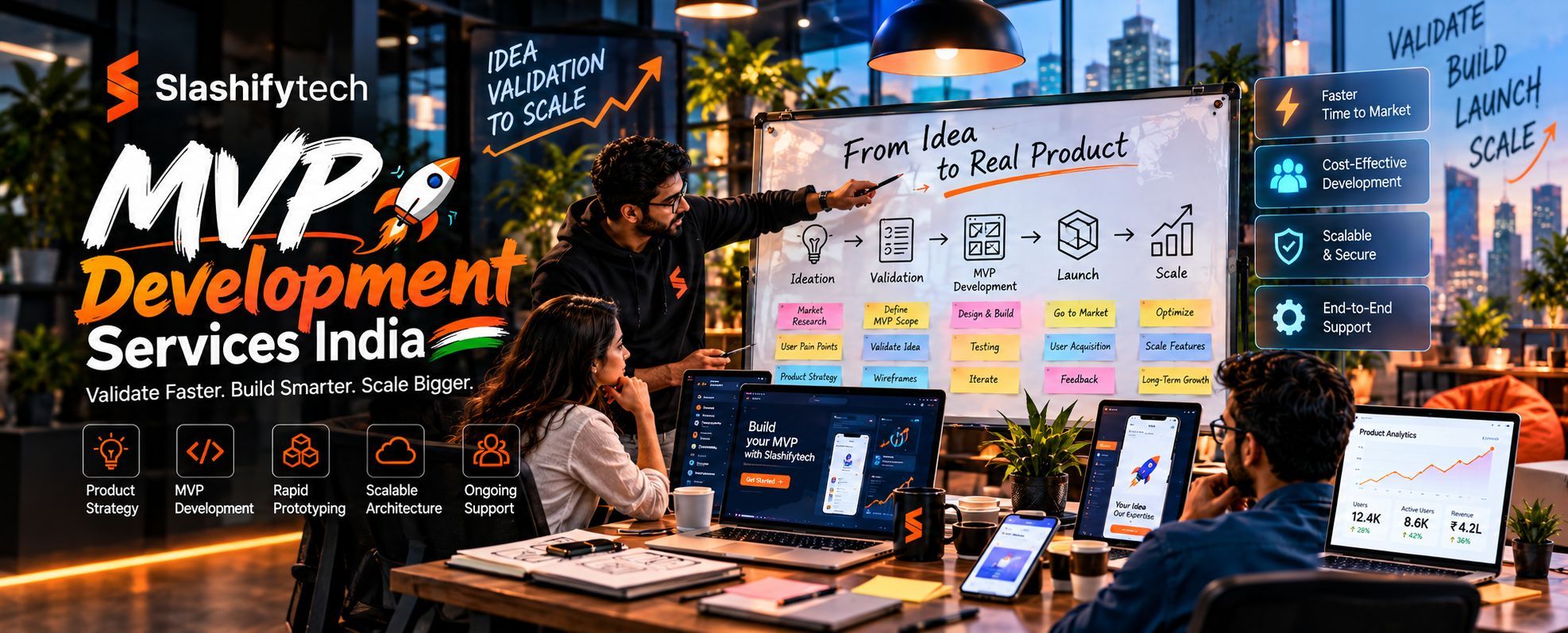
What if your first product release could answer the most important question about your business before you invest in a complete software platform? MVP Development Services India helps businesses turn product ideas into working minimum viable products, allowing them to test core functionality, collect user feedback, and make better decisions about future development. The right service covers more than coding: it connects product discovery, feature prioritization, design, engineering, testing, deployment, and validation.
The goal is not to build an incomplete product. It is to build a focused product that does its main job well and helps you learn what to do next.
What Are MVP Development Services India?
MVP Development Services India covers the planning, design, engineering, testing, and launch of a minimum viable product. An MVP is a working version of a digital product that contains the essential features needed to solve a defined user problem and test a business assumption with real users.
For example, a founder planning a platform for booking local services might initially want customer profiles, provider dashboards, live tracking, loyalty points, recurring subscriptions, AI recommendations, and advanced analytics. An MVP may need only service listings, booking requests, provider responses, basic notifications, and an administration workflow.
The appropriate scope depends on what the business needs to validate. If you want to test whether users will pay for a service, the product needs a credible transaction or payment workflow. If you want to test whether businesses will use a reporting platform, the MVP must deliver a report that addresses a real business need.
A good development partner helps you define that goal before recommending a technology stack or estimating the project.
What Should an MVP Development Services India Include?
An MVP development service should connect business requirements to a working product. Depending on your needs, the engagement may include discovery, product planning, user experience design, frontend and backend development, integrations, quality assurance, deployment, and post-launch support.
Before hiring a provider, clarify which of these activities are included in the proposal. Some providers quote only for engineering, while others include discovery, design, testing, and launch preparation. Those proposals should not be compared as if they cover the same work.
A useful scope document should define the deliverables, included features, exclusions, acceptance criteria, timeline assumptions, ownership terms, and support arrangements.
MVP vs. Prototype vs. Full Product
An MVP is different from a prototype or a fully developed product because each serves a different purpose.
| Product stage | What it provides | Main purpose |
|---|---|---|
| Concept or wireframe | Basic sketches and screen layouts | Explore the idea |
| Clickable prototype | Interactive demonstration of the interface | Test usability and navigation |
| Minimum viable product | Working software with the essential workflow | Validate the product with real users |
| Expanded product | A broader feature set and more mature operations | Serve established requirements and growing demand |
A prototype can show how a product might work without implementing the complete backend. An MVP goes further by enabling real users to complete the central task.
A full product may be appropriate when the requirements are already well established or the business has non-negotiable operational needs. The right stage depends on the uncertainty you need to resolve, not on which option sounds more sophisticated.
Why Businesses Invest in MVP Development
Businesses use MVP development to reduce uncertainty before committing to a larger product build. A focused release lets a team test its assumptions, understand user behavior, and prioritize future investment based on evidence rather than an untested feature list.
Test Demand Before Building a Complete Product
The biggest risk in early product development is not always technical failure. It can be building something that does not solve an important problem for the intended audience.
An MVP lets you introduce the core proposition to real users. Their behavior can help you understand whether the product is useful, which parts cause confusion, and what would encourage them to return or pay.
Validation does not guarantee product-market fit. It provides evidence that helps you decide whether to improve the idea, adjust the target market, change the business model, or invest in the next release.
Reduce Unnecessary Development
Every additional feature can require interface design, backend logic, database changes, testing, documentation, and ongoing maintenance. Features that do not support the first validation goal can increase cost and delay learning.
MVP Development Services India should help separate essential functionality from later enhancements. For example, a basic booking product may need a complete booking workflow before it needs loyalty rewards or advanced recommendations.
Scope reduction should not remove essential quality. Authentication, access controls, error handling, and testing remain necessary when the product’s features depend on them.
Learn From Real Users
Real usage reveals problems that may not appear in planning meetings. Users may abandon a form, misunderstand a label, struggle to complete a task, or prefer a different workflow.
A useful MVP plan defines what to measure before launch. Depending on the product, relevant measures may include account activation, task completion, successful transactions, repeat usage, qualified enquiries, or user feedback.
The right metric depends on your business model. A B2B platform may need to measure successful workflows and willingness to pay, while a consumer app may focus on activation and repeat engagement.
What Is Included in MVP Development Services India?
MVP Development Services India can cover the full journey from an early product idea to a working application in production. The exact scope varies, so confirm each deliverable before signing an agreement.
Product Discovery and Requirements
Discovery turns a business idea into a clear development plan. The team identifies target users, the main problem, essential workflows, technical constraints, integrations, and the assumptions the product needs to test.
A typical discovery deliverable includes a prioritized feature list, user journeys, initial requirements, risks, and a proposed release scope. This work is especially useful when the founder has a broad product vision but has not decided what belongs in the first release.
Discovery should also identify what is excluded. A written list of exclusions reduces misunderstandings when new ideas appear during development.
UX/UI Design and Prototyping
User experience design defines how people move through the application and complete tasks. User interface design translates that flow into screens, controls, layouts, and visual feedback.
The team may create wireframes, interactive prototypes, and responsive designs before implementation. These artifacts help stakeholders review the experience before engineering work becomes expensive to change.
Design should account for errors and edge cases. A booking interface, for example, needs to explain unavailable dates and failed requests. A registration flow should provide clear validation messages when users enter incorrect information.
Frontend and Backend Development
The frontend is the part of the application users interact with. It displays content, accepts input, and presents the results of user actions. The backend processes business rules, checks permissions, communicates with databases, and coordinates external services.
A simple MVP may use a conventional application structure with a frontend, backend, and database. A product with multiple user roles or complex business logic may require more careful separation of responsibilities.
SlashifyTech’s published MVP service describes web, mobile, and SaaS MVP development. Its related web application services list technologies such as React, Next.js, Node.js, MongoDB, and PostgreSQL as part of its broader web application offering. The right combination should be selected according to the requirements of your specific project.
Database and API Integrations
The database stores the product’s information, such as user accounts, bookings, orders, documents, or business records. Its structure should support the way the application creates, updates, retrieves, and relates that information.
An application programming interface (API) allows systems to exchange data or request actions. An MVP may use APIs for payment processing, notifications, maps, analytics, identity services, or other business tools.
Integrations need more than a successful demonstration. The team should test what happens when a service is unavailable, a request times out, a transaction fails, or a user submits the same request twice.
Testing, Deployment, and Maintenance
Testing checks whether the application works as intended before users depend on it. It should cover the main workflows, permissions, data validation, supported devices and browsers, and relevant failure conditions.
Deployment moves the application into its intended production environment. The release plan should address configuration, domain settings, credentials, monitoring, and backups where appropriate.
Maintenance may include bug fixes, dependency updates, security improvements, performance monitoring, and future features. Clarify whether post-launch support is included in the initial price or contracted separately.
Types of MVP Development Services India
The right type of MVP depends on the user experience, business model, and technology required to test the product’s core value. A web application, mobile app, SaaS product, and marketplace can share technical components, but their workflows and operational needs differ.
Web Application MVP Development
A web application MVP runs in a browser and is useful when customers or employees need an interactive product without installing a mobile app.
Examples include booking portals, internal dashboards, customer portals, workflow tools, and business applications. Depending on the use case, the MVP may require user accounts, role-based access, search, forms, reporting, file uploads, or integrations.
A responsive interface allows the product to adapt to different screen sizes. The team should test mobile and desktop workflows rather than assume that a desktop layout will work well on a phone.
Mobile App MVP Development
A mobile MVP is suitable when the product depends on smartphone usage, push notifications, device capabilities, or frequent interactions while users are away from a desktop.
The development team must decide between native and cross-platform approaches. Cross-platform frameworks can share much of the code across iOS and Android, while native development may be suitable when platform-specific capabilities or performance requirements justify separate implementations.
SlashifyTech’s published MVP offering identifies React Native as one potential approach for cross-platform mobile MVPs. The final choice should depend on functionality, budget, maintenance, and the intended user experience.
SaaS MVP Development
A software-as-a-service (SaaS) MVP tests a software product delivered online, often through a recurring subscription or business contract. The first release may include user accounts, a core workflow, a dashboard, subscription billing, and administration tools.
If multiple organizations use the same platform, the architecture must separate their data and permissions correctly. A user from one organization must not be able to access another organization’s records through a modified request.
If subscriptions are involved, the product may need to handle payment status, plan changes, cancellations, failed payments, and billing-related notifications. These requirements should be included in the scope when they are essential to the business model.
Marketplace MVP Development
A marketplace MVP connects two or more user groups, such as customers and providers or buyers and sellers. It must support the interaction between those groups rather than simply display listings.
A first release may include profiles, listings, search, enquiries, bookings, order management, and an administration interface. Payments, reviews, dispute workflows, and automated matching can be added when they are needed for the initial validation goal.
The team should map each user group’s journey. If providers cannot respond to enquiries or customers cannot complete a booking, the product may not test the intended marketplace model effectively.
AI-Enabled MVP Development
An AI-enabled MVP is appropriate when an AI feature directly supports the product’s value proposition. Examples include document summarization, information extraction, question answering over approved content, or assistance with a defined business workflow.
The project should specify what data the model receives, what output it must produce, how quality will be evaluated, and what happens when the output is incorrect. Depending on the use case, the application may need human review, usage limits, privacy controls, and logging.
AI is not automatically the best solution. If a conventional search function, rules engine, or structured workflow solves the problem more reliably, it may be a better choice for the first release.
The MVP Development Process
A structured MVP development process connects product discovery to a working release and then to measurable user feedback. Each stage should have a clear output and an agreed method for reviewing progress.
Step 1: Discovery and Scope Definition
The first stage establishes what the product must prove and what functionality is needed to test it. The team identifies the target user, core problem, main workflow, technical constraints, and launch requirements.
The result should be a written scope that distinguishes essential features from later releases. This prevents the project from expanding every time someone suggests a new idea.
Step 2: Feature Prioritization
Features should be prioritized according to their contribution to the main user journey and validation goal.
Use a simple classification:
- Must have: Required to complete the core workflow.
- Should have: Useful for launch but potentially simplified if necessary.
- Later: Valuable after the first release has been tested.
- Out of scope: Unrelated to the current validation objective.
Review the list with the technical team. A feature that appears optional to a founder may be required to handle permissions, data integrity, or a complete transaction.
Step 3: Design and Architecture
The team maps the user journey, designs the main screens, and chooses an architecture that fits the product’s requirements.
Architecture decisions may include the frontend framework, backend structure, database, authentication approach, hosting, and external integrations. The simplest maintainable approach is usually preferable to a complex system built for hypothetical future demand.
Step 4: Development and Testing
Developers implement the essential workflows and connect the frontend, backend, database, and integrations. The team should demonstrate working functionality regularly so stakeholders can identify misunderstandings before they become expensive changes.
Testing covers normal use and relevant failure conditions. For example, the team should verify what happens when a user loses access, an API is unavailable, or a transaction does not complete.
Step 5: Deployment and Validation
The application is released to its intended users after the required checks are complete. The team then observes how people use the product and collects feedback tied to the original validation question.
The next release should be based on what the evidence shows. If users cannot complete the core workflow, fix that problem before adding unrelated features.
How to Choose the Right MVP Development Approach
The right approach depends on product uncertainty, technical complexity, available budget, and the degree of customization required. No-code, low-code, and custom development can all be useful when applied to the right problem.
| Approach | Main benefit | Main trade-off | Best fit |
|---|---|---|---|
| No-code or low-code | Can support rapid experimentation | Platform constraints may limit customization | Simple workflows and early validation |
| Custom web development | Flexible business logic and browser-based access | Requires engineering and ongoing maintenance | Products with custom workflows |
| Cross-platform mobile development | Shared code across supported mobile platforms | Some platform-specific work may remain | Products targeting iOS and Android |
| Native mobile development | Direct access to platform capabilities | Separate implementation and maintenance may be needed | Platform-specific or demanding mobile requirements |
| Internal development team | Direct access to product knowledge | Requires hiring and engineering management | Continuous, long-term product development |
| External development partner | Access to a delivery team for a defined engagement | Requires clear scope, communication, and ownership terms | Building a focused product without hiring an entire team |
When No-Code or Low-Code Makes Sense
No-code and low-code tools can be suitable when you need to test a straightforward workflow or demonstrate an idea before investing in custom engineering.
Before choosing a platform, check data portability, integration limits, recurring fees, security controls, and the process for moving to another system. If the product relies on complex permissions, unique business logic, or extensive integrations, confirm that the platform can support those requirements.
When Custom MVP Development Makes Sense
Custom development is useful when the product’s value depends on workflows, integrations, or technical requirements that existing tools cannot support adequately.
It also offers greater control over code and architecture, subject to the ownership terms in the contract. However, custom development can be unnecessary for an idea that has not yet been validated. Choose the smallest practical approach that can answer the business question.
MVP Development Cost in India
MVP development cost in India depends on the product scope, platforms, integrations, security requirements, design complexity, and launch expectations. SlashifyTech’s dedicated MVP service page publishes an indicative price range of ₹8,00,000 to ₹40,00,000+ and a typical delivery window of 10 to 16 weeks. These are the figures published on that service page, not a universal price for every MVP. View SlashifyTech’s MVP service details.
A prototype and a production MVP are different deliverables, so their prices should not be compared without reviewing what each includes.
What Affects the Cost?
| Cost factor | Why it matters |
|---|---|
| Feature scope | Each feature may require design, frontend work, backend logic, database changes, and testing. Features with many dependencies generally take more effort. |
| Platform choice | A web MVP, mobile MVP, and multi-platform product have different implementation and testing requirements. |
| Integrations | Payments, messaging, maps, analytics, and external business systems may add engineering work and recurring third-party charges. |
| User roles and permissions | Products serving customers, administrators, providers, and organizations require clear access rules and testing. |
| Design complexity | A small set of standard screens usually requires less work than complex dashboards and many distinct workflows. |
| Security and data handling | Products dealing with sensitive data or strict access requirements may need additional controls and verification. |
| Production readiness | Deployment, monitoring, backups, documentation, and maintenance planning contribute to the real cost of running the product. |
How to Compare MVP Development Proposals
Ask each shortlisted provider to quote against the same requirements. A lower price may exclude discovery, design, testing, deployment, source-code documentation, or post-launch support.
Review each proposal for:
- Included features and explicit exclusions.
- Technology choices and architectural assumptions.
- Milestones, dependencies, and acceptance criteria.
- Payment schedule and change-request process.
- Infrastructure and third-party service costs.
- Source-code ownership and repository access.
- Testing, deployment, and handover deliverables.
- Maintenance, warranty, and support terms.
A transparent proposal makes it easier to understand what you are buying and where extra charges may arise.
Budget for Maintenance and Future Releases
The initial build is only one part of the product’s cost. Once the application launches, you may need hosting, dependency updates, monitoring, bug fixes, security improvements, support, and new features.
Ask the provider to separate the development budget from recurring infrastructure and optional support costs. This helps you plan how much runway remains for validating the product and acting on user feedback.
How Long Do MVP Development Services India Take?
The timeline depends on the number of workflows, platform requirements, integrations, stakeholder approvals, and testing needs. SlashifyTech’s dedicated service page lists a typical MVP development window of 10 to 16 weeks from discovery to launch. The actual schedule depends on the agreed scope. Source: SlashifyTech MVP development services.
A credible plan should include discovery, design approval, development, testing, user acceptance, deployment, and initial feedback review. Coding is only one part of the work.
The timeline can change when requirements expand, external services are delayed, decisions take longer than expected, or testing reveals important defects. Ask the provider to document assumptions and dependencies rather than relying only on a promised launch date.
Essential Technical Considerations
An MVP should have a technical foundation that fits its intended use without introducing unnecessary complexity. The goal is to make the first release maintainable, secure, and suitable for the next set of product decisions.
Frontend, Backend, and Database
The frontend displays the interface and captures user actions. The backend enforces business rules, checks permissions, processes requests, and communicates with databases or external services.
The database stores information needed by the application. Its design should support the product’s actual workflows, data relationships, and access requirements.
The technology stack should be selected based on functionality, team expertise, integration needs, and maintenance, not popularity alone.
APIs and Third-Party Integrations
APIs connect the MVP to external services. For example, a booking product may integrate with a notification service, while a subscription product may connect to a payment provider.
The team should consider authentication, rate limits, timeouts, failed requests, duplicate submissions, and external service changes. These details determine whether an integration remains dependable beyond a successful demo.
Security and User Permissions
Authentication confirms a user’s identity, while authorization determines what that user can access or change. Both matter when the application contains accounts, private records, or different user roles.
Access rules must be enforced by the backend rather than relying only on interface elements. A user should not be able to retrieve another account’s information by changing an identifier in a request.
Security should be addressed throughout development. The OWASP Top 10 is a useful reference for common web application security risks, including broken access control and security misconfiguration. See the OWASP Top 10.
Performance and Scalability
Performance affects whether users can complete the product’s main workflow. Slow screens, unstable layouts, and unclear error messages can interfere with the validation process.
Scalability means the application can accommodate changing requirements or usage without unnecessary rework. A maintainable codebase, suitable database design, clear component boundaries, and monitoring can support future development without requiring every MVP to start with a complex distributed architecture.
Common Mistakes When Buying MVP Development Services India
The wrong scope or contract can create more problems than the choice of framework. Before committing to a provider, watch for these common mistakes.
Choosing a Provider Based Only on Price
Two estimates may cover very different work. Compare the deliverables, testing, integrations, deployment, documentation, and support before deciding which proposal represents better value.
Starting Development Without a Validation Goal
A product can contain many features and still fail to answer the question that motivated the project. Define the user problem, core workflow, and measures of success before finalizing the scope.
Accepting Vague Deliverables
Terms such as “complete app” or “full functionality” are not precise acceptance criteria. Document the screens, workflows, supported platforms, integrations, and conditions that must be met before a milestone is accepted.
Ignoring Ownership and Access
Confirm who owns the source code and design assets, who controls the repository and cloud accounts, and how credentials and documentation will be transferred. These terms should be written into the agreement.
Treating Launch as the End of Development
A launch provides an opportunity to learn from actual users. Plan how the team will monitor the application, resolve critical issues, collect feedback, and prioritize the next release.
MVP Development Myths
Myth 1: MVP Means the Cheapest Possible Application
An MVP should have limited scope, but its core workflow must work. Cutting essential security, testing, or error handling can undermine the product’s usefulness and create expensive problems later.
The objective is to reduce unnecessary features while preserving the quality needed for meaningful validation.
Myth 2: Every Product Needs Custom Development From Day One
A no-code prototype or existing platform may be enough to test a simple assumption. Custom engineering becomes more relevant when the product requires unique workflows, specialized integrations, or greater control over the architecture.
Choose based on the current validation goal and the practical limitations of the available tools.
Myth 3: More Features Mean a Better MVP
A larger feature set can delay launch, raise costs, and make user feedback harder to interpret. If several new features are introduced at once, it may be difficult to understand which one helped or hindered the user journey.
Start with the smallest complete workflow and expand only when evidence supports the next investment.
Illustrative MVP Project Example
Consider a startup planning a digital platform that connects customers with local service providers. The founders initially request customer apps, provider apps, real-time tracking, recurring subscriptions, promotional codes, loyalty rewards, and advanced analytics.
Before development, the team identifies the main business assumption: whether customers will submit booking requests and whether providers can respond effectively. It scopes an initial release around service listings, booking requests, provider responses, basic notifications, and an administration interface.
The product is tested with a defined audience. The team measures booking completion, provider response, and user feedback, then uses the findings to prioritize changes.
This is an illustrative example, not a completed SlashifyTech client project. It demonstrates why an MVP service should connect scope, technology, and measurement to a clear business objective.
How to Evaluate an MVP Development Provider
A suitable MVP development provider should explain how it will translate your requirements into a working product and how you will evaluate the deliverables.
Use this checklist before signing an agreement:
- Relevant experience: Ask for examples of similar workflows or product types.
- Technical capability: Confirm the team can explain the proposed architecture, integrations, data model, and security approach.
- Portfolio relevance: Review examples that match your requirements rather than relying only on broad claims.
- Project scope: Request a written list of features, exclusions, assumptions, and acceptance criteria.
- Communication: Agree on progress updates, demonstrations, reporting, and escalation paths.
- Security: Ask how the team handles permissions, credentials, sensitive data, and dependency updates.
- Scalability: Discuss likely future requirements without overengineering the first release.
- Timeline: Require milestones and dependencies, not only a target launch date.
- Maintenance and support: Clarify bug-fix coverage, support terms, recurring fees, and future development options.
- Pricing transparency: Ask for a breakdown of development, infrastructure, third-party services, and change requests.
- Ownership and access: Confirm rights to source code, designs, repositories, domains, and cloud accounts.
- Documentation: Ensure the handover includes deployment instructions and the information needed to maintain the application.
Also establish how new requirements will be handled. If the scope changes, the provider should explain the effect on cost, timeline, and deliverables before proceeding.
MVP Development Services India at SlashifyTech
SlashifyTech provides MVP Development Services India for startup founders, product teams, and businesses testing digital product ideas. Its dedicated service page describes web, mobile, and SaaS MVP development, along with discovery and scope planning, engineering, and preparation for future product development. Explore SlashifyTech’s MVP development services.
The service page publishes a typical timeline of 10 to 16 weeks and an indicative budget range of ₹8,00,000 to ₹40,00,000+. These figures should be treated as planning references; the final estimate depends on the agreed requirements, platforms, integrations, and delivery scope.
For a product that needs a browser-based interface, SlashifyTech also provides web application development services. For subscription-based products, its SaaS application development service may be relevant.
The best starting point is a clear discussion of your target users, the problem you want to solve, the essential workflow, and the evidence you need from the first release. You do not need to have every technical detail finalized before beginning that conversation.
Planning an MVP? Share your product idea, intended audience, essential features, expected launch window, and approximate budget with SlashifyTech to discuss the scope and development requirements.
Frequently Asked Questions
What are MVP Development Services India?
MVP Development Services India helps businesses plan, design, build, test, and launch a minimum viable product. The work typically includes discovery, feature prioritization, UX/UI design, frontend and backend development, integrations, quality assurance, and deployment. The exact scope depends on the product and should be documented in the provider’s proposal.
How much do MVP development services cost in India?
The cost depends on feature scope, platforms, integrations, security requirements, design complexity, and production readiness. SlashifyTech’s dedicated MVP service page publishes an indicative range of ₹8,00,000 to ₹40,00,000+. Request a scope-based estimate that separates development from infrastructure and post-launch support.
How long does MVP development take?
MVP development timelines depend on complexity, integrations, stakeholder decisions, and testing requirements. SlashifyTech lists a typical timeframe of 10 to 16 weeks. Ask your provider for milestones covering discovery, design, development, testing, deployment, and feedback review rather than relying only on a launch date.
Which businesses need MVP Development Services India?
MVP development can help startups validating a new business idea, established companies testing a new product line, and product teams exploring a new digital workflow. It is especially useful when demand or feature priorities remain uncertain. A focused first release helps these teams collect evidence before expanding the product.
What is included in an MVP development package?
An MVP package may include product discovery, requirements, UX/UI design, frontend and backend development, database setup, integrations, testing, deployment, and handover. Some providers include maintenance or post-launch support, while others charge separately. Review the written scope to confirm which deliverables and services are included.
How do I choose an MVP development company in India?
Compare relevant experience, technical capability, portfolio relevance, scope definition, communication, security, pricing, and support. Confirm source-code ownership, access to project accounts, documentation, and acceptance criteria in writing. A suitable provider should explain technical trade-offs and show how the proposed release will test your core business assumption.
Key Takeaways
- MVP Development Services India connects product discovery, design, engineering, testing, and launch.
- Define the core problem and validation goal before selecting features.
- Choose web, mobile, SaaS, marketplace, or AI-enabled development according to the product’s actual needs.
- Compare proposals by deliverables and assumptions, not headline price alone.
- Keep security, ownership, documentation, and maintenance in scope.
- Use real user feedback to decide what the next release should contain.
Conclusion: Choose MVP Development Services India Around Your Business Goal
The value of MVP Development Services India is not simply the delivery of an application. It is the ability to turn a business assumption into a working product, test it with real users, and use the findings to guide the next investment.
Before choosing a provider, define the problem, prioritize the core workflow, establish measurable validation criteria, and agree on scope and ownership. A focused MVP gives your team a clearer basis for deciding what to improve, what to expand, and what not to build.
If you are planning a new digital product, discuss your requirements with SlashifyTech to explore the appropriate scope, technical approach, and delivery plan.


