



Memoria - The platform was growing, but the backend operations were reactive instead of structured, so we built a clean operational system that helped the Memoria team actually understand how the platform was behaving in real usage.
Client Overview

ClientMemoria
IndustrySocial Memory Platform
PlatformAdmin Dashboard / Web Admin Portal
ServicesProduct Strategy, Admin Experience Design, Dashboard UX Architecture, Frontend Development, Backend System Design, Monitoring Systems, QA & Testing
About the Project
Memoria was evolving into a collaborative memory-sharing platform with features like social circles, events, AI-generated captions, uploads, memory organization, and contributor collaboration. The mobile experience was improving rapidly. But internally, the operational side of the platform was becoming difficult to manage. The admin system existed only at a basic level. There was no clear way to monitor platform growth, understand user behavior, track upload activity, monitor AI usage costs, identify retention problems, manage support issues, or detect technical failures early. The platform was growing, but the backend operations were reactive instead of structured. That's where we came in. Not to build a bloated enterprise dashboard, but to create a clean operational system that helped the Memoria team actually understand how the platform was behaving in real usage.What Was Actually Going Wrong
The problems were not just technical. The real issue was operational visibility. The team lacked clarity about what was happening across the platform.- Platform growth existed, but there was no clear visibility — Users were creating circles, uploading memories, inviting contributors, and generating AI captions. But the admin team could not quickly answer: Are users returning? Are circles collaborative or creator-only? Are uploads succeeding consistently? Is AI usage increasing operational costs? Which users are becoming power users? Are people actually using events properly? The data existed. But there was no operational intelligence.
- User management felt disconnected — Admins could not easily monitor active users, identify storage-heavy accounts, track AI usage behavior, review user activity history, or manage moderation actions cleanly. Even basic workflows like suspending a user or reviewing recent activity required unnecessary effort.
- Collaboration health was invisible — Circles were the core feature of Memoria. But there was no easy way to understand which circles were active, which circles were empty, whether multiple contributors were participating, or which events were actually engaging users. This was a major issue because collaboration was the true success metric of the platform. Without visibility into collaboration, the team could not measure whether Memoria was becoming a real social memory platform.
- Storage usage was becoming risky — Uploads were growing quickly. But there was limited visibility into total storage usage, top storage users, upload failures, storage-heavy circles, or server-side media issues. This created operational uncertainty because media uploads directly affected infrastructure costs.
- AI usage had no proper monitoring — AI features were being actively used, but there was no structured monitoring system for prompt usage, caption generation, failed AI requests, or high AI consumers. Without monitoring, AI costs could scale unpredictably.
- Technical issues were hard to identify quickly — The platform needed better operational monitoring for crash rates, upload failures, image processing failures, and server response issues. Problems were often identified only after users experienced them. That directly affected retention and trust.
- Customer support lacked operational clarity — Support tickets existed, but admins struggled to track issue history, user context, previous conversations, and support resolution flow. The experience felt fragmented instead of centralized.
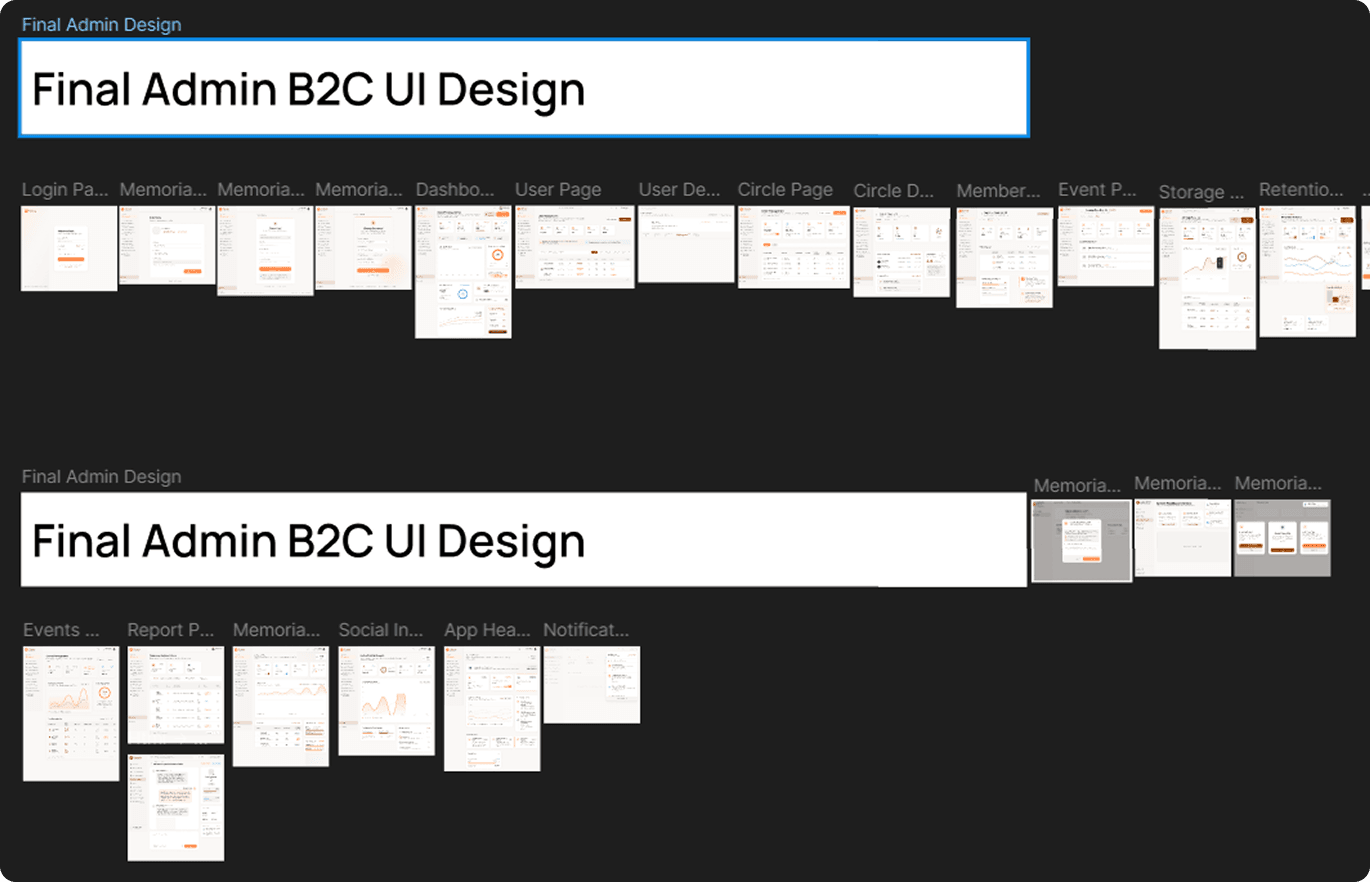
What We Changed (And Why It Worked)
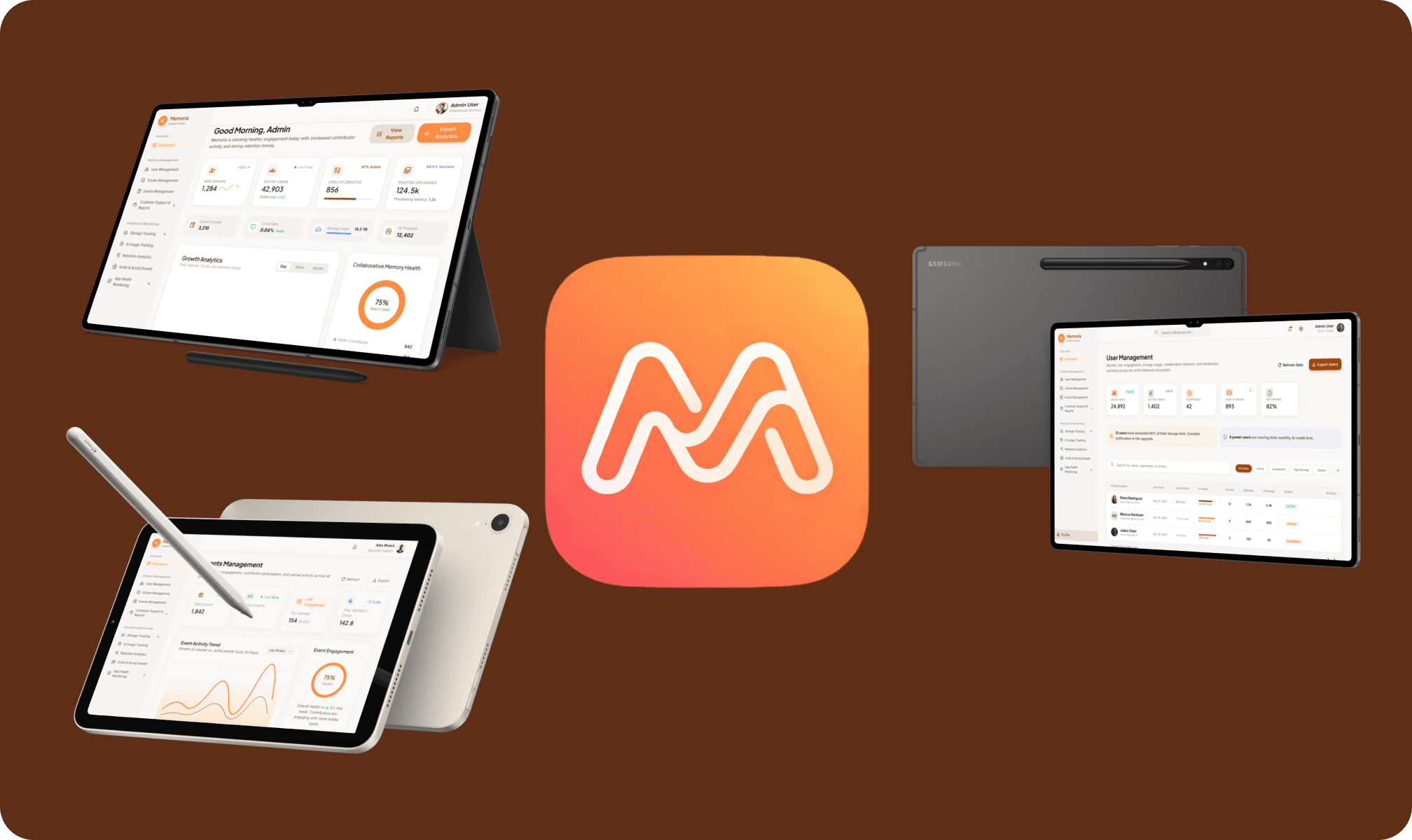
We approached the admin panel like an operational intelligence system. Not a traditional enterprise dashboard. The goal was simple: "Can the Memoria team instantly understand the health, growth, and collaboration quality of the platform?" Everything was designed around clarity and actionability.- Built a real operational dashboard — We designed a centralized dashboard that immediately surfaced signups, active users, uploads, circles created, storage usage, AI activity, and crash rates. But instead of overwhelming the admin team with excessive data, we focused on operationally useful metrics. We introduced trend indicators, warning states, growth comparisons, collaboration signals, and retention indicators. The dashboard became something the team could actually check daily.
- Redesigned user management around visibility — We created a complete user management system that allowed admins to search users instantly, monitor storage usage, track upload behavior, review AI usage, identify high activity users, and suspend/reactivate accounts. We also introduced detailed user profiles with activity timelines, upload history, joined circles, storage analytics, and AI usage tracking. Now the team could understand user behavior instead of just viewing raw accounts.
- Made collaboration measurable — This became one of the most important shifts. We built analytics around the real success metric: "Are circles collaborative?" We introduced visibility into circles with multiple contributors, repeat uploads, contributor participation, active vs empty circles, and event-level engagement. This helped the Memoria team understand whether users were truly building shared memories together.
- Built event-level operational monitoring — Events became a dedicated operational layer. Admins could now track active events, events with no uploads, upload participation, and contributor engagement. This helped the team identify which event experiences were actually driving memory sharing.
- Introduced storage intelligence — Storage was one of the biggest operational cost centers. We designed a storage tracking system that monitored total storage usage, upload size growth, top storage users, top storage-heavy circles, and upload failure percentages. We also added warning systems for storage nearing 90% and increasing upload failures. This allowed the team to proactively manage infrastructure growth.
- Turned AI monitoring into an operational system — Instead of treating AI like a hidden backend service, we surfaced AI usage clearly. The admin system now tracks prompts used, AI captions generated, failed AI requests, and top AI users. We also introduced usage monitoring for users approaching 10 prompts/day and 5 captions/day. This helped prevent misuse while keeping AI operational costs predictable.
- Built retention visibility into the platform — Retention became a first-class operational metric. We introduced tracking for D1 retention, D7 retention, D30 retention, repeat uploaders, repeat circle creators, and weekly returning users. More importantly, we emphasized the platform's core KPI: Percentage of circles with 2+ contributors. This became the clearest signal of whether Memoria was behaving like a social platform instead of simple cloud storage.
- Added social growth intelligence — We designed a dedicated growth monitoring layer around invites sent, invite acceptance percentage, average invites per user, and circles growing through member additions. This allowed the team to measure organic collaboration growth naturally.
- Built a real app health monitoring system — We created a dedicated monitoring module focused on crash rate, upload failures, image processing failures, and timeout-related server issues. The system now surfaces alerts early instead of waiting for user complaints. That dramatically improved operational confidence.
- Centralized support workflows — We redesigned the support system into a structured support workspace. Admins could now manage ticket conversations, track issue history, understand user context, review support timelines, and respond from one centralized interface. This reduced friction for both the support team and users.
- Designed the admin experience like a premium SaaS product — One of the biggest differences was the overall product feel. Most admin dashboards feel crowded, technical, enterprise-heavy, and difficult to navigate. We intentionally designed Memoria's admin panel to feel premium, calm, modern, and operationally intelligent. Inspired by products like Linear, Stripe, Notion, and Framer, we used warm neutral colors, soft shadows, large spacing, clean typography, and lightweight analytics. The result felt less like enterprise software and more like a modern operational command center.
What Changed After That
The impact became visible very quickly. Not just through metrics, but through how the team operated daily.- Operational Clarity Improved — The team could finally understand user behavior, identify engagement trends, monitor collaboration quality, and track retention properly. The platform stopped feeling operationally blind.
- Collaboration Became Measurable — The team could now clearly identify active collaborative circles, low participation groups, contributor behavior, and social growth trends. This helped validate whether Memoria was evolving into a real social memory platform.
- Infrastructure Monitoring Became Proactive — Instead of reacting to issues later, the team could monitor upload failures, storage growth, crash trends, and AI usage spikes before they became larger problems.
- AI Usage Became Predictable — AI monitoring introduced much better visibility into operational costs, heavy AI users, failed requests, and usage trends. This made scaling AI features significantly safer.
- Admin Workflows Became Faster — Support operations, user management, and moderation actions became significantly more efficient. The admin panel reduced operational friction across the entire platform team.
- The Product Felt More Premium Internally — The admin experience itself started reflecting the quality of the Memoria brand. Instead of feeling like a backend tool, it felt like a carefully designed operational product. That improved internal usability dramatically.
Revenue Direction (What This Unlocks)
The admin system unlocked operational scalability. Which directly supports future monetization. The platform can now confidently support premium storage plans, advanced AI subscriptions, private collaborative circles, enhanced memory organization, and enterprise/community features. Because the team now has proper visibility into usage behavior, infrastructure costs, collaboration quality, and retention performance. Operational clarity creates monetization confidence.Impact Summary
The Memoria admin panel evolved from a basic backend interface into a complete operational intelligence system.- Platform activity became clearly measurable
- Collaboration quality became visible
- Retention tracking became actionable
- AI usage became operationally manageable
- Storage growth became trackable
- Technical issues became easier to detect early
- Support workflows became centralized
- Admin operations became significantly faster
- The entire system felt premium, calm, and modern