



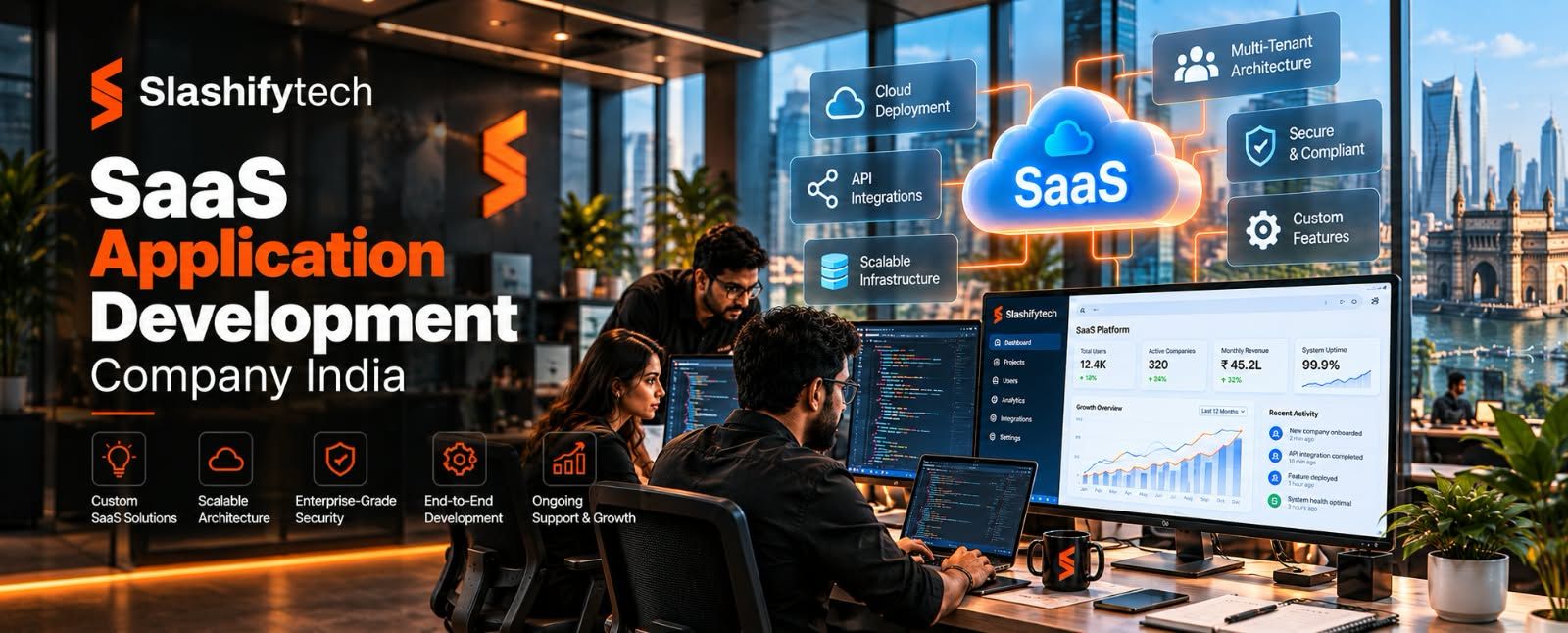
A SaaS product can have an excellent idea and still fail because its architecture cannot support the business model. Subscription billing, multiple customers, tenant isolation, permissions, integrations, analytics, security, and product growth all need to work together.
A SaaS application development company India builds software products that customers access over the internet, usually through recurring subscriptions.
Slashifytech currently provides custom SaaS application development company India covering B2B SaaS platforms, multi-tenant products, AI-native SaaS applications, compliance-driven SaaS, backend/API architecture, billing integrations, onboarding, dashboards, and SaaS modernization.
The right development approach starts with the business model and product architecture, not simply with choosing a programming language.
What Is SaaS application development company India?
SaaS application development company India is the process of designing, building, deploying, and maintaining software that customers access online rather than installing and maintaining it locally.
A SaaS product typically serves multiple customers from a centrally managed platform. Each customer may have its own users, data, permissions, settings, subscription plan, and usage limits.
For example, imagine a company building accounting software for 1,000 businesses. The platform may contain:
- Customer accounts
- Multiple users per customer
- Role-based permissions
- Separate tenant data
- Subscription plans
- Recurring billing
- Usage limits
- Notifications
- Reporting
- API integrations
- Administration tools
- Security controls
- Analytics
The software provider manages the infrastructure and application while customers use the platform through a browser or application interface.
SaaS Development vs Traditional Software
Traditional software may be built for one organisation or installed separately for each customer.
A SaaS product is generally designed around a repeatable platform model. That means your architecture must consider:
One product → multiple customers → multiple users → isolated data → shared infrastructure → recurring subscriptions.
This makes SaaS development fundamentally different from building a normal business application.
When Should You Build a Custom SaaS Product?
Custom SaaS development makes sense when your business model depends on selling software as a service or when standard platforms cannot support your specific workflow.
You may consider custom SaaS development when:
- Your product itself is the business.
- You plan to sell recurring subscriptions.
- Your customers require different accounts and permissions.
- Your industry has specialized workflows.
- You need multi-tenant architecture.
- You need custom integrations.
- Your product requires proprietary functionality.
- Your business requires control over the platform architecture.
- You are converting repeated custom projects into one scalable product.
- Existing SaaS products do not match your business model.
Custom SaaS development is not automatically the right choice. If an existing platform already solves your operational problem without major compromises, buying or configuring that platform may be more practical.
The key question is:
Are you building software to run your business, or is the software itself the product you sell?
That distinction can change the entire architecture and investment model.
What Types of SaaS Applications Can You Build?
SaaS is a business delivery model rather than a single software category. Different industries can use SaaS architecture for very different products.
B2B SaaS Platforms
B2B SaaS applications serve businesses rather than individual consumers. Examples include:
- CRM software
- HR platforms
- Inventory management
- Procurement software
- Sales management
- Financial operations
- Project management
- Compliance software
- Business analytics
- Customer service platforms
A B2B SaaS platform often requires multiple users within each customer organisation. That means the system needs account hierarchies, roles, permissions, billing, reporting, and tenant-specific settings.
SlashifyTech describes its B2B SaaS development service as including multi-tenant architecture, tenant-level data isolation, role-based access, subscription billing, customer onboarding, and self-service administration.
AI-Native SaaS Applications
AI-native SaaS products are designed so AI functionality is part of the underlying product architecture rather than being added as a superficial feature.
An AI-native SaaS platform may include:
- LLM-powered workflows
- AI assistants
- Automated document analysis
- Intelligent search
- Classification
- Recommendation systems
- AI-generated reports
- Agentic workflows
- Natural-language interfaces
The architecture needs to consider how application data is securely exposed to AI systems. For example:
User → SaaS Application → Permission Layer → AI Workflow → Approved Data → Model → Result
The permission layer matters because an AI feature should not automatically gain access to every record simply because the application contains that data.
SlashifyTech currently offers AI-native SaaS development and describes its approach around structured data models, AI-agent access patterns, LLM integrations, and workflows designed for intelligent automation.
Compliance-Driven SaaS
Compliance-driven SaaS products serve industries where security, auditability, access control, documentation, and reporting are central requirements.
Potential applications include software for:
- Fintech
- Legal workflows
- Tax compliance
- Healthcare-adjacent operations
- Government-aligned processes
- Financial reporting
- Regulatory management
These systems may require:
- Audit trails
- Role-based access control
- Secure authentication
- Data isolation
- Data retention policies
- Reporting
- Access monitoring
- Strong documentation
The compliance requirements should be translated into technical requirements before development begins.
Vertical SaaS
Vertical SaaS focuses on one specific industry.
For example, instead of building a generic CRM, you might build a CRM specifically for:
- Automotive dealers
- Real estate agencies
- Healthcare providers
- Logistics companies
- Educational organisations
- Legal businesses
- Financial service providers
The advantage is that the product can reflect the terminology, workflows, data structures, integrations, and operational requirements of the target industry.
Turning Custom Software Into SaaS
A company may discover that it has built similar software for several customers. Instead of continuing to develop each project separately, the company can extract common functionality and create a multi-tenant SaaS product.
For example:
Custom projects
Client A → separate application
Client B → separate application
Client C → separate application
can potentially become:
SaaS platform
One product → multiple tenants → configurable workflows
This requires more than combining databases. The architecture needs a proper configuration layer so customer-specific requirements can be handled without creating separate codebases.
SlashifyTech specifically describes this type of transformation for businesses moving from repeated custom builds toward a genuine SaaS product.
What Makes SaaS Development Different From Normal Software Development?
The biggest difference is that SaaS architecture must support multiple customers while maintaining separation, reliability, billing, and operational control.
A normal internal application might have:
Company → Users → Data
A SaaS product may have:
Platform → Tenants → Users → Roles → Data → Subscriptions
This introduces additional engineering requirements. You need to consider:
- Tenant identification
- Tenant data isolation
- User hierarchy
- Subscription status
- Billing
- Feature entitlements
- Usage limits
- Tenant-specific configuration
- Customer onboarding
- Account suspension
- Data export
- Data deletion
- API access
- Monitoring
A SaaS product must also handle the possibility that one customer's usage increases dramatically without negatively affecting other customers.
Core Architecture of a SaaS Application
Multi-Tenant Architecture
Multi-tenancy allows one SaaS platform to serve multiple customers. There are several ways to implement it.
Shared Database, Shared Schema
Multiple tenants share database tables, with tenant identifiers separating records. This can be cost-efficient but requires strict query and access controls.
Shared Database, Separate Schemas
Each tenant may have a separate database schema. This provides stronger logical separation but increases operational complexity.
Separate Database Per Tenant
Each customer receives its own database. This can provide stronger isolation but may increase infrastructure and maintenance requirements.
The correct approach depends on:
- Compliance requirements
- Number of tenants
- Data sensitivity
- Infrastructure budget
- Scaling model
- Operational complexity
There is no universal architecture that is correct for every SaaS product.
Tenant Data Isolation
Tenant isolation is one of the most important SaaS architecture concerns. A request should never be allowed to retrieve another customer's records simply because the underlying database contains them.
A simplified flow might be:
Authenticated User → Tenant Identification → Authorization → Query Scope → Database → Response
Every relevant data operation needs to respect the tenant boundary.
For larger or compliance-sensitive SaaS platforms, architecture may incorporate database-level controls, tenant-scoped queries, or other isolation mechanisms.
SlashifyTech's published SaaS architecture describes tenant isolation through approaches including PostgreSQL row-level security, tenant-scoped MongoDB queries, and containerised infrastructure on AWS or GCP where appropriate.
Authentication and Authorization
Authentication answers:
Who are you?
Authorization answers:
What are you allowed to do?
A SaaS platform may have:
- Platform administrators
- Organisation administrators
- Managers
- Employees
- External users
- Read-only users
- API users
Each role may have different permissions. For example:
A company administrator may manage billing and users.
A manager may access team reports.
An employee may only access assigned records.
A read-only user may view information but cannot modify it.
Permissions should be enforced on the backend rather than relying only on frontend interface controls.
Subscription and Billing Infrastructure
SaaS revenue depends on subscriptions, so billing is part of the product architecture.
A SaaS platform may need:
- Monthly subscriptions
- Annual subscriptions
- Trial periods
- Plan upgrades
- Plan downgrades
- Coupons
- Usage-based billing
- Payment failures
- Invoices
- Tax handling
- Subscription cancellation
- Account suspension
- Billing history
SlashifyTech currently lists integrations with payment and subscription platforms including Stripe, Razorpay, and Chargebee for B2B SaaS applications.
The application should not assume that a payment gateway alone manages the entire subscription lifecycle. Your SaaS platform still needs to know:
Which plan is active?
Which features are enabled?
When does access change?
What happens after payment failure?
What happens when a customer upgrades?
These business rules belong in the application architecture.
API Architecture
APIs allow the SaaS application to communicate with external systems and sometimes allow customers to access your platform programmatically.
Common API approaches include:
- REST
- GraphQL
- Webhooks
- Event-driven communication
An API architecture may support:
- CRM integrations
- Accounting software
- Payment systems
- Communication tools
- Analytics
- External customer applications
- Automation systems
API security should include authentication, authorization, input validation, rate limiting where appropriate, logging, and controlled access to data.
Database Architecture
The database is responsible for storing the information that makes the SaaS platform useful.
Typical data may include:
- Users
- Organisations
- Subscriptions
- Products
- Transactions
- Customer records
- Permissions
- Activity logs
- Configuration
- Analytics
SlashifyTech's published SaaS development stack includes PostgreSQL and MongoDB depending on project requirements.
Relational databases can be useful when data relationships and transactional consistency are central to the product. Document-oriented databases can be useful for specific data models where flexible structures are beneficial.
Database selection should follow the product's data requirements rather than trend-driven technology choices.
Cloud Infrastructure
A SaaS product normally requires infrastructure that can support:
- Application servers
- Databases
- Storage
- Backups
- Monitoring
- Networking
- Security
- Scaling
- Deployment
SlashifyTech identifies AWS and GCP among the cloud infrastructure options used in its SaaS architecture.
Cloud architecture can also support separate environments for:
Development → Staging → Production
This helps teams test changes before deploying them to paying customers.
Essential Features of a Modern SaaS Application
A SaaS product should be designed around customer workflows rather than a generic feature checklist. Common capabilities include:
Customer Onboarding
The user should be able to create an account, configure the organisation, invite users, and start using the product with minimal friction.
Self-Service Administration
Customers may need to manage:
- Users
- Permissions
- Plans
- Billing
- Integrations
- Organisation settings
Dashboard
A dashboard should surface information that helps users complete their work.
Search and Filtering
Enterprise SaaS products often contain large amounts of information, making search, filtering, sorting, and pagination important.
Notifications
Notifications may be:
- Transactional
- Operational
- Security-related
- Billing-related
- Workflow-based
Reporting
Reporting should answer business questions rather than simply display data.
API Access
Depending on the product, customers may need API keys, webhooks, or integration endpoints.
Audit Logs
Audit trails are especially important for business-critical and compliance-sensitive products.
SaaS Technology Stack
The technology stack depends on the product's architecture, team, requirements, and integrations.
| Layer | Example Technologies | Purpose |
|---|---|---|
| Frontend | React, Next.js | Product interface |
| Backend | Node.js, Django | Application logic and APIs |
| Database | PostgreSQL, MongoDB | Data storage |
| Cloud | AWS, GCP | Infrastructure |
| Payments | Stripe, Razorpay, Chargebee | Subscription billing |
| API | REST, GraphQL | System communication |
| AI | LLM providers where required | Intelligent product capabilities |
| Authentication | RBAC, secure authentication | Identity and permissions |
These technologies are among those currently associated with SlashifyTech's SaaS development offering.
The stack should be selected after understanding the product rather than before defining it.
SaaS application development company India Process
A disciplined process can prevent expensive architectural changes later.
1. Product Discovery
Start by documenting:
- Target customers
- Customer problems
- Product value proposition
- User roles
- Business workflows
- Pricing model
- Subscription structure
- Integrations
- Security requirements
2. Product Requirements
Convert business requirements into technical and functional requirements. For example:
Business requirement: Customers need different subscription plans.
Technical requirement: The application needs plan definitions, entitlements, billing status, feature gates, and subscription lifecycle events.
This translation is essential.
3. Architecture Planning
Define:
- Frontend
- Backend
- APIs
- Database
- Multi-tenancy
- Authentication
- Authorization
- Billing
- Cloud infrastructure
- Monitoring
- Backup strategy
4. UX/UI Design
Design the workflows before building them. Important screens may include:
- Registration
- Login
- Onboarding
- Dashboard
- Account settings
- Billing
- User management
- Core product workflow
- Reports
- Administration
5. MVP Development
Build the smallest complete product that validates the core business model.
An MVP should not mean a broken or incomplete product. It should mean a focused product containing the minimum functionality necessary to deliver its intended value.
6. Testing
Testing should cover:
- Functional behaviour
- User permissions
- Tenant isolation
- Billing
- APIs
- Integrations
- Performance
- Security
- Responsive behaviour
7. Deployment
The application moves through controlled environments before production. Deployment should include:
- Production configuration
- Database migration
- Backup verification
- Monitoring
- Security controls
- Rollback planning
8. Launch and Support
After launch, the team monitors:
- Errors
- Performance
- Usage
- Customer feedback
- Infrastructure
- Security
- Subscription events
SaaS development continues after launch because the product itself evolves with customers and market requirements.
How Much Does SaaS Application Development Cost in India?
SaaS development costs depend heavily on product complexity, architecture, integrations, security requirements, user roles, AI functionality, and the maturity of the product.
SlashifyTech currently publishes an indicative SaaS development range of ₹15,00,000 to ₹1,50,00,000+ depending on platform complexity, compliance requirements, and multi-tenant architecture depth.
Its published pricing structure further identifies:
| SaaS Project Type | Published Indicative Range |
|---|---|
| Focused SaaS MVP | ₹15 lakh - ₹40 lakh |
| Full B2B SaaS | ₹40 lakh - ₹80 lakh |
| Compliance-driven / AI-native SaaS | ₹80 lakh - ₹1.5 crore+ |
These are indicative ranges rather than universal market prices.
What Changes the Cost?
Product Complexity
A simple workflow platform is fundamentally different from an enterprise SaaS with dozens of modules.
Multi-Tenancy
Complex tenant isolation and configuration can increase development requirements.
Integrations
Every external integration introduces additional development and testing work.
Billing
Subscription models require more than connecting a payment button.
AI
AI-native products may require additional infrastructure, data architecture, model integrations, evaluation, monitoring, and security controls.
Compliance
Compliance requirements can affect architecture, logging, data storage, access controls, documentation, and testing.
Migration
Modernising an existing SaaS platform can require legacy data migration and compatibility planning.
How Long Does It Take to Build a SaaS Application?
SaaS applications commonly take several months because development involves product discovery, architecture, UX, coding, integrations, testing, deployment, and launch preparation.
SlashifyTech currently states that SaaS application projects typically take 4 to 12 months from discovery to launch.
A practical project structure might look like:
| Stage | Main Activity |
|---|---|
| Discovery | Requirements and product definition |
| Architecture | Multi-tenancy, database, APIs, infrastructure |
| Design | UX/UI and user workflows |
| Development | Core product engineering |
| Integration | Billing, APIs and external services |
| QA | Functional, security and performance testing |
| Deployment | Production release |
| Launch | Monitoring and customer onboarding |
The timeline should be based on scope and dependencies rather than an arbitrary launch date.
SaaS Security and Compliance Considerations
Security is especially important for SaaS because one platform may contain information belonging to many organisations.
Tenant Isolation
Customers must not be able to access another customer's data.
Authentication
Use secure authentication mechanisms appropriate to the sensitivity of the platform.
Authorization
Permissions should be enforced at the backend.
Encryption
Sensitive information should be protected during transmission and, where appropriate, at rest.
Audit Trails
Record important activities such as:
- Login events
- Permission changes
- Data modifications
- Administrative actions
- Billing changes
API Security
APIs should validate requests and enforce appropriate authentication and authorization.
Dependency Security
Third-party dependencies should be monitored for known vulnerabilities.
Backups
A SaaS provider should have a documented backup and recovery strategy.
Monitoring
Monitoring can detect:
- Application errors
- Infrastructure problems
- Suspicious activity
- Performance degradation
- Failed integrations
For regulated products, security requirements should be mapped to the relevant industry and legal requirements rather than treated as generic checkboxes.
Custom SaaS vs Off-the-Shelf SaaS
These solutions serve different purposes.
| Factor | Custom SaaS Development | Off-the-Shelf SaaS |
|---|---|---|
| Primary purpose | Build your own software product | Use an existing product |
| Workflow | Custom | Standardised |
| Multi-tenancy | Designed into your platform | Controlled by vendor |
| Custom functionality | High | Limited by vendor |
| Ownership | Greater control | Vendor-controlled |
| Integrations | Custom | Based on available integrations |
| Initial cost | Higher | Usually lower |
| Maintenance | Your responsibility or development partner | Vendor-managed |
| Best suited for | SaaS companies and unique products | Standard business requirements |
| Revenue model | You sell subscriptions | You pay subscriptions |
The distinction is critical.
If you are a company purchasing CRM software for internal use, an off-the-shelf product may be appropriate.
If you are building a CRM product that your customers will pay for every month, you need a SaaS platform.
Common SaaS Development Mistakes
Building Features Before Understanding the Customer
A SaaS product can accumulate features without solving its core customer problem. Define the primary workflow first.
Treating Multi-Tenancy as an Afterthought
Retrofitting multi-tenancy into a single-tenant system can require substantial architectural changes. If multiple customers are part of your business model, plan tenant architecture early.
Ignoring Subscription Lifecycle Events
A customer can:
- Start a trial
- Subscribe
- Upgrade
- Downgrade
- Fail payment
- Cancel
- Reactivate
Your application needs rules for each state.
Building AI Before Building Data Foundations
AI functionality depends on reliable data. If your underlying data model is inconsistent, adding an AI layer does not automatically solve the problem.
Underestimating Security
Security should influence architecture, authentication, APIs, databases, infrastructure, and monitoring.
Creating Too Many Features in the MVP
An MVP should validate the core product. It should not attempt to become the final version of the software on day one.
SaaS Development Myths and Misconceptions
Myth 1: SaaS Means One Database for Everyone
SaaS means customers use a centrally managed software service. It does not dictate one specific database architecture.
Depending on requirements, SaaS can use shared schemas, separate schemas, separate databases, or hybrid approaches.
Myth 2: A SaaS MVP Should Be Cheap at Any Cost
Reducing the scope is sensible. Ignoring foundational architecture is not.
A product can have a small MVP while still implementing proper tenant isolation, authentication, billing logic, and security.
Myth 3: Adding AI Automatically Makes a SaaS Product AI-Native
Adding a chatbot to an existing application does not necessarily make it AI-native.
AI-native architecture considers data structures, model access, workflows, permissions, evaluation, and how AI contributes to the actual product experience.
Practical SaaS Development Example
Consider a hypothetical company that provides compliance services to hundreds of businesses.
Its current process relies on email, spreadsheets, documents, and manual reminders. The company wants to convert its expertise into a SaaS product.
The platform could include:
- Organisation registration.
- Multi-tenant customer accounts.
- Employee and administrator roles.
- Compliance task management.
- Document uploads.
- Automated reminders.
- Approval workflows.
- Reporting dashboards.
- Subscription billing.
- Audit logs.
- Customer notifications.
- API integrations.
The SaaS architecture would separate customer data while allowing the provider to operate one central platform.
The development team could then measure product success through actual customer usage, workflow completion, subscription activity, support requirements, and retention-related product signals.
This is an illustrative scenario, not a claim about a specific SlashifyTech client.
How to Choose a SaaS application development company India
Choosing a SaaS development partner requires evaluating both software engineering and product understanding.
Use this checklist before signing a development contract.
1. SaaS Experience
Ask whether the company has actually built SaaS platforms rather than only websites or single-company applications.
2. Multi-Tenant Architecture
Ask how tenant isolation will work. A provider should be able to explain the architecture clearly.
3. Billing Experience
Ask how subscriptions, upgrades, downgrades, failed payments, cancellations, invoices, and webhooks will be handled.
4. API and Integration Capability
Check whether the team understands REST, GraphQL, webhooks, authentication, third-party APIs, and integration failure handling.
5. Security
Ask about authentication, authorization, encryption, audit trails, backups, vulnerability management, and monitoring.
6. Product UX
A technically sound backend can still produce a poor SaaS product if users cannot navigate it easily.
7. Scalability
Ask how the architecture will handle:
- More customers
- More users
- More data
- Higher API traffic
- Larger files
- Increased reporting
- New modules
8. Ownership
Clarify ownership of:
- Source code
- Database
- Cloud infrastructure
- Domain
- API keys
- Documentation
- Design files
9. Maintenance
Ask what happens after launch.
A SaaS product requires ongoing updates, security maintenance, infrastructure monitoring, and feature development.
10. Pricing Transparency
Request a line-item proposal covering:
- Development
- Infrastructure
- Third-party services
- Integrations
- Testing
- Deployment
- Maintenance
Why Consider SlashifyTech for SaaS Development?
SlashifyTech currently positions its SaaS application development company India service around production-grade SaaS platforms for B2B businesses, fintech startups, compliance-driven businesses, and enterprises. Its published service covers custom B2B SaaS, AI-native SaaS, compliance-driven SaaS, multi-tenant architecture, SaaS backend/API development, and SaaS modernization.
Its published SaaS technology approach includes React/Next.js, Node.js/Django, PostgreSQL/MongoDB, AWS/GCP, and integrations with subscription platforms such as Stripe, Razorpay, and Chargebee where appropriate.
SlashifyTech also states that its process includes discovery, architecture and planning, development, testing, deployment, and ongoing support.
For a business evaluating a SaaS development company, the important question is whether the development partner can translate your business model into a technically sound product.
That means understanding:
Customer → Product → Workflow → Data → Architecture → Subscription → Security → Scale
The technology should support the business model rather than dictate it.
Key Takeaways
SaaS application development company India is the engineering of subscription-based software platforms that can securely serve multiple customers while managing tenant data, users, permissions, billing, integrations, and product workflows from a scalable architecture.
- SaaS development is different from ordinary software development because the platform must support multiple customers.
- Multi-tenancy and tenant isolation should be considered during architecture planning.
- Subscription billing is part of the product architecture, not simply a payment gateway integration.
- B2B, AI-native, vertical, and compliance-driven SaaS products can require very different architectures.
- Custom SaaS development is most relevant when you are building software as a product or have requirements that standard platforms cannot adequately support.
- Development costs vary significantly based on complexity, architecture, integrations, compliance, AI, and migration requirements.
- A good SaaS development partner should understand product architecture, security, billing, APIs, infrastructure, UX, and long-term maintenance.
Should I build a custom SaaS product or use an existing platform?
Build custom SaaS when your company is creating software as a product, requires unique workflows, needs specific integrations, or needs control over the platform architecture. Use an existing SaaS platform when standard functionality already satisfies your operational requirements without major compromises.
Can AI be integrated into a SaaS application?
Yes. AI can be integrated through assistants, document processing, intelligent search, recommendations, automation, classification, reporting, or agentic workflows. AI integration should account for data permissions, security, model access, evaluation, cost, reliability, and the specific product workflow rather than being added only as a cosmetic feature.
FAQs
What does a SaaS application development company do?
A SaaS application development company designs and develops subscription-based software platforms that customers access online. The work can include product architecture, multi-tenancy, user management, billing, APIs, databases, security, dashboards, integrations, cloud infrastructure, testing, deployment, and post-launch maintenance.
How much does SaaS application development cost in India?
SaaS development cost depends on product complexity, multi-tenant architecture, integrations, compliance, AI requirements, user roles, and infrastructure. SlashifyTech currently publishes a range of ₹15 lakh to ₹1.5 crore or more, with focused MVPs at lower complexity and compliance-heavy or AI-native platforms requiring greater investment.
How long does it take to build a SaaS application?
A SaaS product commonly takes several months because development includes discovery, architecture, UX/UI, engineering, integrations, testing, deployment, and launch preparation. SlashifyTech currently states that its SaaS application projects typically take 4-12 months from discovery to launch, depending on scope and complexity.
What is multi-tenant SaaS architecture?
Multi-tenant SaaS architecture allows one software platform to serve multiple customers while keeping their data and permissions appropriately separated. Depending on security, compliance, scale, and operational requirements, tenant isolation can be implemented through shared schemas, separate schemas, separate databases, or hybrid architectures.


